Latest from Coffee House

Latest from Coffee House

All the latest analysis of the day's news and stories

Alan Greenspan doesn’t exist

From our UK edition

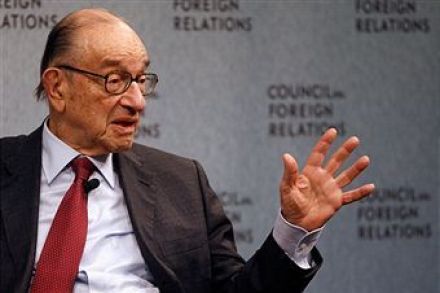
Five years have passed since Alan Greenspan stepped down from the most influential banking job in the world. (Now that’s how to leave at the right time.) Described in books, interviews and profiles too numerous to mention as ‘the most powerful regulator/person on earth’, he served as Chairman of the Federal Reserve for 19 years. For reasons of sheer longevity, perhaps Greenspan deserves to be called the architect of the modern global economy more than any of his elected contemporaries.
How the banks were framed

From our UK edition

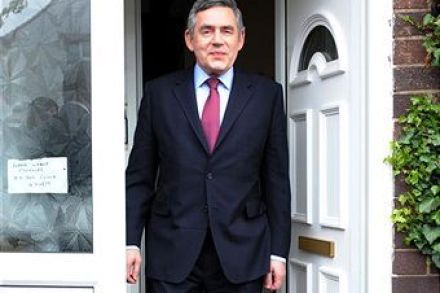
A week that started with the Vickers review on banking has closed without another national explosion of banker-bashing. Thank God. Beating up on the banks has lasted almost three years now, and it’s blinding us to the real causes of the financial crisis. The banks are the perfect alibi: blaming them gets everyone off the hook. How, asks Gordon Brown, was a mere Prime Minister to know that banks were doing such fiendishly complicated things? How, asks George Osborne, was an opposition expected to detect what the government could not? How, asks Mervyn King, was the Bank of England governor supposed to know that these bankers had been so wicked? For all of them, the bankers have been the perfect scapegoat.

Charting Labour’s future

From our UK edition

The Labour Party is still ambling in the wilderness – sure of its destination, but uncertain of the route. Its response to last year’s general election defeat has been silence, publicly at least. In the privacy of debating chambers however, the party is charting its potential renewal. These circles murmur that ‘the state has reached its limits’; or, in other words, that Fabianism, the dominant force in the post-war Labour movement, has been tested to destruction.

Irish banks in a worse state than was thought

From our UK edition

Robert Peston called it: the Irish banks are mired. The latest round of stress tests has been conducted and the headline figure is that the Irish banks face a shortfall of 24 billion euros. A major recapitalisation will follow and it’s likely that more institutions will be taken under state control. Ireland is also likely to ask for more cash from the EU. These tests were based on conservative criteria, where the Irish economy contracted by 1.6 percent this year, unemployment peaked at 15.8 percent and there was a cumulative collapse in property prices of 62 percent. It’s grim in Ireland, but not that grim: most forecasters are predicting GNP growth of around 1 percent in 2011.

Are two Eds better than one?

From our UK edition

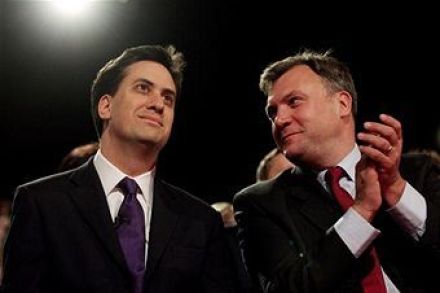
This was the question raised by today’s joint Balls Miliband press conference. The two Eds are very different in both body language and temperament. Balls is the far more pugilistic politician, always looking to dispute the premises of a question and happy to use aggressive language. While Miliband is far more of a conciliator, looking to find consensus and using only gentle humour. They even stand at the lectern in different ways: Balls hunched over his, leaning into the fight. Miliband hanging back from his, and taking a gentle step towards it when answering a question. The danger for Miliband is that Balls appears to be the alpha male, the one taking the fight to Labour’s enemies.

Rooting out the cause of the crisis

From our UK edition

David Frum is doing a great series on the Financial Crisis Inquiry Commission report. The report is, obviously, US-centric but its argument that the problem was not with the regulation but the regulators strikes me as highly important: “[W]e do not accept the view that regulators lacked the power to protect the financial system. They had ample power in many arenas and they chose not to use it. To give just three examples: the Securities and Exchange Commission could have required more capital and halted risky practices at the big investment banks. It did not. The Federal Reserve Bank of New York and other regulators could have clamped down on Citigroup’s excesses in the run-up to the crisis. They did not.

Treading the road to recovery

From our UK edition

It will have been a quiet morning in the Balls household. Fresh economic indicators suggest that the British economy is not in some cuts-induced recession but, instead, doing rather nicely, thank-you. As I said last week, economic health is assessed by all manner of indices – and the ONS (which is forever having to tear up its GDP forecasts) might just have boobed last week with its preliminary Q4 GDP figures. Today we have the Manufacturing PMI surging to heights not even reached in the early 1990s:   Now, this might be a flash in the pan, you say. But then consider corporate liquidity – that is, how much debt Britain’s companies have lurking on their balance sheets. The figures out today are not too bad either.

Ed Balls: I don’t think a double dip is the most likely outcome

From our UK edition

And this, folks, is a day where Ed Balls is having his cake and eating it too. Not only is he basking in the grim light of the growth figures, but he is using the opportunity to recast his own stance on the economy. Speaking on the Daily Politics just now, he de-emphasised the argument that in-year cuts were to blame for today's numbers, instead claiming that people have "changed their behaviour in anticipation of what's coming in the future." And, more ear-catching still, he added: "I don't think [a double dip] is the most likely outcome." This, as Fraser suggested earlier, is surely necessary caution on Balls's part. He can't go too far with the dread warnings, lest the economy pick up again next quarter.

What to make of the GDP fall?

From our UK edition

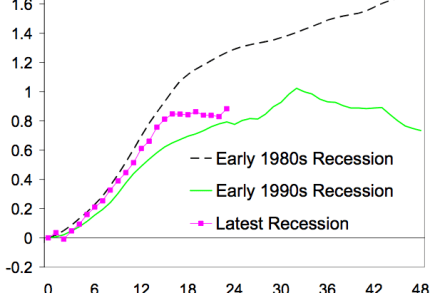
"Recession here we come, a snow-dabbed double-dip" tweeted Faisal Islam, Channel Four's economics editor. He summed up much of the hysterical reaction. It may spoil a good story, but here is what I suspect the broadcasters won't tell you today. 1. Erratic GDP swings are common when recovering from a recession. Remember how stunned everyone was with the surging quarter three data? Now, we're all shocked by plunging quarter four figures. I'd advise CoffeeHousers to treat these two imposters just the same. After the 80s recession, quarterly growth rates swung between -0.7 percent and 1.5 percent. Following the ERM-induced recession in the 90s, growth rates swung between -0.2 percent and 0.5 percent. A swallow does not make a summer.

The Irish government folds

From our UK edition

Yesterday, Brian Cowen resigned; today his government has imploded. The Green Party, which was bolstering Cowen’s ruling coalition (if such a phrase is applicable in this instance), have left the government. The Fianna Fail-led coalition is now two votes short of a majority, and therefore the finance bill may not pass in its current form. If that is so, Ireland may return to the precipice on which it found itself a couple of months ago, and its principal creditors and trading partners with it. But there is more to this than balance sheets. In his statement, the leader of the Greens said that the people had lost confidence in the political process. It’s hard to demur.

The Tories waste no time in getting stuck into Balls

From our UK edition

One thing worth noting before we discuss Balls’ appointment is that the reasons Johnson have resigned are personal. It is not about his competence or otherwise. The Tories are wasting no time in getting stuck into Ed Balls. One just said to me, ‘the man who created this economic mess is back. He designed the fiscal rules that failed, he designed the FSA that failed…’ Certainly, the Tory attempt to make Labour’s economic record the premier political issue has just become a lot easier. Balls will be a more aggressive opponent for Osborne. But I suspect that he will prefer facing Balls to Yvette Cooper.

The coalition decides to accept the flak over bonuses

From our UK edition

The truth, as they say, is out: it doesn't look as though the coalition will be doing much about bankers' bonuses after all. According to this morning's Times (£), it's a case of the Tories getting one over the Lib Dems – and particularly Vince Cable – by not pushing down with more taxes on the City. But that, I suspect, is only half the story. The other half is that the coalition never had much in their armoury, but harsh rhetoric, in the first place. If they want the banks to start lending to business again, then their most substantial hope has always been a trade-off over bonuses. Which – as Benedict Brogan suggests in an insightful post over at the Telegraph – is hardly an ideal situation for the coalition.

Unpicking Miliband’s deceits

From our UK edition

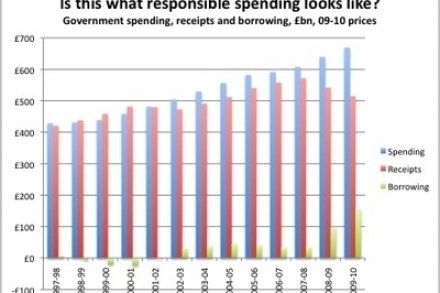
Ed Miliband has penned a combative but incredible piece in today’s Times (£). He makes two substantial points. First, that the coalition is deceiving people: Labour was not to blame for the deficit. And second, the coalition’s cuts package (in its entirety) is unnecessary. Oh what a tangled web he's weaved. His argument is a maze of conceits, sleights of hand and subterfuge, and he interchanges between debt and deficit at his convenience. But, occasionally, his position is exposed. As this Coffee House graph recalls, Labour built a substantial structural deficit prior to the economic collapse.

Access all areas | 18 December 2010

From our UK edition

It is an exciting day for Liberty Osborne, the Chancellor’s daughter, to join him at work. The windows at HM Treasury are boarded up, workmen line the road replacing the bombproof (but not student-proof) glass. Graffiti defaces the walls, but although several politicians are named and shamed in spray paint (‘Why did Nick Clegg cross the road? Because he’d promised not to’) there is nothing unkind about the author of the cuts: George Osborne himself. When we meet the Chancellor at 10.30 a.m. in 11 Downing St, he does not look the slightest bit like a man under siege. Seven-year-old Liberty bounds out of his study, waving at us cheerfully. The Chancellor is no less upbeat.

The Big Squeeze

From our UK edition

The media pack is often blind to an impending political car-crash.  For instance, very few in Westminster, or the media, noticed the scrapping of the 10p tax band until the screech of twisting steel turned heads. The same is happening now in relation to living standards. The media and political establishment are yet to wake up to the fact that working families in Britain are about to become poorer (though hat-tip to Allister Heath for being quick off the mark on this front). The gathering wisdom is that, with the recession now behind us, household budgets will start to recover.  We have just published a new report – Squeezed Britain  – that paints a darker picture.

The corpse of Black Wednesday has been exhumed, and the demon exorcised 

From our UK edition

Cameron clearly doesn’t rate Ed Miliband. That may be a mistake in the long run but it worked fine today. The opposition leader returned to PMQs after a fortnight’s paternity leave and Cameron welcomed him with some warm ceremonial waffle about the new baby. Then came a joke. ‘I know what it’s like,’ said Cameron, ‘the noise; the mess; the chaos; trying to get the children to shut up,’ [Beat], ‘I’m sure he’s glad to have had two weeks away from it.’ This densely worded, carefully crafted, neatly timed quip had obviously been rehearsed at the Tory gag-conference this morning. The fact that Cameron had time to polish it suggests that he anticipated no trouble from Miliband today.

The kiss of death | 19 November 2010

From our UK edition

Oh dear. On Wednesday night, we at The Spectator saw David Cameron handing Lord Young his Spectator/Threadneedle Parliamentarian of the Year in the category of Peer of the Year. “Over the decades,” said yours truly, “Prime Ministers have come to value his advice. As Thatcher put it: ‘other people bring me problems, David brings me solutions.'” Not any more - David has brought him a problem, followed by a resignation. Less than 48 hours after picking-up our award, his political career appears to be at an end.   It is true that there are some people who have had a “good recession”. That is: faced no danger of losing their job and saw the cost of their mortgage collapse as part of the monetary stimulus.

Forcing an apology

From our UK edition

Admittedly, this is but an item of marginalia in the notebook of British politics – but I'd appreciate CoffeeHousers' views on it nonetheless. I'm talking about the Tories' efforts to squeeze an apology out of Labour for the state of the public finances. This is something that they've been trying to do since the election, but the strategy has been reheated in the aftermath of Ed Miliband's election. As Sayeeda Warsi put it on Saturday, "what I noticed in his acceptance speech was that there was … no apology for the role that he had played in the current economic mess." Other Tory folk have called for that to be put right. I'm inclined to take a dim view of this.

The speech that David Miliband would have given on Saturday?

From our UK edition

Caveats about positioning after the event, of course, but Andrew Pierce's account of the speech that David Miliband would have given on Saturday is still worth noting down: "You could have heard a pin drop in the conference hall when the new Labour leader delivered his acceptance speech. Far from being triumphalist, he issued a stark and unwelcome warning that shocked the Party: it had to change, or lose the next election. Only minutes after the applause had died down on Gordon Brown’s valedictory address, his successor savaged Brown’s record as Chancellor and Prime Minister. He mocked the claim that Labour had ended the cycle of boom and bust.

The “progressive coalition” cuts its teeth

From our UK edition

Trust Bob Crow to turn down the charm. Explaining why he was boycotting Mervyn King's address to the TUC today, the RMT union boss managed to liken the Governor of the Bank of England to both the "devil" and the "Sheriff of Nottingham". Unsurprising, perhaps – but it's yet another reminder of why, for the Labour leadership contenders, marching in lockstep with the unions may not be such a good idea. To Harriet Harman, a Labour Party bound to Crow & Co. might be a “progressive coalition”. But to the rest of the country, it will probably look slightly left of sane. Only David Miliband, to his credit, seems to have properly grasped this fact – and the fact that he might hope to work alongside people like King one day.

Stephen Green’s double-dip warnings

From our UK edition

The Big Tent just got a little bit bigger with the appointment of Stephen Green as trade minister. As most of the papers point out, landing the HSBC boss is something of a coup for the coalition. David Cameron was struggling to fill the role, but he's ended up with someone who is widely credited with steering his bank through the worst of the financial storm. Even HSBC's purchase of a dodgy sub-prime company in 2003 has done little to tarnish Green's reputation. Now that he's in government, though, it's worth pointing out that he is yet another minister who has warned of a double-dip recession. Here's how the FT wrote up a speech of his in July: "'We are three years into a crisis that is far from over,' he said.

The double dip predictions

From our UK edition

Hark, there seems to be a lot of noise about a double dip recession at the moment – added to, yesterday, by Dr Martin Weale of the Bank of England. So I thought I'd collect some of the more recent, more prominent warnings and predictions for posterity's sake. Do let me know (either in the comments or on phoskin @ spectator.co.uk) if there are any that are worth adding: Sir Alan Budd, 16 August Sir Alan was asked on BBC Radio 4's Today programme whether he believed Britain would avoid slipping back into negative growth. "I'm not confident of it," he said. "Our fan charts show that it is a possibility, just as much stronger growth is a possibility. It's not the most likely outcome.

Ominous signs in the housing market – but Osborne must remain undaunted

From our UK edition

Are we on the verge of a double-dip in housing? The graph above, courtesy of Citi, certainly looks ominous enough. The blue line is a Royal Institute of Chartered Surveyors metric for the balance of surveyors reporting rising house prices - and, last month, it slipped into negative territory for the first time since July 2009. The pink line is the rise in house prices, year on year - and it's heading downwards too. At first glance, the picture looks a lot like the peak which preceded the crash in 2008. The question is whether we're going to plumb a similar trough. Citi, it must be said, are fairly sanguine about our prospects.

Cable’s 50-50 warning

From our UK edition

As compliments go, there's something slightly backhanded about Vince Cable's claim that, "Having worked with [the Tories] at close quarters, I've been pleasantly surprised that they're not as I'd envisaged them." And that's just one of the little nuggets embedded within his interview with Decca Aitkenhead this morning. The Business Secretary touches on everything from what he thinks of George Osborne ("he's clearly able") to his own ability to craft a joke ("I'm actually quite good at one-liners"). If you want a sense of where Cable is at, then Aitkenhead's piece is worth a quick read.

Boris’ calculations

From our UK edition

There has been some speculation, most of it idle, that Boris Johnson will not stand for re-election as London Mayor in 2012. Speaking to the Today programme about the necessity of protecting the Olympics budget, Boris commented on his putative re-election campaign. He said: ‘If things are still going well I would be totally crackers not to have another go at it then. But I'm going to be making an announcement later on.’ Many would describe his tenure so far as a comedy of inertia. I don’t: Johnson battled hard to shield the City from puerile political indignation at the height of the financial crisis. It showed a seriousness and determination not usually associated with a panel show politician.

Would Britain buy Balls?

From our UK edition

Asks Iain Martin, and I suspect he’s back in Rentoul territory. It is, nonetheless, a question that merits more than a cursory no in reply. For all his egregiousness, you know where Balls stands: in the crude but distinctive colours of the old left. He is convinced that any approach to spending cuts other than his own will precipitate a double-dip recession. As Iain puts it: ‘Balls is also calculating that the second half of a double-dip recession is on the way and is staking out ground on which he can be the one to proclaim to the country: I told you so.’   In terms of Britain’s economic debate, I agree with Pete: it would be preferable if Balls were banished to obscurity.

Back to the West: Irish Economic Update

From our UK edition

A follow-up to this post on the Irish economy: our friends on the Emerald Isle are now officially out of recession. That's good news. The bad news? Unemployment remains above 13% and, if you exclude multinational corporations, the "indigenous" economy (if you can call it that) still hasn't recovered completely. The bleeding has slowed but the patient remains enfeebled. Nevertheless, overall the economy grew by 2.7% in Q1, assisted by the euro's decline agaist the pound and dollar. It's going to be some time before all is well but it's certainly possible that Irish Austerity, painful as it may be, is not proving a terrible failure. Then again, Ireland is helped, perhaps, by the fact and the memory that it's done this before.

Nearing the precipice?

From our UK edition

Recent events in the Eurozone have led a number of commentators to suggest that we are nearing some repeat of the financial crisis that followed the nationalisation of Fannie Mae and Freddie Mac in August 2008 and the subsequent (and consequent) bankruptcy of Lehman's. In my view, the current situation is rather different from that in 2008, but matters could turn out much worse.

The death of the male working class | 27 May 2010

From our UK edition

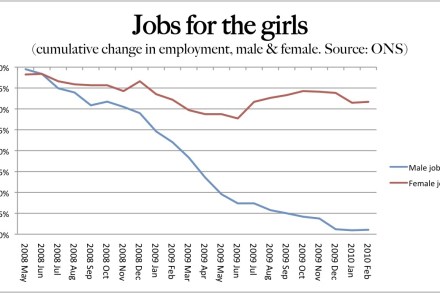
Gender discrimination is illegal in Britain – but tell that to the recession. It has hit male jobs harder than female jobs and in a cover story for this week’s Spectator, Matthew Lynn looks behind it. This has been, he says, a Mancession, where "the jobs lost in the last two years have tended to be ones done by men, whereas the preponderance of new vacancies are in areas of the economy in which women do best." I asked the ONS for the official figures – and here they are:   They show that, if you count everyone in Britain employed over the age of 16, there has been a 3.9 percent reduction in male jobs and just a 0.8 percent reduction in female jobs.

Ten questions for Gordon Brown tonight

From our UK edition

By rights, Gordon Brown should fear this debate on the economy more than any other. Here are ten questions I would like to hear him answer:   1. You told Gillian Duffy yesterday that you have a "deficit plan to cut the debt in half over four years." This was a lie, wasn't it? Our debt is £771bn now. Your deficit plan ­- ie, to run huge deficits for years - will actually double it to £1,406 billion within four years according to the Treasury. The debt for which Mrs Duffy and other taxpayers are liable would double under your plans ­- yet you told her it would halve. How can you tell a lie of that magnitude, to the very sort of women whose taxes you intend to use to service this extra debt? 2.

No, Gordon, this recession hasn’t been milder than others

From our UK edition

Today’s new economic data gives a handy piece of ammo to the Conservatives.  It is untrue that, as Gordon Brown says, this recession was somehow milder than others. The economy contracted by 6.3 percent this time – it was 3.8 percent in the 1980s recession and just 2.4 percent in the early 1990s recession. I feel confident that the Conservatives will get this point across clearly, next time that Brown boasts that this recession has been somehow milder, thanks to his decision to “intervene” (ie, double our national debt).

GDP grows by 0.2 percent in first quarter of 2010

From our UK edition

Now we know: the official preliminary estimate says that GDP grew by 0.2 percent in the first quarter of the year. So the double dip looks to have been averted (for now) – but not by much. The figure is at the low end of economists' estimates and lower than the growth experienced in the final quarter of 2009. Labour, of course, will spin this as further proof that we can't risk the recovery by voting for those dastardly Tories.  And the Tories will say that it shows just how damaging Gordon Brown has been for our economy.  But I wonder whether voters will choose between the two messages, or come to see a hung parliament as a decent compromise between them.  If it's the latter, then fasten your seatbelts, etc.

Brown demolishes himself with untimely ‘admission’

From our UK edition

Sorry is the hardest word and Gordon Brown stil hasn’t said it. But, everyday brings surprises. His ‘admission’ about his errors is the first time I’ve ever agreed with his economic analysis. In short, even Brown knows he’s not what he’s cracked up to be. Making such an admission at this stage of the election cycle is extraordinary. The intention may have been to make Brown look human. In which case, he’s succeeded, but to his detriment. Brown looks Biblically fallible. Labour’s campaign rests on one deduction. Gordon Brown built an era of prosperity; then Gordon Brown saved the country from a recession that originated in America; therefore Gordon Brown is the man to lead the country back to prosperity.

British jobs for British workers…

From our UK edition

Did you know that there are fewer British-born workers in the private sector than there were in 1997? I'd be surprised if so: these official figures are not released. The Spectator managed to get them, on request from the Office of National Statistics. We use the figures in tomorrow's magazine, but I thought they deserves a little more prominence here. See the graph above, which shines a new light on the boasts Gordon Brown has been making. He said his Glasgow speech last month that: "If we had said twelve years ago there would be, even after a global recession, 2.5 million more jobs than in 1997 nobody would have believed us.