Culture

The good, the bad and the ugly in books, exhibitions, cinema, TV, dance, music, podcasts and theatre.

Jenny Boyd goes beyond the muse

The beautiful muse to great male artists is a tricky figure, omnipresent in history but a bad fit for our fussy time. From Edie Sedgwick to Zelda Fitzgerald, and even some male ones, such as Neal Cassady, they’ve always been part of artistic scenes. In the scene of great Sixties rock, one of the most important was Jenny Boyd. She may not be as well-known as Yoko Ono, or her sister Pattie, who was married to George Harrison. But she may have been as influential. She was in the backstages, the bedrooms and the jam sessions with some of the most iconic musicians of all time. Shortly after traveling around India with the Beatles, she married (then divorced and remarried) Mick Fleetwood. Later, Donovan would write a love-sick song about her, "Jennifer Jupiter." So would Mick Jagger.

Jenny Boyd

How they treat trans children across the pond

England's National Health Service made the major announcement last week that they would limit the prescription of puberty-blocking drugs for transgender children to clinical trials. A report released by the NHS on June 9 states that "there is not enough evidence to support their safety or clinical effectiveness as a routinely available treatment and that they should only be accessed as part of research." The decision is the latest consequence of a multi-year review into how the medical community in England should treat children who suffer from gender dysphoria.

LGBT activists gather outside the Stonewall Inn (Photo by Spencer Platt/Getty Images)

Beware the New York Times kids section

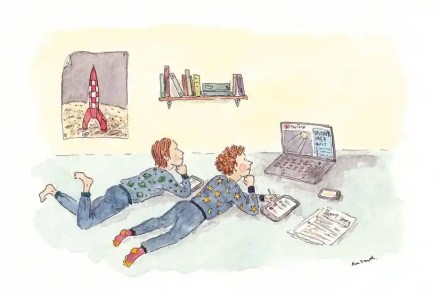
“Stinky. Sweaty. Hairy. Pimply. Totally Normal.”  That’s the seemingly innocent tagline of the “Puberty Issue” of the New York Times for Kids, which appears in the print newspaper on the last Sunday of every month.  The kids section, which was started in March 2017 as a part of the New York Times magazine department, often looks harmless at first glance. The cover typically boasts colorful and engaging artwork, while inside, children are greeted with cartoons, games, puzzles and mini articles about cool accomplishments by other kids. Past issues covered how kids could spend their summer vacations, interesting facts about bugs and other creepy critters, and how to start growing a garden.

The New York Times for Kids ‘Puberty Issue’ (Amber Athey/The Spectator)

Why I’m afraid of transphobia

J.K. Rowling’s Twitter feed “creates trans phobias,” writes Washington Post gender columnist Monica Hesse. Listening to Rowling, says Hesse, is exhausting. “It’s exhausting because it requires constant vigilance.” And the constant vigilance, says Hesse, is necessary in order to determine when Rowling’s words stray into “transphobia.” I confess my own “exhaustion” reading opinions like Hesse’s. I understand that “transphobia” has a very extensive Wikipedia page citing supposed medical experts who give the concept a veneer of legitimacy.

A new book and a newborn

One of the most famous lines from the classic 2002 romcom Sweet Home Alabama has leading lady Reese Witherspoon incredulously asking a redneck hometown friend, “You brought a baby... to a bar?” I encounter that incredulity frequently, every time I cart my kids to work events, including those at bars. But a book tour? This was a new one. A book tour with a baby is hard, but babies (and kids) are worth all the hardships. As Scrubs’s wise Dr. Kelso once explained, “Nothing that’s worth having in life comes easy.” That’s a mantra in our home as we wade through the hard times, and it’s a lesson we impart to our kids as we endeavor to raise them into happy warriors and resilient and caring adults.

book

Should I have had a sensitivity reader review my book?

Reason magazine reported last summer on the rise of sensitivity readers, and publishers have made headlines for their plans to release sanitized versions of Roald Dahl's and Ian Fleming's works. I’m not sure what’s more depressing: the fact that publishers are hiring sensitivity readers to purify these books, or the fact that I probably should have had one review my books before they were published. In an ideal world, sensitivity readers would be in as much demand as Betamax repairpersons. But we do not live in an ideal world. We live in a world full of hypersensitive Twitter users who relish finding offense in the unlikeliest of places. Hence the proliferation of sensitivity readers, or "authenticity readers" as they’re sometimes called.

sensitivity
latinx

The growing bipartisan backlash against ‘Latinx’

Since its emergence, the term “Latinx” has been unpopular with Hispanics. Yet despite this opposition, progressive activists and organizations continue to use it as a means of identifying people of Latin American heritage in a supposedly more sensitive way. The term's origins remain a subject of debate, although its users argue that the word "Latino" reinforces the patriarchy while the "x" recognizes nonbinary people. According to the Wall Street Journal, it made its debut in academic literature a decade ago in Puerto Rican psychology periodicals as part of an effort to "escape the gender binaries encoded in the Spanish language." Since then it has been adopted by many progressives as part of their ever-expanding twenty-first-century lexicon.

San Francisco reparations and the Golden Age of Revision

We live in the Golden Age of Revision. Not everyone has noticed, so let me mention some of the highlights of the art of the Michelangelos and Monets of the revisionist moment. First, of course, we have found the path to revising birth certificates and chromosomes on the matter of an individual's sex, or as we have been taught to say, gender. This is revision par excellence, but only the beginning. Then we have the New York Times in the company of many thousands of American school teachers who have miraculously overthrown the burden of snow-capped mountains of historical evidence and wizened learning of generations of historians. Their revision reveals that the real history of America began in 1619 with the arrival of Angolan captives at Jamestown.

san francisco

East Palestine and the roots of rural mistrust

The East Palestine, Ohio, train derailment has thrust rural America into the national spotlight. Town mayor Trent Conaway, a hefty, scruffy figure who resembles many a resident of flyover country, has been all over cable news expressing his “frustration” over how the federal government has handled the disaster. “Frustration” is exactly the word I’d use to describe the predominant feeling I encountered last week during my visit to East Palestine. It’s the same attitude I come across constantly in my rural Pennsylvania homeland. The way the East Palestine disaster has unfolded magnifies the rural perception of government, and both sides of the aisle would be wise to take a closer look and listen.

rural

Business schools are dating apps for the super-rich

“D’you know what the acronym MBA stands for?” The twenty-seven-year-old who asked me this had a deep tan and fluorescent teeth. He may have winked, but the eye-twitch was more likely a nervous tic developed from looking at himself in the mirror so much. I responded with a look of indifference mixed with fear. “Married” — he paused for dramatic effect and demonstratively looked at my wedding ring — “but available.” I felt nauseated. I was in my first semester of business school in New York City and had so far learned how to make an educated estimate of a company’s optimal capital structure, how to make a balance sheet look balanced and how to use the word “conceptually” to sound smart in strategy class.

business school
name

What’s in a name?

Someone, I think it was Martin Amis, once said that you can judge a novelist by how much effort he puts into his characters’ names. If that’s true, a political independent who grew up in the 1990s with the name “Matt Purple” may be a sign of some cosmic writerly laziness. Yes, that is my real name. The one you see in the byline there. I’m always amazed at how many people assume it’s a nom de plume, as though if I could have any last name I wanted I’d choose an Easter color. I actually did write an essay under a pseudonym once: “Matt Thomas,” Thomas being my middle name. Given that it was instantly posted to the top of a prominent website and discussed on a national radio show, I sometimes wonder whether I’m the victim of nomenclature discrimination.

seed

Seed catalogs and their rejuvenating power

Winter’s bleakest days have set in. “The holidays” are a distant memory. Rose-colored resolutions to wake up earlier, eat healthier and exercise have gone the way of Dry January — all a wash, as you quickly discovered the only antidote for your Seasonal Affective Disorder was something equally cold and dark. You glimpse the N/A beers in the back of the fridge the same way you spy the sun — in passing, and with a feeling of faded hopefulness. As you lug bags of empty bottles to your sidewalk, you glance up at the brightish blob lending a hazy glow to the grayscale landscape. You deposit your clanging bag of glass and cans beside your Christmas tree’s corpse and shuffle back inside to refill the fridge and cover up reminders of your dalliance with the sober-curious.

Bianca Censori: Kanye West’s new handler

Cockburn would usually think twice about celebrating a man that’s under his wife’s thumb. But after seeing reports that Kanye West's new wife Bianca Censori “runs the show,” Cockburn can’t help but think that arrangement is probably for the best. The forty-five-year-old disgraced rapper shocked fans last month when he married the Yeezy architectural designer Censori, in a top-secret ceremony just two months after finalizing his divorce from Kim Kardashian. A source told the Sun, "Bianca runs the show. She has been around Ye for about three years, things got serious really fast in mid-November. "Bianca handles Ye's daily logistics from Yeezy clothing management to construction of the new Yeezy headquarters/ Donda Academy.

kanye west wife bianca censori handler

The tragedy of corporate America’s anti-child messaging

My brothers and I grew up in a very active household. We were always busy with sports, schoolwork, and chores, and there was a constant revolving door of friends and teammates. Both of my parents worked full-time as business owners and as our informal chauffeurs. Along with thousands of meals to be prepared, loads of laundry to be done, fights to break up, and the occasional window to be replaced, ours was a house that was never quiet, especially when my brothers tapped their illegal fireworks stash. To an outsider, it might have looked like being in the middle of a domesticated Lord of the Flies. But there was a purpose to the madness and chaos. We learned conflict management, independence, fire safety, and the value of hard work and cooperation.

newborn

Dana White’s Power Slap is a gruesome freak show

UFC president Dana White’s new show Power Slap: Road to the Title debuted on January 18 to paltry ratings — a reported 295,000 viewers following a helpful lead-in from the pro wrestling show AEW Dynamite, which had nearly a million — and widespread critical outrage due to the seeming inhumanity of the sport. Those who did tune in watched in mute horror as Chris Kennedy was brutally knocked out, his hands curling up in what Chris Nowinski, a former football player and wrestler turned brain trauma researcher, referred to as “fencing posture,” indicative of serious brain injury — then later proved unable to recollect what had happened to him.

Dana White

Thirty years from Waco: what the fatal siege wrought

On a windy morning thirty years ago, the FBI staged a surprise attack on the Branch Davidian compound near Waco, Texas. The Branch Davidians were a splinter group of Seventh-day Adventists who followed the apocalyptic preaching of their self-styled prophet, David Koresh. They had been holed up in their ramshackle retreat for fifty-one days. Finally, at 6:02 a.m. on April 19, 1993, tanks broke through the compound’s flimsy walls, firing tear gas at the people inside. The gas was meant to end the standoff by flushing the Davidians out, but Koresh had handed out Army-surplus gas masks. Some of the Davidians took shelter. Others shot at the tanks and federal agents outside. Hours later, fire leveled the compound. Several Davidians burned to death.

Waco
ancestral

Going native: is ancestral eating the answer to our dietary woes?

The question of what to eat has plagued Americans since the first conquistadors hit the shores and started rounding up and eliminating the only people who actually knew what was meant to grow and be eaten here. Historical accounts show the first colonists living in abject terror of the foreign foods of Native Americans, believing that if they began eating the strange corn, squash and beans around them then they would literally turn into Indians. As a result, many of them starved trying to grow their old-world crops in America. Now, hundreds of years later, the colonizers’ descendants are looking to the past in search of a solution to the countless health problems that plague consumers of American food. They’re calling it the ancestral diet.

When the moon brought America together

The Artemis rocket is back from the moon. Within a couple of years, if all goes to plan, it will bring men to the moon’s surface. It is a great loss that a bigger deal hasn’t been made of this expedition. I was only three when John F. Kennedy died, and his famous 1962 pronouncement that we would go to the moon not because it was easy but because it was hard was already history. The picture books I got on birthdays always included him in the history of space exploration. Those books made sure every kid knew how “we” were going to get to the moon. They changed us, and with us, America. We started with Mercury, baby steps mostly proving we could launch men into space. Then Gemini, a long proof-of-concept program to try out the technology of docking.

tip

Save American tipping culture

Recently, I ordered a pizza. Since the establishment was only a few blocks away, I decided to pick it up myself. Manning the cash register was a slouching paragon of the zoomer generation. “Can I help you?” he asked in some patois that mixed English and bovine. I said hi and told him I was picking up a pizza. He tossed his bangs almost imperceptibly; a tsunami raced across the Pacific. Another employee then brought my pie, upon which my man seemed to slip into a persistent vegetative state, staring at some fixed point on the horizon while I swiped my credit card through the reader. The check printed. On it was a line for a tip. Before we go any further, I want to make clear that most service employees are nothing like my catatonic cashier.