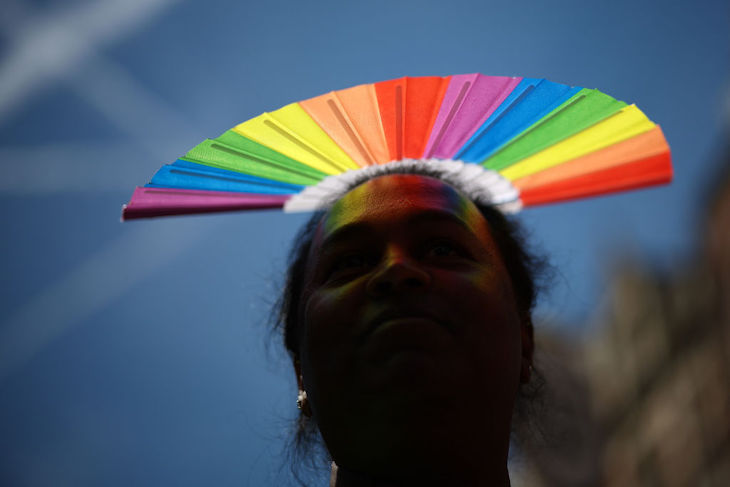
The annual Pride parades celebrated across the globe are not the events they used to be. First held in New York City on 28 June 1970 and going by the name of the Christopher Street Day Marches, they were initially designed to commemorate the first anniversary of the Stonewall Riots, when the gay community in that city rose up in protest against police brutality. Yet what began as a show of defiance and demand for equality by gays and lesbians has incrementally metamorphosed into an event which largely celebrates trans people. And many gays are not happy about this transformation. Not happy at all.
This superficiality is most evident by the straight trans allies in attendance, those incurious ideological groupies who have forever aligned themselves to the cause
As an observer at London’s Pride parade on Saturday, I could for sure discern many gays and lesbians who had made their way there to participate in the festivities: a pair of men holding hands on Lower Regent Street, with one supporting the other who had evidently indulged himself too much; a man at Charing Cross Station with a t-shirt bearing the legend ‘Bisexual’; and, later that evening, a couple of women at St Pancras Station, hand-in-hand, their faces painted in rainbow colours. There was even a smattering of the original Rainbow flags, that simple emblem designed to represent those of a non-straight sexual orientation, not those who identify as a different sex.
The usurpation of that flag in recent years by the Progress Pride flag, the symbol with the chevron and added colours which represent the trans community, pansexuals, asexuals, the non-binary and people of colour, embodies the altered direction of this movement. When I walked through Old Compton Street in Soho earlier this year, as a former habitué of the famous Coach and Horses pub back in the 1990s, I couldn’t help but notice how the original Rainbow flag had almost completely disappeared, replaced outside bars by the Progress Pride colours.
I remember well the bombing of the Admiral Duncan pub in Old Compton Street in 1999 by a neo-Nazi. My next door neighbours in west London then were an ageing gay couple, and one lamented to me a few days later how ‘we thought all that hatred was in the past’. Therefore one banner on display on Saturday commemorating that atrocity seemed strangely out of kilter. As my neighbour’s words suggested, even by the 1990s homophobia in society seemed to be on the wane, before it became decidedly mainstream.
It also seemed out of keeping in an event that was not about fighting for gay rights – not least because that battle in western countries has been won. As the veteran activist and journalist Julie Bindel wrote last week: ‘Across the West, gays and lesbians like myself have achieved legal parity with heterosexuals in one of this century’s most successful campaigns for equality.’ The fight for gay acceptance seems redundant in a society in which homophobia, while still present, has been much diminished.
That partly explains why Pride has shifted its focus to the rights and acceptance of trans people, and how the parades have taken on a new tone and appearance. And that has been a source of disquiet for many observers. The displays of nudism and fetishism manifest on Saturday strike many as cheap exhibitionism and inappropriate for a public event. Many gay campaigners of old find tawdry the sexualisation of a movement that was once principally political. As Bindel continues: ‘According to some queer advocates, we should allow such practices as bestiality, sex with children, sex in public, and sexualised behaviour and imagery in the vicinity of children.’ The Mayor of London Sadiq Khan’s post on X at the weekend – ‘we’ll show the world that love will always triumph over hate’ – seems symptomatic of a movement that has become reduced to shallow, empty slogans.
This superficiality is perhaps most evident by the straight trans allies in attendance, those incurious ideological groupies and callow students who have forever aligned themselves to the cause, believing they’re simply doing the right, progressive, compassionate thing. These are the types who don’t understand what the Progress Pride flag represents, how many homosexuals now see it as a hostile symbol, one that stands for a movement that has turned on gay youngsters. Over the weekend, X teemed with messages from older gays and lesbians venting their anger at an event that embodies a movement they see as essentially homophobic and misogynistic.
As one of that demographic’s best-known and vociferous gay rights campaigners in this country, Dennis Kavanagh, put it: ‘Not even a pretence anymore that this obnoxious display is anything at all to with gay rights. Even as 200 more children are due to be chemically castrated at the behest of trans activists.’
‘Love not hate’, was the message repeated on Saturday. It’s a shame that many gays and their allies today simply do not believe this mantra. Quite the reverse.






Comments