
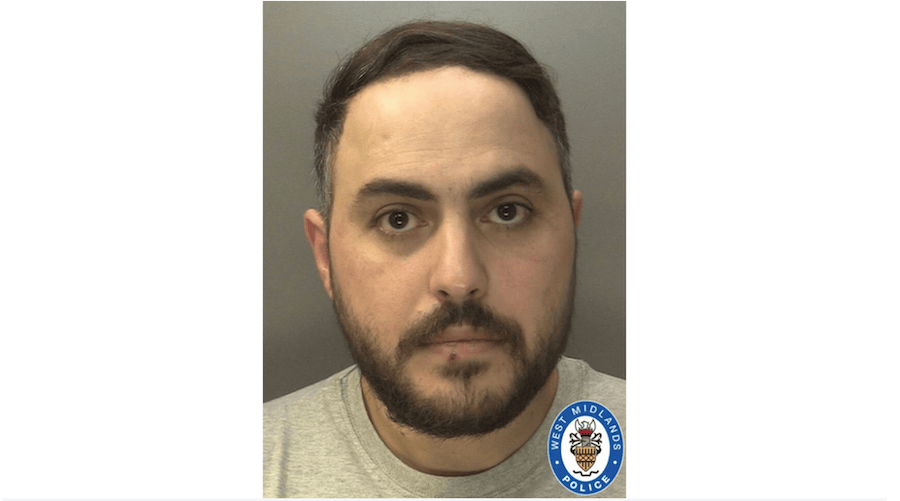
One wonders how much more conspicuous Mohammed Alfatih Naim’s association with Hamas would have had to be for the British authorities to decide that he was not a suitable candidate for asylum. His father was a senior Hamas politician. He had worked as a bodyguard to Ismail Haniyeh, the terrorist organisation’s leader, and there were photographs of him doing so. He had even been detained in Egypt on suspicion of operating a Hamas smuggling tunnel. One might have thought that establishing his credentials would have required rather less than the full resources of the British intelligence services. Yet, having entered Britain illegally in 2014, he was granted asylum in 2015 and British citizenship five years later.
At least we can now name Naim, a 40-year-old father of three living in suburban Birmingham, thanks to an almost farcical incident involving his wife’s unpaid parking fines. A bailiff who turned up at the family home to recover the debt found himself confronted by Naim wielding two large kitchen knives. Unbeknownst to Naim, the encounter was being filmed by undercover counter-terrorism officers who had been watching his house for rather more serious reasons. Naim has now been convicted of unlawful wounding, two weapons offences and criminal damage, although he was acquitted of wounding with intent. The conclusion of his trial means that we can finally report what had attracted the interest of the security services in the first place.
This is hardly a failure for which Labour alone can be blamed
German prosecutors accuse this naturalised British citizen of organising what investigators believe would have been Hamas’s first terrorist attack in mainland Europe: a massacre of Jews in Berlin and Vienna on the second anniversary of 7 October.
The details are extraordinary. On 28 July last year, Naim allegedly travelled from Britain to Berlin, where he met an accomplice in Hasenheide Park and collected five loaded semi-automatic pistols. He is accused of transporting the weapons to Vienna and depositing them in a rented lock-up, along with balaclavas, gloves and combat clothing. In an alleged martyrdom video, he appeared masked, sitting in front of two pistols, threatening to deliver a ‘message in blood’ to Israeli prime minister Benjamin Netanyahu on behalf of Hamas’s military wing.

The intended recipients of that message, of course, were not Israeli politicians or soldiers, but European Jews going about their lives. The plot was disrupted following a tip-off from Mossad (but Israel are the bad guys, remember). German police arrested several suspects on 1 October 2025, while West Midlands Police detained Naim on suspicion of expressing support for a proscribed organisation. He was released on bail and placed under surveillance. Had it not been for his subsequent run-in with the bailiff, Naim might by now have been extradited to Germany to face terrorism charges. Instead, the extradition proceedings had to wait while the British courts dealt with his rather more suburban violence.
Astonishingly, the original reporting restriction imposed at Westminster Magistrates’ Court would have granted him anonymity for 100 years. Had the Sunday Times not challenged the order in September, we would have been prohibited from naming him until 2125. The court acknowledged its error and amended the restriction, allowing Naim to be identified once his British trial was over. He now faces extradition to Germany, where the terrorism allegations will be tested in court.
But perhaps the most remarkable aspect of this story is how little detective work appears to have been required to establish Naim’s background. Photographs uncovered by the Telegraph show him accompanying Haniyeh in Gaza in 2006. His father, Basem Naim, served as Hamas’s health minister and subsequently as an adviser to Haniyeh. He remains one of the organisation’s most prominent international spokesmen, familiar to viewers of Sky News and CNN and listeners to the BBC. Since 7 October, he has used his appearances on Western broadcasters to deny that Hamas deliberately murdered civilians and to defend the massacre as an act of self-defence. The identity of Naim’s father was hardly a secret requiring the investigative talents of MI5 to uncover.
Naim’s own account of his past is curious. An online CV claimed he had studied logistics management in Birmingham from 2009 at a college which says it never offered such a degree and whose local campus did not open until 2015. In 2010, when he was supposedly studying in England, he was detained by the Egyptian authorities. Since 7 October, Naim has also been involved in pro-Palestinian demonstrations in Britain, acting as a steward at several marches (but they aren’t hate marches, remember). Photographs show him wearing a keffiyeh and a high-visibility vest, carrying a ‘Free Palestine’ placard. His alleged activities elsewhere in Europe rather invite the question of what, precisely, he understood by that slogan.
The revelations come at an interesting moment in British immigration policy. The government is actively facilitating the arrival of more Palestinians from Gaza, bringing university students, medical evacuees and eligible accompanying relatives to Britain. In June, Yvette Cooper announced the continuation of these programmes. In September, Shabana Mahmood announced the reopening of the UK Resettlement Scheme, with places specifically allocated to Palestinian refugees living in Jordan and Lebanon. We are assured, naturally, that security checks will be carried out.
Meanwhile, in July, it emerged that an immigration tribunal had ruled that a Palestinian woman granted asylum in Britain should be permitted to bring 18 members of her extended family here from Gaza. These include her parents, siblings, their spouses and their children. The Home Office had refused their applications. But the tribunal decided that the consequences of keeping the family apart, including the effects on the mental health of the woman and her children in Britain, were sufficient to override the public interest in immigration control under Article 8 of the European Convention on Human Rights.
Britain’s asylum system is predicated on the idea that we are offering protection to people fleeing persecution. But Gaza has been governed for nearly two decades by an Islamist terrorist organisation, and just three years ago an invading force of Hamas terrorists, members of other Palestinian armed groups and Palestinian civilians murdered, mutilated and raped its way through southern Israel. So establishing whether an applicant is fleeing Hamas, quietly accommodating it or actively working for it is surely a rather important preliminary to offering him or her the protection of the British state in the future.
Naim was granted asylum under Theresa May and citizenship under Priti Patel. This is hardly a failure for which Labour alone can be blamed. But it is a failure from which the present government, and the Home Office in particular, ought to be learning. Who exactly in the Home Office is letting the family of well-known terrorists into our country, and why? Before ministers congratulate themselves on their warm-hearted generosity towards the people of Gaza, perhaps they might explain how Britain came to offer refuge, and eventually a British passport, to a man who had apparently been entrusted with the personal safety of the leader of Hamas, and how they might prevent that from happening again.






Comments