
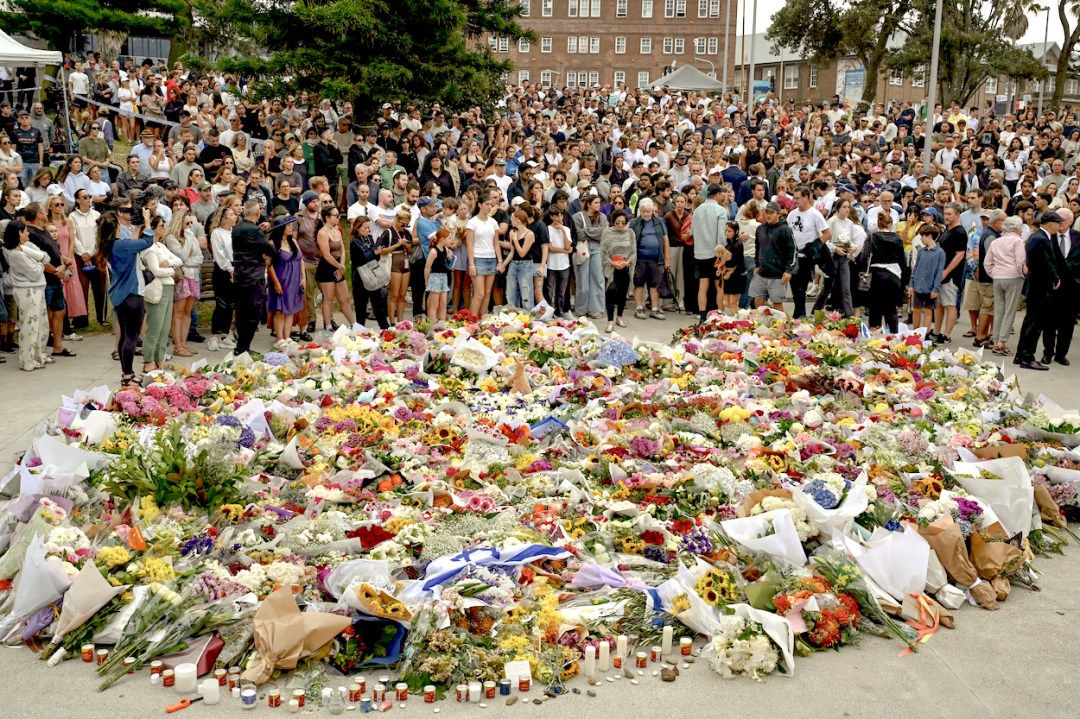
Bondi Beach is not occupied territory. Yet a Jewish celebration there ended in blood. It is not within a military zone, not contested land, not an ‘open air prison’, but still, among civilians, on a day marked for celebration, Jews were once again slaughtered, picked off by a Muslim father and son who were motivated to kill as if it were their God-given right. The images from Bondi are now etched into public memory, but the political reaction now taking shape confirms how little our leaders understand the nature of what they are facing.
The war has not ended. It has migrated. The images coming out of Bondi as the horrors unfolded were a field report from a war already underway. It is a war without formal declarations, which does not depend on tanks or treaties. It spreads through ideology, through grievance networks, through digital propaganda and imported narratives, recruiting from mosques and message boards, from fringe collectives and activist mobs. The enemies of the West no longer require battalions; they need only a few men with weapons, a crowd willing to intimidate, and a state too diffident to respond.
In this war, they aim first at Jews, but we are neither the only victims nor the bigger ‘enemy’ being targeted. In London last week a mob gathered outside a popular Notting Hill restaurant simply because it is owned by the Israeli chef Eyal Shani. The police failed to move them on, leaving the job to a small gathering of upstanding non-Jews who regularly counter such street protests. One of their founding members left with a black eye, after the mob called for ‘backup’ to come and intimidate him. The people who assaulted him were part of a campaign that presents itself as offering ‘solidarity’, and tries to cloak itself in virtue.

Our political leaders are experienced now at expressing sorrow without consequence, mistaking symbolism for statecraft. After the Bondi massacre, Keir Starmer posted a photo of himself and his wife lighting a Hanukkah candle. ‘Light will always win over darkness,’ he wrote, hours after the attack. The delay was telling, the content, worse. Starmer, who permitted months of hate marches through British cities, who has yet to articulate any clear red line on anti-Semitic incitement, who made a point of ‘recognising’ a fantasy Palestinian state, offered candles instead of action. Just a few weeks ago two people were killed in an Islamic terror attack in a Manchester synagogue. Yet nothing much has changed.
No serious political response should rely on metaphors, visual or verbal. Yet we are governed by people who believe that such hollow gestures will suffice in the face of organised ideological aggression. They urge Jews to stay calm, as if a lack of calm is the issue. They light candles while synagogues are barricaded. They mouth solidarity while failing to enforce the law.
Many Jews are drawing the only logical conclusion available: their governments may not ever properly protect them. They are making plans – not out of hysteria, but realism. It is no longer taboo to talk about emigration. About Israel. About America. About alternatives. It is not cowardice to prepare for an exit when one’s position has been abandoned from above. It is memory at work.
The persecution aimed at us and the danger we face is thanks to a convergence of several forces. Islamists provide the theological engine. The far left supplies the ideological cover. Anarchists and foreign regimes exploit the cracks. Mainstream left-wingers might wring their hands when it all goes wrong, but nod along silently regardless. The result is an unholy alliance, diffuse but coordinated, whose shared aim is to destabilise the West from within. Their targets are not only Jews but the norms that sustain western civilisation: public safety, legal equality, freedom of expression, civic trust.
Such bad actors thrive in weak societies. When leaders are weak, when our collective identity is weak, when our defences are weak, they flourish. They test the most vulnerable parts and see what gives. As a tiny minority, Jews are one such pressure point, but we won’t be the last one. This time they came for Hanukkah. Next time they’ll come for Christmas.
Jews represent the freedoms and values of the West, not because we exist freely thanks to them, but because many of those values are actually ours, embraced and adopted by Christianity and wider secular society. That is why these enemies of civilisation hate us so much, and why their attacks on us are actually just one small part of their broader attacks on the entire West.
First they came for Hanukkah, next they’ll come for Christmas
Places once thought neutral, from restaurants to campuses or beaches, are now contested ground. The battlefield has shifted to where people live, gather and believe themselves safe. Security measures once reserved for foreign embassies are now required at primary schools. This is not normal. And yet normalisation is precisely what is happening. This is the modern Jewish experience.
The moral clarity required to confront this has been replaced by moral confusion. The result is paralysis. The state, instead of defending its citizens robustly, now negotiates with those who threaten them. It manages risk rather than removing it. That is how a festival becomes a crime scene. That is how a democratic state begins to lose legitimacy in the eyes of its most loyal citizens.
The tragedy is not only that Jews are being hunted again, but that our societies, once proud to defend us, now don’t. There is still time to reverse this, but it requires a change of posture not just of language. The father and son who attacked Bondi were not sending a message to Jews alone. They were testing the defences of the West. We now know what they found.



Comments