
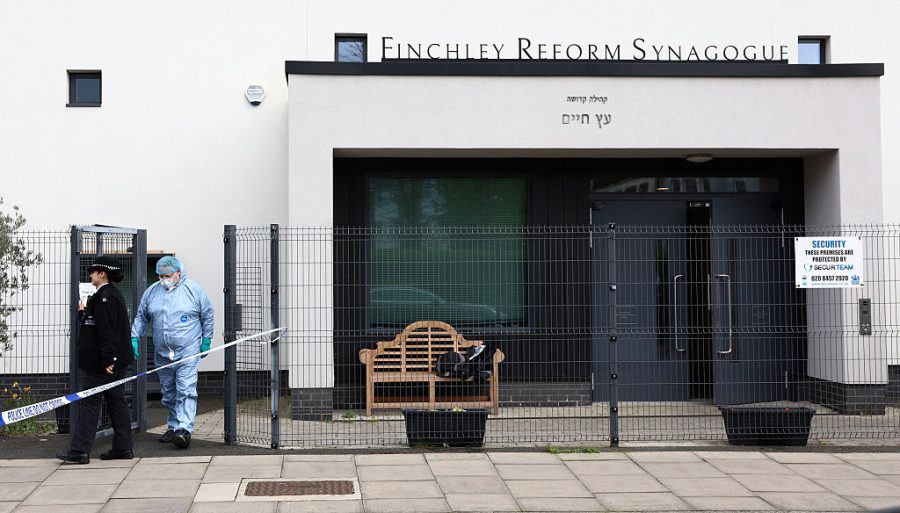
The news of last night’s attempted fire bombing at Kenton United Synagogue in London, and of last week’s arson attack at Finchley Reform Synagogue in London, wasn’t even surprising. Just a few weeks ago, ambulances operated by a Jewish volunteer organisation were firebombed and destroyed. In Manchester, a synagogue was attacked on Yom Kippur, leaving two people dead. Over the last couple of years, there have been around 20 documented cases of arson or firebombing attacks targeting synagogues across the world, from North Africa to Europe, North America and Australia. A synagogue in London is simply the latest in what has become a global pattern.
But this is not only about Jews. In the same period, churches have also been targeted. Across Europe, 94 church arson attacks were reported in 2024, nearly double the previous year. That amounts to almost two churches every week. And yes, there have been some attacks on mosques as well, though far, far fewer. None of these arson attacks should be tolerable or acceptable.
There clearly is a place in our society for Jew-hatred to grow and thrive
In August 2024, an attacker in France, wrapped in a PLO flag, set multiple fires at a synagogue using gas canisters. In December, a historic synagogue in Melbourne was gutted by arson after accelerants were poured inside and ignited, an attack Australian authorities linked to the Iranian Revolutionary Guard Corps. In March this year, an explosive device was detonated at a synagogue in Rotterdam. The list continues. What is surprising is how ordinary this has all become.
The apparent 21st century normalisation of synagogue burnings reminded me of that line in the ’80s Scottish band Del Amitri’s song, ‘Nothing Ever Happens’: ‘They’ll burn down the synagogues at six o’clock and we’ll all go along like before.’ For Jewish children in the ’90s, that line about synagogue burnings resonated in our innocent minds as some kind of deep historical reference. We never expected it to have been prophetic. Reaching middle age, we’ve seen the polish come off things and we’ve all had to grow up a bit. That line about burning synagogues seems to have come true, along with the chorus: ‘And nothing ever happens, nothing happens at all.’
The motivations for the arson attacks are not uniform, but patterns do exist. Many of these attacks are linked to Islamic ideology or individuals influenced by it, sometimes directly, sometimes indirectly. In cases where perpetrators and motives are identified and known, that connection appears frequently. In other cases, particularly attacks on churches, information is often incomplete or underreported, leaving a gap in public understanding.
And if we ‘all go along like before’, it is because there’s a broader reluctance to confront uncomfortable realities about ideology, radicalisation and the sources of violent hatred. While the reflex reaction of governments and police forces to increase spending on physical security is important, without clarity about causes, there will be no meaningful reduction in these attacks.
Jewish Britons are increasingly sick of hearing from our politicians that there is ‘no place for anti-Semitism’ in our country, because the attacks carry on happening anyway. There clearly is a place in our society, or many places, for Jew-hatred to grow and thrive. And those places, both literal and ideological, are often under-policed, overlooked and skirted around for fear of seeming ‘racist’ or ‘intolerant’.
Existing legal tools already allow for us to tackle some of the ideological breeding grounds for these bad and poisonous ideas, including the exclusion of foreign nationals who promote hatred or violence. But it seems they just aren’t used evenly or sensibly. Kanye West was rightly barred form entering the country after his numerous pro-Hitler anti-Semitic episodes, each one designed to appeal to a large audience. The Dutch political activist Eva Vlaardingerbroek was also recently barred from entry to the UK, less justifiably so. Yet many Islamic hate preachers still seem free to enter our country and preach the kind of material which encourages anti-Jewish, anti-women and anti-Western ideology, sometimes leading to real-world violence and terrorism.
Similarly, the government itself has done little to counter the regular expressions of hatred directed either towards Jews or even towards our traditional British way of life, whether they have been part of regular street protests, moments of violence and destruction aimed at buildings or objects, or deliberate acts of public worship and dominance. So-called ‘far right’ protestors have been pushed through the justice system swiftly and imprisoned in record time, but those who vandalised legal defence sector factories, struck the police physically, or preached hatred inside mosques as religious leaders have all somehow escaped the same heavy hand of justice. When violence stems from religious belief or dogma, it can’t simply be given a free pass.
We can hardly be surprised when some people feel emboldened enough to carry out violence towards synagogues or churches. Our national weakness gives them strength.






Comments