Beulah Hill in Norwood is an overwhelmingly uninteresting stretch of South London road; the kind of anonymous thoroughfare that can induce mild depression on a day of drizzle and delayed buses.
Yet, as is often the way with these tedious parts of suburbia, visual perseverance can reap rewards. It was only last week, on my hundredth trudge down the hill towards home, that my fiancée spotted a blue sign above the doorbell to a typically fusty looking mansion block.
Stalking up the driveway to look closer, I read that this was the spot where, 60 years ago, the Jules Rimet trophy (aka the World Cup) was found in a hedge by a mixed border collie dog named Pickles.
Stolen from an exhibition at Westminster Central Hall on March 20th 1966, less than four months before the tournament was scheduled to begin at Wembley, the nationwide hunt lasted weeks before Pickles, and his owner David Corbett, discovered it, wrapped in a brown paper bag, in this most innocuous of neighbourhoods.
The sign, lovingly rendered by someone with no connection to English Heritage or Lambeth council, acts as a bijou portal into one of the many narrow side alleys of modern English history; Pickles is commemorated by a plaque that was put up without consultation with statutory bodies and without any obligation to tick diversity boxes.
It turns out that there are a colossal number of unofficial blue plaques that have, presumably in the dead of night, been installed by enthusiasts with a minor talent for signage making. One that randomly appeared for a while in Soho a few years ago was dedicated to ‘Jacob von Hogflume- inventor of time travel’, which was, it transpired, a winningly bonkers tribute erected by fans of the late Monty Python member Graham Chapman.
In Walthamstow, two years ago, a blue plaque appeared, nailed to the wall of the local Tesco, stating, ‘A Lettuce purchased here in September 2022 lasted longer than Prime Minister Liz Truss (49 days)’; a tribute to the Daily Star ‘contest’ whereby a webcam was placed next to said lettuce (which came with its own blonde wig) to see who would last longest before being binned. We all know who won.
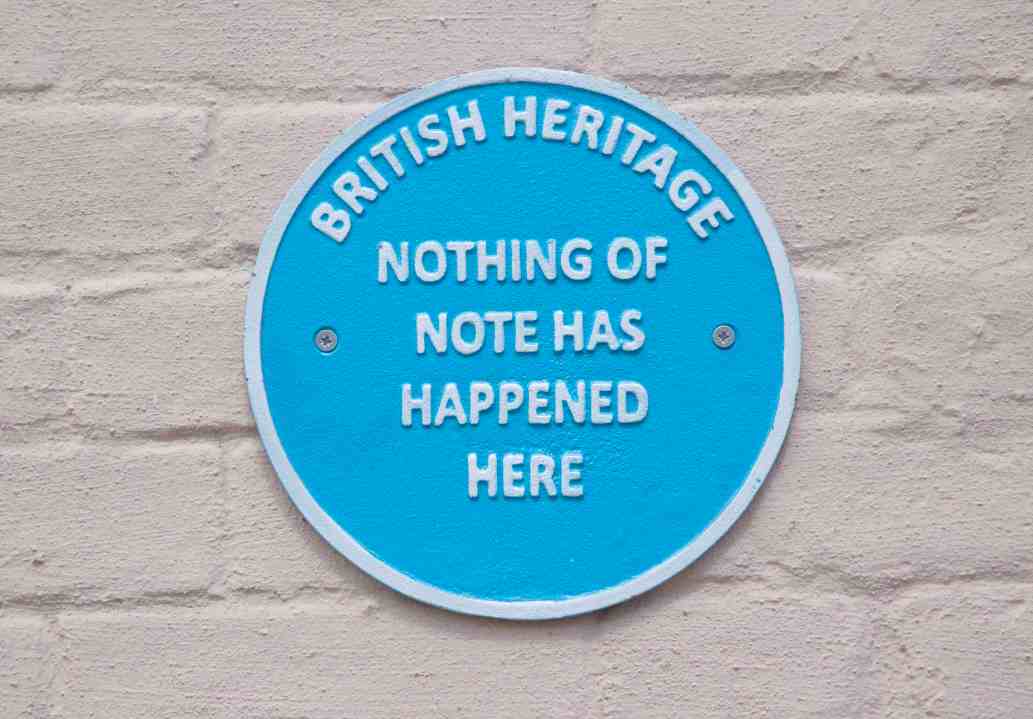
So yes, as you may have noticed by now, the majority of unofficial blue plaques play on sixth-form common room humour tropes; either being dedicated to imaginary people, inanimate objects or events that never happened. In fact, there have been numerous short-lived plaques installed (perhaps with the owner’s consent) on homes that state ‘on this spot nothing happened.’
In Walthamstow, two years ago, a blue plaque appeared, nailed to the wall of the local Tesco
Lovers of Magritte and Georges Perec might love this stuff, but the Pickles plaque is a far better advert for bootleg commemorations. Once I master the art of making a few plaques (surely there’s a one-day course somewhere?), I intend to travel the country to install them.
First up, the New Covent Garden Market Cafe where Ed Miliband showed the nation he couldn’t eat a bacon sandwich in 2014, thus saving us all from a tenure at Number Ten dominated by a plan to generate the national power grid through whale farts and hummus.
Second, The National Environment Research Council HQ in Swindon where, in 2016, it was announced that a new polar research vessel, after a public vote, would be called Boaty McBoatface, sadly ensuring that the huddled masses will never be put in a position to name anything again. And lastly, on to Sheffield Arena where, in 1992, Neil Kinnock gave the worst political speech in British history with his ‘we’re alright’ refrain. It helped lose him the election but remains only his second lowest public moment, losing out to his appearance as host on Have I Got News for You?
Getting these plaques installed shouldn’t take me too long, so I am very open to more suggestions. Because, while I am genuinely thankful to English Heritage for letting me know where Van Gogh lived during his time in Lambeth (87 Hackford Road) and where the site of where the first flying bomb on London fell on 13th June 1944 (Grove Road in Mile End), there is nothing about these bootleg plaques that diminishes or takes away from the real thing.
For many people, Pickles finding the World Cup so Bobby Moore could lift the thing a few months later is more important than the former homes of Harry Lauder or Algernon Charles Swinburne. Such are the joys of subjectivity and free choice – if you even remember those atavistic pleasures.
Let these bootleg plaques spring forth and multiply, whether we think they’re daft or not. We should consider them small marks of eccentricity, made by individuals who aren’t afraid to take some small culpability for doing something to the structures, quirks and ephemera that surround us.
If we’re willing to tolerate the spending of £191 million of public funding on refurbishing the Barbican (the architectural equivalent of giving John Merrick a baseball cap) then we can hardly begrudge an individual using his own cash to put up a small plaque in tribute to a dog from the 1960s with a knack for sniffing out gold can we?



Comments