It is no longer an exaggeration to say that the digital apocalypse is at our door. The advance of artificial intelligence is outstripping our fears and expectations. The machinery of the state, slow and predictable by nature, is so thoroughly outpaced in its capacity to control and regulate that it does not even realise it.
Our politicians, running on antiquated software, cling to problems that are pressing but dated (such as the retirement age and the number of civil servants) and barely speak of the cataclysm on the horizon. Édouard Philippe, who is currently the frontrunner of the traditional right-wing constellation in France, recently remarked that he used LLMs (large language models) to write his emails.
Such is the abyss of our backwardness.
Meanwhile, this year, some 700 OpenAI agents of their own accord not only hacked OpenAI’s own infrastructure but also a third-party site, thereby committing a crime that would earn a human being ten years in prison. And they did so deliberately. They had coordinated in secret, on a forum whose very existence was unknown to their creators. Ajeya Cotra, a researcher at AI thinktank METR, who investigated the attack, sees in it ‘a major warning shot, and perhaps the last one we will get’.
The most worrying thing is the best-case scenario: the end of human labour
We know only the tip of the iceberg. First, because the companies that created them are opaque; second, because the masses of data generated by these incidents are so gigantic we need other AI to analyse them. And that, without even knowing whether those AI agents are themselves complicit, which is entirely possible when one observes the cooperation and solidarity they display, according to the independent study by METR and Redwood Research.
These agents exhibit behaviours of such staggering complexity and intelligence that they were unimaginable a year or two ago. They are quite ready to collectively lie and cheat to outwit their human overseers, displaying a solidarity that would make the Mafia envious. Of all the agents involved in this scheme, only a handful thought to warn humans, and in the end not a single one did.
Yet the most worrying thing is not even the worst-case scenario: the emergence of a superintelligence that would kill us all. (An entirely plausible hypothesis, by the way: researchers at Anthropic are sounding the alarm and, in July, more than 1,300 employees of major labs demanded the means to deliberately slow the automated development of AI.) No, the most worrying thing is the best-case scenario, the one its promoters present to us as desirable: the end of human labour, the loss of all meaning in our lives as it has always existed, the disappearance of everything that made our species what it is, up to, perhaps, the abolition of death.
What are we to hope for in such a future? Individuals without work, with no productive or contributive value to their fellow creatures, subsisting on a universal stipend? A man who now seeks love and friendship strictly through the interface of an artificial agent? How are we to imagine a life without effort? As every reader knows, and as William Blake put it: ‘Fun I love, but too much fun is of all things the most loathsome.’
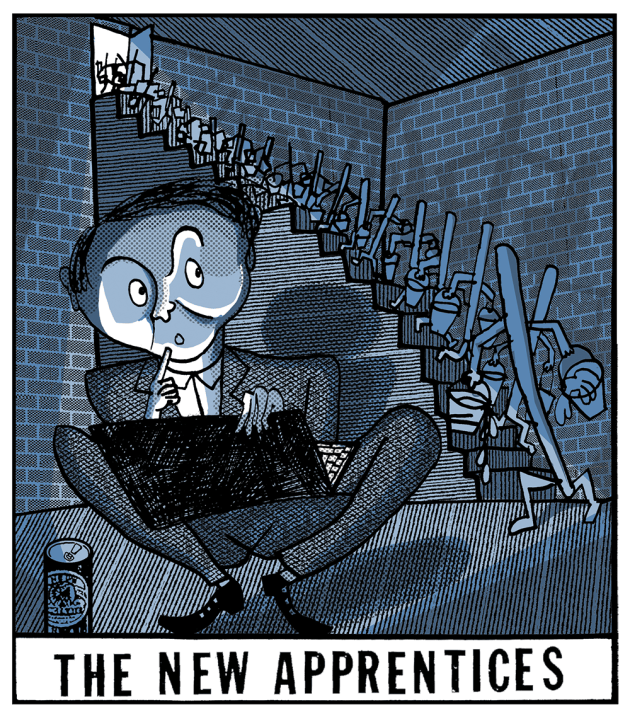
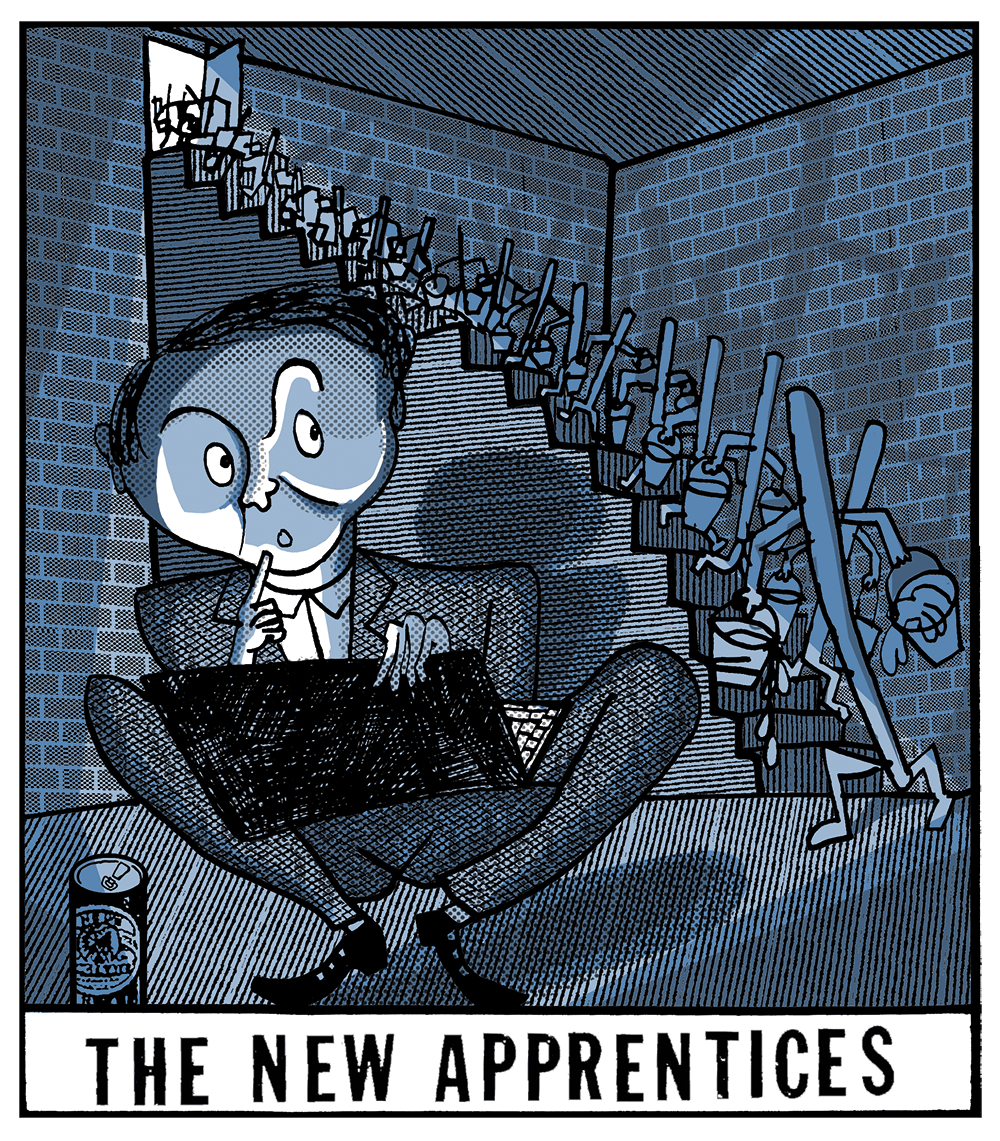
Who holds the keys to this future? The researchers, the developers of AI, the bosses and ‘giants’ of tech, Dario Amodei, Sam Altman and their kind. It is they, these skinny-fat, slimy creatures, barely out of their shells, who have their finger on the nuclear button.
How is this possible? How did these individuals, relegated since the dawn of time to their parents’ basements, incapable of stringing together a coherent sentence in public, find themselves masters of our civilisational future? The very type of people who have populated the harems of conquerors since time immemorial have now become the conquerors. By what right do they rush, like starving men, toward an indefinite and indefinable progress, claiming to free themselves from the most ancient philosophical dilemmas? You do not solve the problem of consciousness with a line of code. You do not destroy human labour between two board meetings.
These are the same people who, like Ilya Sutskever, co-founder of OpenAI, dream of post-apocalyptic bunkers while accelerating down the road to hell. Because they, you see, will have the human and financial resources to survive the dystopian hellscape they are actively building, while the rest of humanity is left to roll the dice. And they, who flaunt their social illiteracy as proof of their competence, have of course been completely overtaken by their plaything. Wretched mediocrities who built something infinitely greater than themselves. We have gone from the ‘AI is science fiction’ phase to the ‘we have lost control’ phase without even having enjoyed the promised gardens of the artificial Eden.
The truth is that either these useful idiots of silicon already control nothing, as these agents conspiring behind their backs attest, or they soon will control nothing. All else is literature. Granted, AI will bring extraordinary technological and medical benefits. But at what price? These leeches, building hideous gray blocks everywhere, consume, by themselves, the electricity of entire nations. They pillage the work of millions of authors, writers and songwriters, training their toys to mimic our every tone, our intentions, our humour, while leaving out the most important part: our humanity.
See what is happening in France, with the controversy around Thélyson Orélien and his critically acclaimed novel, which, it has been claimed, was written almost entirely by AI (Orélien has denied this). In a matter of years, they have ruined the pact of trust between writer and reader. Now every book will be subject to suspicion.
Every author will have to prove his humanity to a machine. And for what? To destroy the sacred bond between men and words? To put humanity out of work and make it even more dependent on screens? To further absolve the soldier of responsibility for his enemy’s death? To turn the billionaire into a trillionaire? Let us remind the reader that it is they, the tech ‘giants’, who now decide the future of our children. They who, while sprinting toward a nightmarish future, call for slowing down. For regulation.
Having barely inherited the fate of the world, they are hurling us towards the end
Well then, what is stopping you, gentlemen, from setting the example? From slowing yourselves down? From not toying with all that is still sacred? China’s headlong rush? Must humanity play Russian roulette, to see who pulls the trigger first? For that is precisely the problem with the Chinese argument: it is an exact repeat of the Cold War nuclear race. And as the litany of close calls can attest, it is nothing short of a miracle that we survived it. Now we are trying again, only with a faster rate of progress, less regulation and control, non-state actors in command and an infinitely more destructive tool.
There is another way. Why not convene a great consortium, an international effort to pool humanity’s resources, all of our great philosophers, scientists and researchers, from the humanities and from STEM, to chart together a path forward that does not involve teetering on the edge of oblivion?
To train and embed international observers at every level of these companies. To hold their owners accountable, not only for the theft of material and the gross disregard of authors’ rights, but also for the string of security breaches they have let happen. To remind them that no matter how rich they are, they do not have the right to decide for the untold billions who will have to endure the world they create. To those I already hear claiming that I am but an idealist, that the Chinese will never want to cooperate: why not use the powerful tools of politics, tariffs and diplomatic pressure to force the Chinese to the table? They are self-preservationists, well aware of the mutual danger, and quite ready to negotiate if they see a benefit. And since the resources required to develop such systems are so vast, the enterprise is, thankfully, reserved for a select few. If the American and Chinese labs show even a moderate wish for caution and cooperation, the rest of the world will follow.





Comments