How the Froggies must be laughing. Such a gracious loan. So kind. Like England lending Henry V’s longbows to the Louvre – or sailing HMS Victory up the Seine. Well, let them titter. The Tapestry is home. Nothing else matters.
Likely sewed in Canterbury in the 1070s, before being sent across the Channel, it has only ever left Bayeux twice before. In 1803, when Boney was contemplating a pop at the White Cliffs, he displayed it in Paris. (After Trafalgar, it was quietly returned to Normandy.) Then, as the Nazis were retreating from Operation Overlord, it was taken for safe-keeping to the cellars of the Louvre and, in late 1944, only weeks after Paris’s liberation, placed on public view.
Today’s minibreak from Bayeux comes in rather happier times. Monsieur Macron made a promise to Theresa May in 2018, only to welsh on the deal when Boris appeared. The French, we are told, produced “the best experts… to explain in perfect detail why [the loan] was impossible.” Dashing British diplomats and curator Michael Lewis persisted and, seizing the occasion of le Président’s 2025 state visit, got the gold.
And now here it is in all its glory, fabulous to behold. Stretched out in one long, extraordinary strip in the inky black of the British Museum, it has the presence of a holy secret – to which we are now permitted to come astoundingly close. Laid flat in its shallow case, one can approach, at first quarters, the very stitchwork of which Edward, Harold, William and their hangers-on are made.
Close up its mortality is manifest – the gaps, repairs and human errors that come of so long a life. And yet, for all the shocks it has endured, such a survival is arrestingly freakish – perishingly few textiles have come down from the 11th century. Here, somehow, is 75 yards of the stuff, a product of deeply careful historical design.

How one shudders to think of all those embroideries lost to time. We know of a few. The widow of Earl Byrhtnoth (he of Battle of Maldon fame) bequeathed Ely “a hanging… embroidered with the deeds of her husband.” Abbot Baldric of Bourgueil wrote a poem for Countess Adela of Blois, the daughter of the Conqueror, describing a sumptuous tapestry adorned with gems depicting her father’s invasion of England that hung in her bedroom (one wonders how he knew). Those who stitched the current exhibit had surely performed much similar work before. A whole class of medieval art and history has been obliterated.
This one is always likely to have been something of a best in class. Its length suggests a very large building (as Bayeux Cathedral was and is.) That said, there are other means of display. In the early 19th century, the Tapestry was kept on a roller and unwound across a table to show to visitors. Involve a second roller and you can conceive the story being spooled from one to another and shown like a film.
Even on foot today, the experience is filmic. Walking the exhibit, events drag you from left to right. Here is a world in which history is propelled by horses and ships. When, briefly, the action flows the other way, how abrupt and dangerous it feels – as when Harold is arrested on the French coast or when the Normans surround the Saxon fyrd at Hastings.
Along its length, we walk two years. A surprising amount – about a third – occurs in France. Harold goes to Normandy, is detained by Count Wido, freed by William, serves in his army, swears an oath in William’s presence at Bayeux, and returns to England. Harold’s adventures take him some 550 miles on French soil past six named settlements. This is a tapestry that plays in part to a Norman audience.
As I say, however, it was almost certainly sewed in Kent. The inspiration for several scenes can be found in manuscripts from St. Augustine’s Abbey in Canterbury. Odo – bishop of Bayeux, half-brother of the Conqueror, patron of the Abbey and Earl of Kent – plays a very strong supporting role. He advises William, rallies his knights, fights with gusto; and because the Tapestry later surfaces in his cathedral it has been long supposed to have been his brainchild. Well, peut-être. Other Norman sponsors are available. Take the enigmatic Wadard, Domesday tenant of both Odo and St. Augustine’s. Handsome fellow. Pops up out of nowhere, fully armed and on horseback underneath the caption “HERE IS WADARD.” Can imagine someone coughing up fulsomely for that kind of close-up. Vital and Turold – two other men of Odo’s – likewise briefly attract the camera. It is not too much to imagine that out of love and loyalty to Lord Odo this trio bankrolled the project and employed the ladies of St. Augustine’s to do the handiwork.
Many have thought the needling must be that of nuns. Well if nuns they were, what worldly nuns. The Tapestry has 93 penises – 89 equine, four human. (Presenters on the Today program were brave indeed when they asked a schoolboy for his favorite scene.) If nuns they were not, they may have just been working women; English women, wrote the Conqueror’s chaplain, were supreme seamstresses. Under the exhibition’s gentle light, their precision is notable. What eyesight must have been needed to sew such work in small-windowed rooms. Such color, too. If these are the hues after nine and a half centuries, whatever did they look like when first unfurled? The brutalities of the Reformation and Civil War have conned us into envisaging medieval life and architecture cast in monochrome. Not so. The Tapestry tells of long-forgotten buildings, clothes and boats slathered in color. Little details otherwise unrecorded suck in the eye. That the dogs wore collars. That the ships had magnificent grotesque figureheads. That roasted meats were served on sticks like shish kebab. (William’s 26th great-grandson noted the invader’s “enormous cask of wine… for all the troops. Very sensible.”)
The big details are these: Harold swore an oath on holy relics supporting William’s claim to the English throne, then lost his life and kingdom to an army flying the papal banner. Such were the Normans’ justifications for their putsch. Still, Harold is shown as pious, noble, brave. He is called “rex” – a title that Anglo-Norman legal texts were busy annulling. Indeed, the Tapestry text is so sparse, so devoid of adjectives, that, in the hands of the right commentator, Harold can be made the victim of events. Blown off course. Forced to promise. “Given the crown of the king” by the English. Alternative narratives are there to be told.
If nuns they were, what worldly nuns. The Tapestry has 93 penises – 89 equine, four human
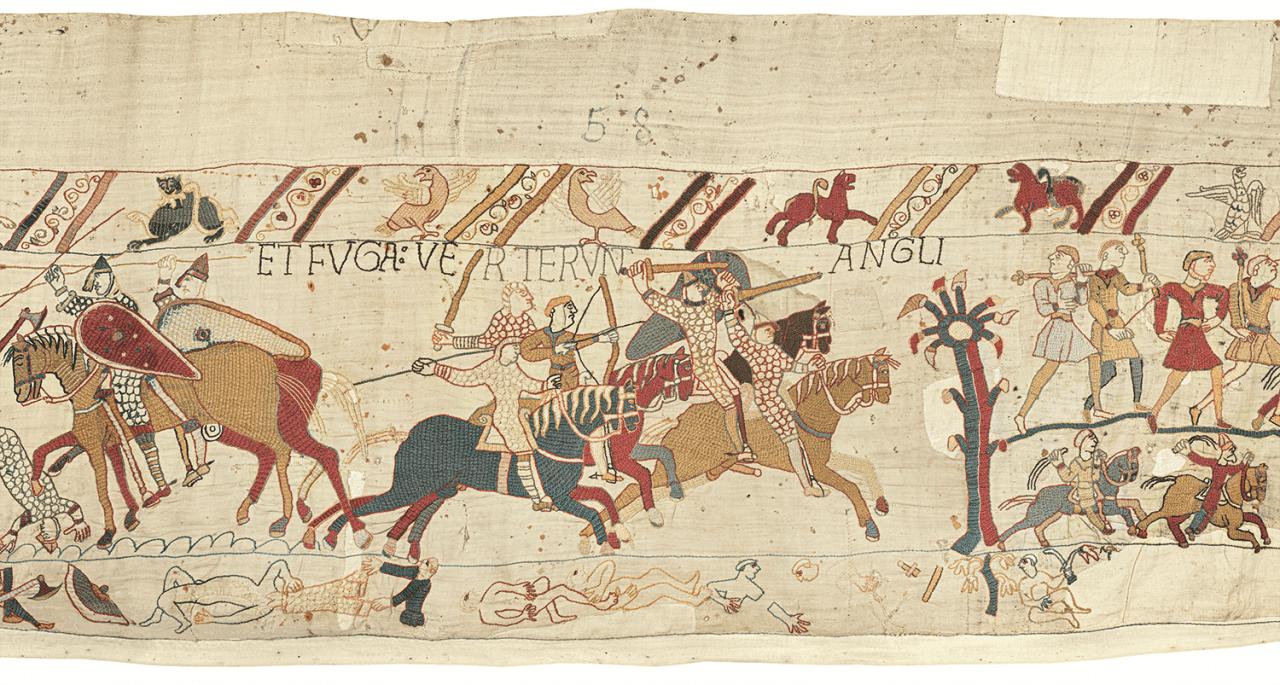
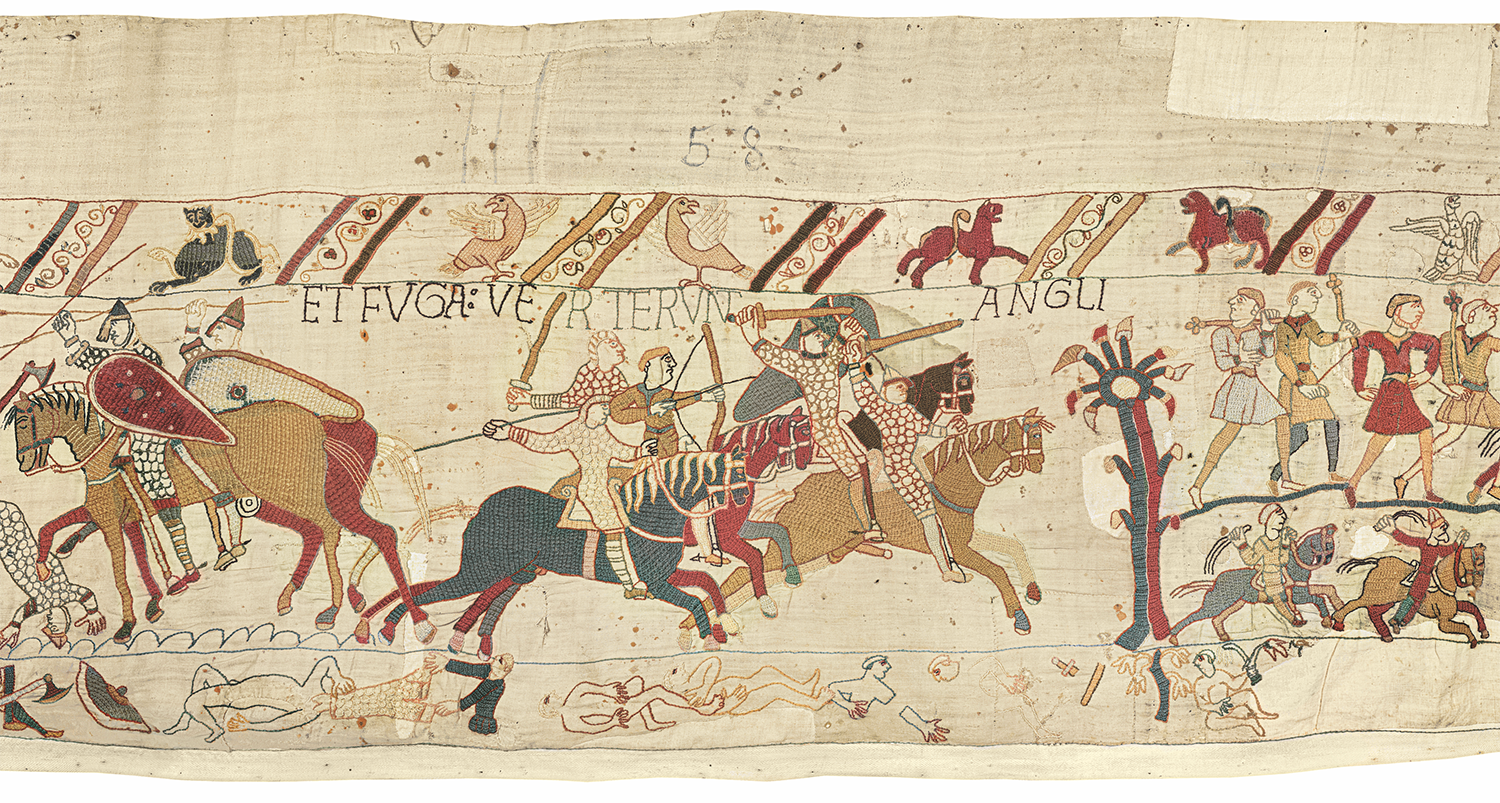
The Tapestry is also keen to relate that the English were no pushovers. William has to prove to his troops that he is not dead. In what is perhaps the artistic high point, the Normans’ horses rear over backward unable to break the Saxon line. Dismembered dead pile up in the margins. The nearest-run thing you ever saw in your life.
This is fourth time I’ve seen the Tapestry. As a child I thrilled at the violence, the nudity. As an undergraduate I delighted in the intrigue, the power. When a lecturer, I saw what is not said. Now in high middle age, what loom are the mistakes and misadventures, the incompatible ambitions and long-seeping sores that lead to war. How quickly the present changes itself to past. In the year preceding Hastings, how many Englishmen had any sense of what was to come? In January 1066? How many at midday on October 14? What a fragile thing is a country.
The last surviving frame – heavily damaged and repaired – shows a few surviving Anglo-Saxons in flight, galloping desperately into oblivion. Professor George Garnett has described, evocatively, how an English traveler returning home in 1100 after a 40-year absence would have found so much, so quickly, unrecognizable. The new elite and their language, the castles thrown up, the churches torn down, the many people missing. Old England irreversibly gone. As the William of Simon Armitage’s The Bayeux Tapestry (2001) has it:
No(thing) remains.
History is mine.
England is France
in (all but) memory and name.
All the base horrors of 11th-century bloodshed are here. The British Museum’s simple alchemy makes them unblemished gold. The presentation of a central artifact in the country’s story is a unique achievement. It is a triumph for George Osborne and his team. It is that gift of a truly great exhibition: a national moment of delight and reflection that reclasps us to the complexities of our past.
The Bayeux Tapestry is at the British Museum until July 11, 2027.





Comments