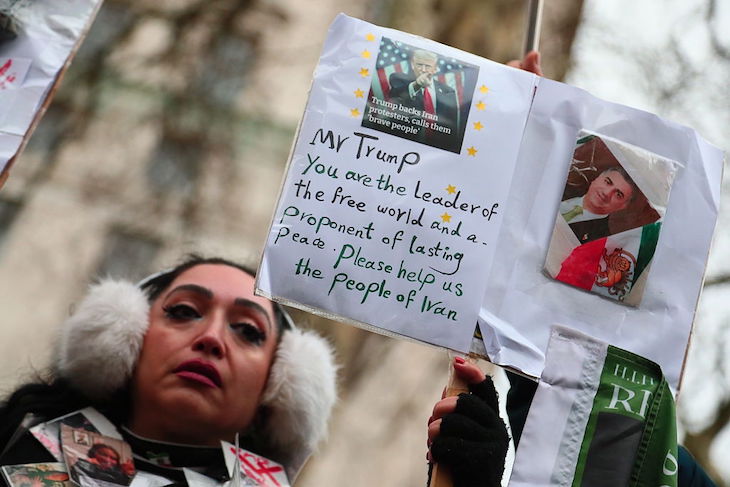
The longest war of the twentieth century was between Iran and Iraq and lasted for eight years. Yet during those eight years, Iraq killed fewer Iranian civilians than the Islamic Republic has reportedly killed in the past two weeks. The regime’s security forces enter hospitals, not merely to arrest protesters, but to shoot them in the head. In the piles of bodies visible in the tragic videos circulating online, some corpses, with bullets in their heads, still have hospital monitors attached. This is a government at war with its own people. It is an occupying force that does not see Iranians as citizens, but as expendable sacrifices for the larger goal of spreading Islamic revolution across the world.
This is a historic opportunity. Millions have risen up in Iran. Tens of thousands have given their lives
Which legitimate government would charge some families between $5,000 (£4,000) and $7,000 (£5,000) simply to return the bodies of relatives it has killed? One of the Islamic regime’s most brutal forms of torture is forcing families searching for their daughter, brother, sister, or mother to visit warehouses stacked with bodies, where they must look through corpses to find their loved one. Under the Islamic Republic, an Iranian does not even have the right to retrieve the body of a family member murdered by the state.
It is therefore no surprise that Iranians inside Iran are calling for help from Donald Trump. The fact is that many Iranians trust American or Israeli bombs more than Islamic Republic guns. Western strikes – such as those Israel has conducted on Iran – are targeted not merely at buildings, but sometimes at the very bedrooms in which IRGC commanders are sleeping. During the twelve-day war, according to the Islamic Republic’s own judiciary, fewer than a thousand people were killed, more than 70 per cent of whom were military officials, members of the IRGC, or the Basij.
Where in the Middle East, except Iran, do protesters chant, ‘America is not the enemy – the enemy is within’? In which Middle Eastern country do protesters rename streets after the president of the United States? In which country do people chant, ‘No to Gaza, no to Lebanon – I will give my life for Iran’? Nowhere. Nowhere else in the Middle East do millions take to the streets against political Islam; usually, it is precisely the opposite. This is the fundamental difference Iran represents – and failing to understand it would be a catastrophic foreign-policy mistake. Iran is not Iraq. Iran is not Libya. Iran has a population that is sympathetic to western values governed by a regime that does not represent who the people are.
What exists is the tyranny of a violent, intolerant minority – armed, organised, and dangerous. Iran today resembles the final days of the Soviet Union, except without a Gorbachev. Even Mohammad Khatami – the regime’s ‘moderate’ figure – has dismissed the protests as a ‘planned conspiracy’. His words prove that no genuine reformer will emerge from within the Islamic Republic. This is what makes the regime uniquely dangerous.
That is why, if the United States does not act, it will regret missing this opportunity to remove the head of the snake in the Middle East. In every case where foreign intervention failed, one never encountered the three elements that exist simultaneously in Iran. The first is a pro-Western population. The second is a clear and recognised alternative. Across Iran, there is only one name being chanted as a leader: Crown Prince Reza Pahlavi. He has articulated a plan and has become a unifying figure for the Iranian opposition. This means there is a clear replacement for the tyranny of the mullahs.
Tony Blair has said that his greatest mistake in Iraq was underestimating the power of political Islam after the fall of Saddam Hussein. Iran presents the opposite case. Without the Islamic Republic, political Islam could collapse entirely. There are no significant Islamist political opposition groups waiting in the wings, nor is there any desire among the Iranian people to return to an Islamic government.
As part of his anti–old neoconservative establishment rhetoric, Trump has repeatedly emphasised a ‘no boots on the ground’ strategy. In Iran’s case, this approach could nonetheless result in regime change because of the unique structure of the IRGC. The IRGC is not a modern national military but a terrorist organisation wholly dependent on one individual: Ali Khamenei. Remove him, and the structure collapses. Following Trump’s assassination of Qassem Soleimani during his first term, and Israel’s recent elimination of senior IRGC and military leaders, there is no remaining figure capable of unifying the forces or launching a coup. Targeted attacks – against senior leadership or strategic bases, including those that have shut down Iran’s internet for over a week – could be highly effective.
The real tragedy would be Western inaction. Iranians who still trust the West would see indecision as effectively backing a regime whose stated goal is the destruction of Israel and the United States. It would repeat Barack Obama’s historic mistake after the 2009 Iranian Green Movement: drawing no red lines, only to find the regime not moderated by diplomacy, but emboldened and more aggressive.
This is a historic opportunity. Millions have risen up in Iran. Tens of thousands have given their lives. If the West does not act now, it will signal to China, Russia, and every authoritarian regime in the world that, as Dostoevsky warned in Notes from Underground, ‘everything is permitted’.




Comments