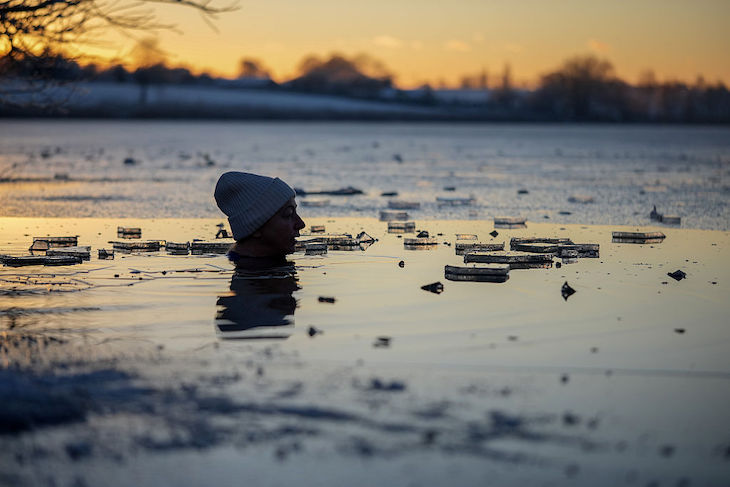
I fear the sea because I should. Not the depths or the blackness or its creatures or the cold but the currents and tides. So I was horrified at the recent tragic deaths in the sea off Budleigh Salterton, in Devon, and Withernsea, in Yorkshire, of people who were swept away by the force of the ocean, either by accident or because they were heroically attempting to save others.
They get an eyeful and they are welcome to it. Nothing matters when you need to get warm
After those tragic events, various experts were interviewed in broadcast media; they talked darkly of cold water shock and how risky cold swimming is. Cold water shock is simply named: when the body encounters cold water, it goes into shock. You may immediately breathe in water, and then your fate is probably set. But while cold water swimming can be dangerous, there was little mention of another truth: that cold water can be swum in safely. It can, because I do – but always with a clear understanding of what cold does to my body and how I can protect it. This requires Special Forces levels of preparation.
To swim in a winter lake in France, one of my regular swimming spots, I have learned everything from my friend Katie, who always swims through the winter. The preparation starts the day before, with neoprene gloves and boots dried and warmed by the fire. On the day of the swim, I pack a bag with two woolly hats (one for the water, the other for after), a thermal top, a thick hoodie, fleece-lined joggers and big thick socks. Sometimes I pack underwear, but that is never crucial. The thermal top cannot be too tight or I won’t be able to get it on and time cannot be lost tugging and fiddling when you are cold and getting colder.

This prep is for what cold swimmers call ‘skins’ swimming: swimming in a swimsuit. If I have a changing robe with me, I’ll take that. It’s easier to get changed under it, and we no longer care about the men playing pétanque right behind our changing area. They get an eyeful and they are welcome to it. Nothing matters when you need to get warm.
Then the other important steps. Plastic bags to use as liners in the neoprene gloves and boots: Katie swears they add to the warmth. My gloves are lobster gloves: half glove, half mitt. The glove bit allows for some dexterity still; the mitt bit is warmer. Then, one or two hot water bottles, wrapped in our towels, and a flask of hot drink. It doesn’t matter what (mine is usually hot Marmite). The point is the warmth and where it’s going.
We each have a bright float though the lake is small. You don’t need much water to drown in, and it is always useful to have something to hold on to if your legs start cramping, as I learned in the middle of Bassenthwaite having climbed Skiddaw first.
At the changing area, I put my clothes in the order I’ll need to put them on: thermal top first, then hoodie, then joggers, then socks. My towel-wrapped hot water bottle is uppermost.
The most important safety measure we can take is deciding whether to swim. It’s different in a lake, but ferocious winds would postpone a swim: when your body has to deal with cold water followed by cold air, it’s risky.
Our entry method is straightforward: we walk in slowly but definitely. Another friend stands in the water up to their thighs and does deep breathing. My calming method is to count aloud. For 55-65 seconds, my brain continues to scream at me to get out and make this stop. But I keep counting and I stay in and then there is always grudging acceptance. I’d never say I was warm in a swimsuit in 5-degree lake water, but I can tolerate it.
The next protection is to know how long to stay in. Hypothermia is cunning, fooling you into thinking you are warm (so hypothermic people are often found with their clothes removed) or that you can stay in longer. The way to beat hypothermia is to know it’s coming even when you can’t see it. We set a limit – usually about 15 minutes in winter – and never deviate.
Out, now, and speed is essential. Now we have to stop the afterdrop, when the body continues to cool when you get out. It used to be thought that – because the body diverts blood from the extremities in the water to protect the core – this colder blood then moves to the core and drops the temperature further. A newer idea is that the cold body surface continues to chill the core. Take heed from the excellent Outdoor Swimmer magazine: even melons get afterdrop. And they don’t have cold fingers.
Swimsuit and boots and gloves thrown off. Warm towel, warm clothes, warm everything put on. Then drink. There is no scientific evidence that drinking hot liquid (Marmite in my case) keeps my core warm but it works for me. I put a hot water bottle against my lower back (after a passing Frenchwoman told us that warmth through the kidneys spreads better than through belly fat, and she was right). There may be some shivering: this is the body’s way of warming and one of the reasons cold swimming burns more calories than warm. We deal with this by dancing, flinging our limbs around – the Can Can is a good option – to get blood back to the extremities and raise core temperature.
Then a drive in a warm car back to a wood burning stove, more hot drinks, definitely some food, and not a hot shower. Subjecting the body to hot water before it has properly warmed can lower blood pressure. Swimmers have fainted in hot showers. I wait an hour or so, until I feel warm.
Other cold water people will have other routines. In a different lake, we get out, get shoes on and run for a mile before drinking hot tea. That works too. Some people pour warm water over themselves afterwards. Whatever works. Whatever keeps you safe. And plenty can.
Why go through all this? Because there is nothing like swimming in a cold lake – yes, every single passer-by who shouts the same question at us, it is cold – to lift the soul. Because risk is human. And cold water is a survivable risk if you treat it right.




Comments