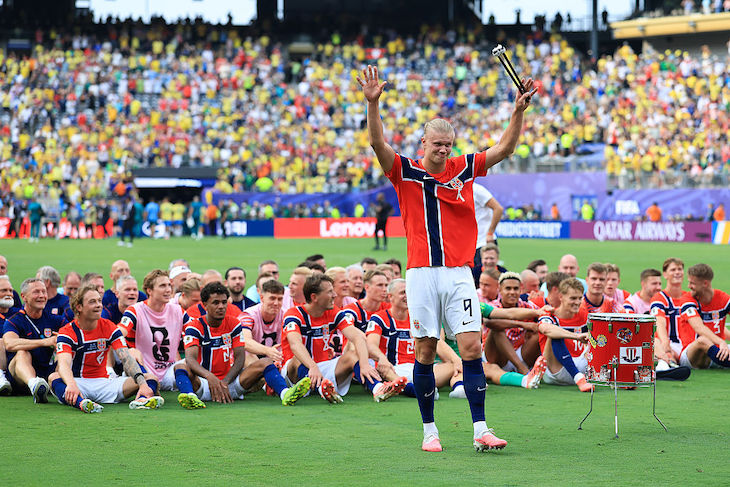
On paper, England should beat Norway in their World Cup quarter-final clash today. They have the Premier League: the richest clubs, the biggest audiences, elite academies, top-tier coaching, early age talent spotters and the most relentlessly competitive stage in world football. They have a deeper talent pool than Norway, and a squad trained by the weekly expectation to perform above and beyond. England have scale, money, noise and Harry Kane. Norway, rather inconveniently, have Erling Haaland.
Norway’s success in making it to their first World Cup quarter final shows football excellence can be reached in more than one way
That, at least, is the tempting way to frame Saturday’s game. Kane v Haaland. England’s tournament experience against Norway’s once-in-a-generation striker. The country that invented football against the country that first discovered oil and then world-class centre-forwards too.
Norway’s rise is nonetheless more interesting than one giant in Manchester City blue. Haaland is not an accident, nor is Martin Ødegaard. Both emerged from strikingly local football worlds. Haaland grew up at Bryne, a small club in a small town on Norway’s west coast. Ødegaard began at Drammen Strong, where his father coached him and where the decisive early investment was not a glossy elite pathway, but something far more Norwegian: a gravel pitch turned into artificial turf by parents and local club people who took children’s football seriously.
Norway is not simply punching above its weight because it happened to produce two exceptionally talented footballers. It is punching above its weight because it has enough national confidence – and the means – to take the unglamorous things seriously: local clubs, volunteer coaches, artificial pitches for long winters, patient development and a Nordic community culture that still expects even superstars to know they did not get there alone.

Norway’s oil wealth did not buy a national team in the way a Gulf state buys a club. It bought something less spectacular and more powerful: infrastructure, patience and fewer of the financial pressures that force most other football ecosystems into short-term thinking. More than 500 artificial pitches have been built since 2016 alone. In a country of long winters, these pitches make the difference between merely admiring talent and actually producing it: giving a child in Bryne or Drammen a proper place to play, a serious football environment and a route from a local club to the national team, the Premier League or Real Madrid. Wealth matters. So does what a country thinks wealth is for.
That is where the football story starts to reveal something larger about the country behind it. Small countries can be provincial, but they can also be coherent. In Norway, the distance between local communities, national institutions and decision-makers is short enough for practical knowledge to travel upwards. If a youth system is not working, people notice. If artificial pitches matter in a country of long winters, the powers-that-be can understand why. Good ideas are less easily buried under jargon; bad ones are less easily hidden behind glossy strategies. The result is not perfection, but it is often seriousness without theatricality.
This is not an argument that Norway are about to beat England. But Norway’s success in making it to their first World Cup quarter final shows that football excellence can be reached in more than one way, especially when a country builds around its own size, climate, wealth and strategic realities rather than borrowing someone else’s model.
England’s model is scale: the biggest league, the biggest revenues, the biggest audience, the biggest expectations. All of England’s players, not just the stars, are conditioned by the pressure, speed and scrutiny of the world’s most demanding football league. Nor are England likely to offer Norway the same indulgences as a strangely lacklustre Brazil just did. England remain favourites. My money, for what it is worth, is still on England.
Norway are too small to replicate England’s model, but they have something that England does not: Norway is a small, rich, high-trust country built around local clubs, long winters, practical infrastructure and the belief that talent grows best from the bottom up and without market pressure to grow too fast.
That is what should make Saturday’s quarter-final formidable. England are not merely facing Haaland and Ødegaard. They are facing a small country rowing in Viking formation towards the discovery that the world is beatable, provided you are brave enough to do things your own way.






Comments