
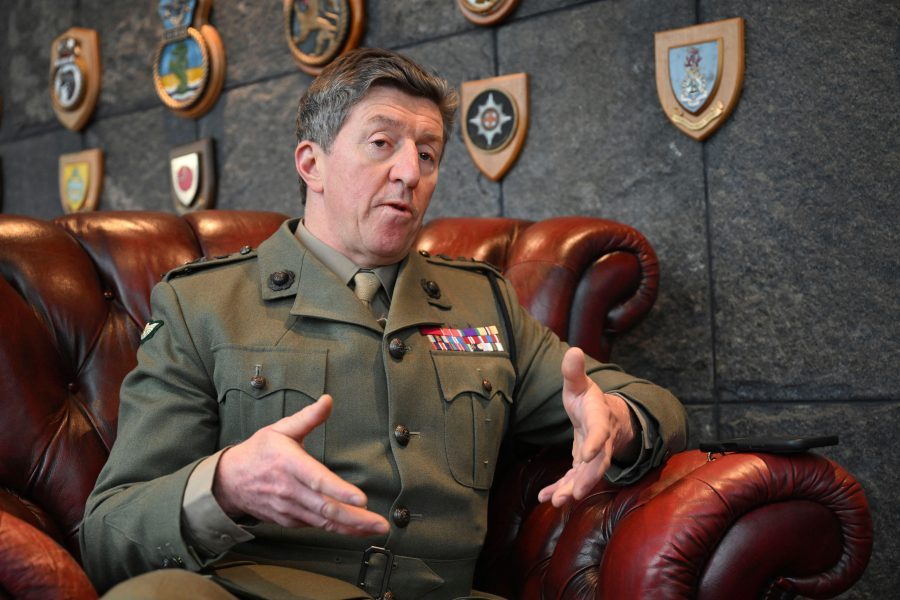
Russia’s threats towards Britain in recent weeks of ‘consequences’ for its continued support of Ukraine have allowed the government to start warning the electorate of the scale and nature of the new dangers the UK faces – from Russia and from its allies. The baton has now been taken up by the First Sea Lord, General Sir Gwyn Jenkins. Appearing on the Defence Talks podcast, Jenkins warned of potential ‘catastrophic events’. Nato, he said, would currently ‘struggle to contain’ Russia’s maritime strength in undersea warfare. This covers a wide spectrum, from conventional crewed submarines familiar from our conception of the Cold War to autonomous underwater vehicles – drones of the sea rather than the sky – operating from and in concert with crewed motherships.
This is consistent with the First Sea Lord’s vision of creating a hybrid Navy, as he proposed in a speech at the RUSI think tank in April. He referred to ‘the vulnerability of traditional platforms’ like aircraft carriers and other large surface ships. This is a challenge of which Russia is all too aware, having lost the guided missile cruiser Moskva, flagship of the Black Sea Fleet, three patrol boats, two landing ships and around 23 various other vessels to Ukrainian drone and missile strikes.
Command of the seas has always been vital to Britain’s success and survival
This hybrid Navy ‘encompasses our traditional air, surface and subsurface platforms fighting with and alongside drones and other cutting-edge weapon systems’ and is ‘about increasing the mass, survivability and lethality of our force’. It is vital both for maintaining at least technological parity with our potential adversaries and for increasing the Royal Navy’s efficiency and lethality – allowing it to provide more bang for its bucks in a world in which we are desperately short of bucks but need every bang we can get.
Amid all the advanced technology and emerging doctrine, Jenkins was talking about something fundamental, a factor which has defined our history and provided opportunity and security for centuries:

Let’s not forget that we are an island nation, we are utterly dependent on the sea for all our data, virtually all our trade, virtually all our energy.
One of our most critical vulnerabilities now is the network of undersea cables and data connectors. The vast majority of telecommunications data rely on undersea cables, and 75 per cent of the UK’s transatlantic capacity is provided by just two cables. Russia has a track record of targeting critical infrastructure, and its Main Directorate of Deep-Sea Research (known by the acronym GUGI) is tasked with carrying out reconnaissance on, and undertaking sabotage against, underwater infrastructure. Its intelligence-collection vessel Yantar has been repeatedly observed and intercepted in the waters around Britain’s coast, including close to undersea cables and connectors.
Command of the seas has always been vital to Britain’s success and survival. The creation of the Bank of England in 1694 gave the Crown access to previously unimaginable levels of credit and allowed it to build the Royal Navy into a globally dominant force. Nelson’s victory at Trafalgar in 1805 denied France maritime superiority and ensured that Britain could not lose the Napoleonic wars. The Naval Defence Act 1889 formally established the ‘two-power standard’, whereby the royal Navy, the largest in the world, would maintain a strength at least the size of that of the next two naval powers combined. Thus would – and did – Britannia continue to rule the waves.
The UK’s potential vulnerability is obvious. Parliament’s Joint Committee on the National Security Strategy published a report last September entitled Subsea telecommunications cables: resilience and crisis preparedness. What concerns the First Sea Lord is Russia’s well-developed capabilities in this area: he described ‘a real growth in undersea capability that we are, if we’re really honest as allies, we are struggling to contain’.
As matters stand, the Royal Navy is on the back foot. There are impressive plans and available technologies to support the development of Jenkins’s hybrid Navy, but we are not there yet.
Our underlying strength is not helped by the desperately poor rate of availability of our five Astute-class attack submarines. When the United States began its war with Iran in February this year and UK personnel and installations became potential targets, we had only one submarine deployable, and it was in Australia. At various points over the last year or so, all five boats have been unavailable for deployment.
Jenkins is a hard-nosed Royal Marine, and when he gives a warning, we should listen to it. He sounded the alarum in unmistakeable terms:
If we were to find ourselves fighting an opponent who had transitioned to autonomous warfare and we had not, we would lose. My job is not to lose, my job is to win.






Comments