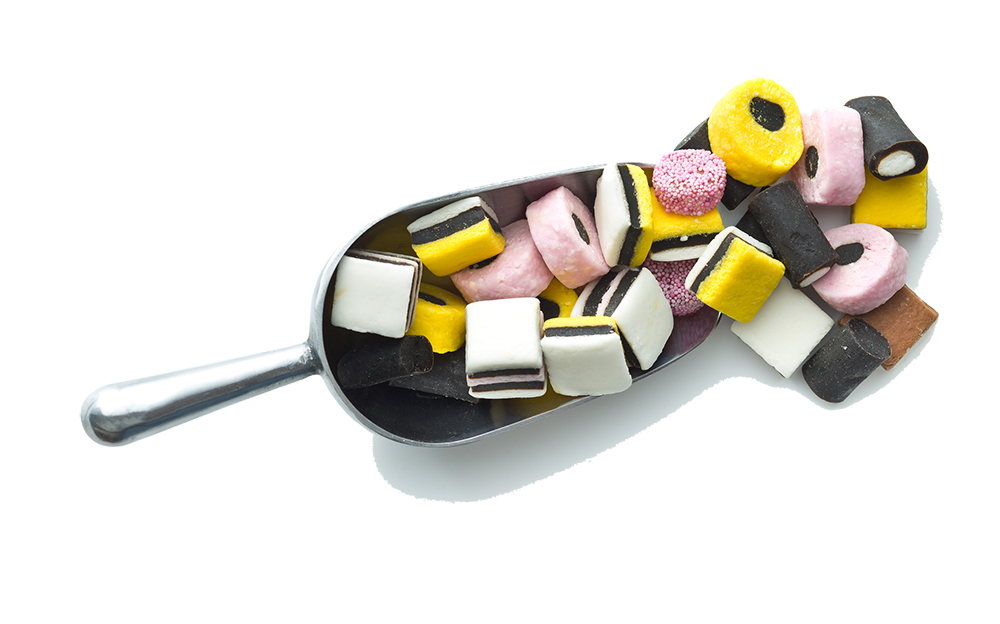

“I’ll swap you two of my rolls for three of your spogs.” That was the sort of thing you’d hear round the tuckshop in morning break when we schoolboys swapped and bartered our Liquorice Allsorts. We all had our favorites, spogs being the round pink or blue jelly buttons that had a coating of tiny sugar grains, while the pink or yellow coconut rolls featured a plug of licorice surrounded by coconut ice.
Pontefract Cakes were another schoolboy favorite: small round discs of licorice that were allegedly one of, if not the oldest commercial sweets in the world. In the 11th century, Benedictine monks introduced licorice to Pontefract, Yorkshire. At that time, the plant’s roots were commonly chewed to soothe sore throats, ease coughs and help digestion.
Pontefract Cakes have been more or less unchanged for more than two centuries, dating back to 1779 when a local chemist, George Dunhill, invented them. Licorice was ground in Pontefract Castle and the roots stored in the cellars. That’s why each Pontefract Cake is embossed with an image of the castle. Business thrived through generations of Dunhills until 1994, when the eponymous company was acquired by the confectionery giant Haribo. The hard-up among us, who couldn’t afford two ounces – let alone a quarter pound – of Allsorts, could buy plain licorice by the inch, cut to measure from a huge coil of it. We’d hide it under our shirts, taking surreptitious bites during lessons. Or if you had the skill and patience, you could try to unwind a tempting licorice wheel.

Although licorice is no longer grown commercially in Britain, you can grow your own by buying a packet of 20 seeds for £1.65 from Just Seeds, based in Wrexham. Mind you, it takes about four years for the roots to grow large enough to harvest – but after that, you’ll have a regular supply every year.
Licorice plants are part of the bean family and are perennials that grow up to three feet high with purply violet-blue flowers. Their long and tuberous roots can reach up to 40 feet.
The plant’s historical roots are equally deep. The Greeks were among the first to document its use, with physicians such as Hippocrates mentioning its healing properties. Ancient civilizations, such as the Egyptians, valued it for its medicinal properties. It was even found among the treasures in Tutankhamun’s tomb. Apparently, both Alexander the Great and Julius Caesar gave licorice to their troops for them to chew on. Napoleon Bonaparte was partial to it, always keeping some in his pocket as a remedy for indigestion and colds. Even on his deathbed, he requested a drink of licorice root mixed with water.
Today you might be better off downing a Black Daiquiri cocktail made with the Italian licorice flavor Antica Sambuca. Pour one part Antica Sambuca Black, one part white rum, a little less of lime juice and a couple of spoons of sugar into a shaker with ice. Give it a whirl and strain into a chilled glass. You can feel the velvety licorice doing its job while you raise your glass to toast Pontefract Castle… in spite of Henry IV imprisoning Richard II there in 1399 where he is thought to have starved to death. All without the comfort of a stick of licorice.






Comments