


Mary Wakefield has narrated this article for you to listen to.
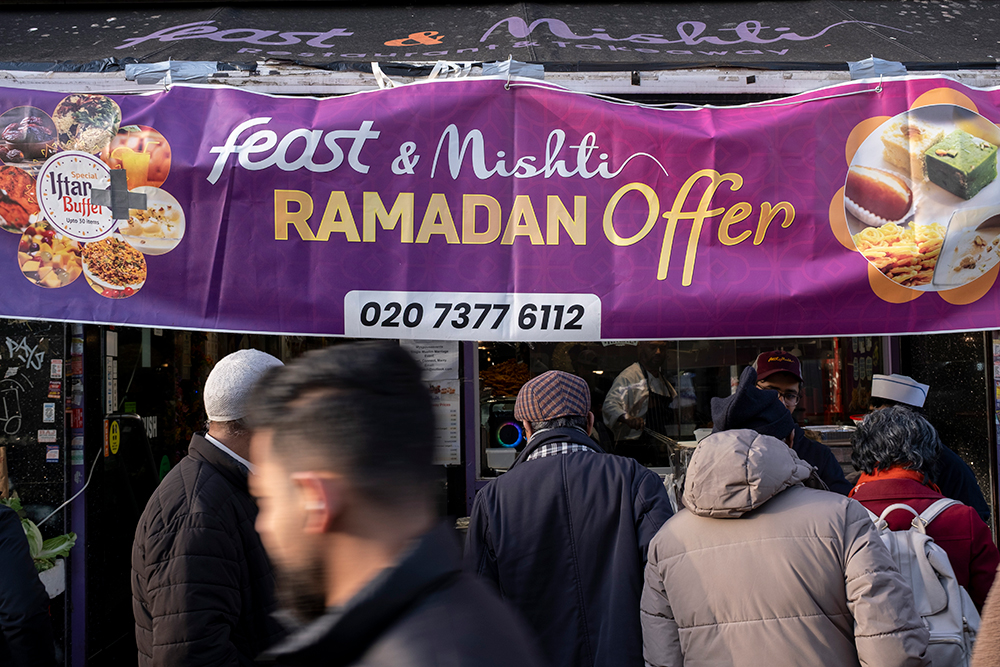
On the way back home down Mile End Road, I stopped for a cup of tea in a nice-looking café. It was vast, once I’d stepped inside, extending out into a sort of gazebo – but empty. On display under glass, a good four metres of immaculate cakes: red velvet cake, baklava cheesecake, dipped doughnuts, Dubai chocolate cronuts. ‘Fast now, Iftar after,’ said a sign on the counter. It was the fourth week of Ramadan in Stepney Green, Tower Hamlets; the sun was low in the sky and the whole place seemed to be waiting for the fast to end.
As I sat there with my tea, a woman of about my age entered and began to chat to the tidy young man at the counter. She was sick of life in London, she said, sick of this country. ‘You can’t even get a healthy lunch in Tesco.’ What, no carrots? I pricked up my ears. ‘It’s all bacon. There’s bacon in everything – everything. It didn’t used to be like this,’ she said with a knowing look, as if Islamophobes had taken charge of the Tesco lunch shelves.
‘Yes. I’m going back to Bangladesh,’ said the young man, ‘It’s the taxes too. How can I pay this much?’
‘Go! At least you will be healthy there.’
Last week details of Keir Starmer’s new plan to combat Islamophobia were revealed – a new definition of ‘anti-Muslim hostility’ which includes, as hostility, treating Muslims ‘as a collective group’ defined by ‘fixed and negative characteristics’. This is part of a broader ‘cohesion plan’, said the Prime Minister, for bringing the country together.
But how is it possible not to treat people as a group when they themselves insist on a group identity?
Some 40 per cent of the population of Tower Hamlets are Muslim, mostly ethnically Bangladeshi. And when the man behind the counter spoke of moving back, he probably meant very specifically to Sylhet in the north-east, on the banks of the Surma river, because 90 per cent of British Bangladeshis are from Sylhet. Sylhetis are conservative both in terms of their culture and their attitude to Islam. What the prophet said goes. Is it anti-Muslim hostility to point this out?
We need a two-way street, said Starmer – tolerance, compromise, integration. But integration becomes a touch tricky when very integral parts of British culture are haram. Bacon, dogs, ladies’ knees – even Jesus. A few days ago, Tom Holland (the historian, not the superhero) unearthed local government guidance which suggested that out of respect to the Muslim community, schools should avoid asking pupils to draw pictures of Jesus Christ. Jesus – Isa – is a prophet for Muslims, and prophets, as we all know, mustn’t be pictured.
It’s a terrible, craven piece of advice, but it points to the problem. It’s all very well to talk about mutual tolerance, but the Quran is a totalising text. There is no other perspective. What’s haram is haram. You don’t get much more integrated than Tesco: great Ramadan deals on flour and oil; crescent moon cards and banners; lanterns; an Eid advert with genuine spiritual feeling, unlike the bleak Christmas ads. None of that makes bacon clean.
There are some astonishing houses along Mile End Road. A beautiful late-17th-century house, once owned by the widow of the East India Company’s governor of Bombay; the Trinity Green Almshouses, for ‘decayed masters and commanders of ships’, with two intricately carved marble galleons perched on the gatehouse. From Whitechapel to Stepney Green station, there are now also imposing vertical banners hanging from the lampposts. ‘Trust in Allah, give Zakat.’
If the owner of that café is feeling skint, it’s not just because of income tax and the rising price of cake ingredients, but because observant Muslims like the Sylhetis are expected to pay, as a form of charity, 2.5 per cent of all their assets (though not their home). Zakat is compulsory for everyone who possibly can – one of the five pillars of Islam. What’s interesting to me is that it cannot and must not be used for any non-Muslim cause. The Quran forbids it.
How is it possible not to treat people as a group when they themselves insist on a group identity?
I thought about that as I sat waiting with the cakes. There’s a lot to admire about a community with commitment. All that fasting and almsgiving. Try imagining the C of E putting banners down Oxford Street: ‘Fast. Repent. Christ is King.’ They’re more likely to advertise Zakat.
How sustainable is it for a community that absorbs so much to give back only to its own? The Sylheti community depends heavily on benefits. Nearly half of the borough’s population lives in a household receiving at least one means-tested benefit. Around 30 per cent of all households receive housing benefit, and a little more than that a reduction on council tax. Nearly half of all pensioners claim the ‘guarantee credit’, the highest proportion in England and more than triple the national average. Is this Starmer’s two-way street? You can gift-aid Zakat, as it happens, another 25p from the taxpayer to the Ummah. The assumption with a diaspora is that it gradually integrates and intermarries over time, but Tower Hamlets has really bucked that trend. Sylhetis overwhelmingly marry Sylhetis. As I bike about I see buses advertising Muslim marriage: ‘Is it time?’ They jostle along the Essex Road past the buses with ads for ‘Amicable: Divorce is not a dirty word’.
If Tower Hamlets is struggling economically, well, then at least Sylhet is on the up. There’s no real way to calculate the exact remittance from the UK to Sylhet, but estimates vary between half a billion and £1 billion. Snooping around in Bangladeshi chat-rooms, there are worries that the money has not translated into the right sort of prosperity back home – children are still poorly educated, there’s not enough cash for hospitals and playgrounds. The money washing in from the UK has gone in recent years toward new mosques and madrasas, with the result that Sylhet, ironically, is becoming not less but more religious and conservative. But the building business is booming. Residents say the work is constant: shopping malls, hotels and elaborate second homes, often built in what’s known as ‘Londoni style’, several storeys high with Stepney Green-style pitched roofs. There’s even a fake Tesco, with the same distinctive blue and red, spelled Tescoo to avoid trouble – and with no bacon.




Comments