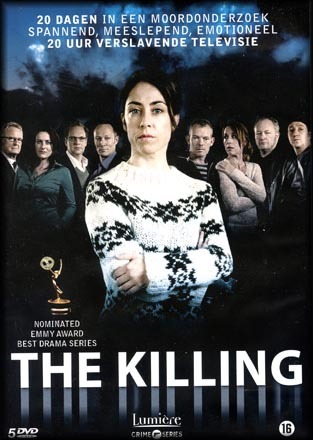
 I’ve a piece in Standpoint about The Killing, one of the most interesting dramas on television. It’s not British, alas, and provides another reason for the
controllers of British television to stop patting themselves on the back and saying “we make the best television in the world”. But nor, like so much of the best television drama, is it
American. The Killing is from Denmark, and I suggest that a reason why Scandinavian thrillers are so popular is that they come from countries where the sight of women in positions of power is
unremarkable.
I’ve a piece in Standpoint about The Killing, one of the most interesting dramas on television. It’s not British, alas, and provides another reason for the
controllers of British television to stop patting themselves on the back and saying “we make the best television in the world”. But nor, like so much of the best television drama, is it
American. The Killing is from Denmark, and I suggest that a reason why Scandinavian thrillers are so popular is that they come from countries where the sight of women in positions of power is
unremarkable.
The best way to describe Sofie Gråbøl, who plays detective Sarah Lund, is to list what she is not. She is not a glamorous film star. Neither is she the “feisty” heroine, beloved by television and film executives alike, who is just as tough as the men she works with. Nor is she a feminist heroine, like DCI Tennyson in Prime Suspect, who must cope with the resentments of her male colleagues. True, her deputy is a tough guy, whose willingness to bend the rules contrasts with her adherence to the letter of the law. But what looks like standard male/female typecasting breaks down as the series moves on. Lund operates in a society where a woman in a position of power is unexceptional. As a result, she can be something extraordinary in contemporary drama, an intelligent middle-aged woman who has no time to put on make-up or change her outfit because she is trying to solve the rape and murder of a teenage girl. Instead of worrying about her gender, the camera watches Lund as she quietly notices small details, and becomes ever more preoccupied as the pressure on her builds.
To produce a 20-hour drama (each hour covers a day of the murder investigation) takes some guts, and it is heartening to see that the makers of The Killing have confidence in themselves and their audience. Having freed themselves from stereotypes, and been allowed by Danish culture to make that freedom feel plausible, the writer Søren Sveistrup and the director Birger Larsen reveal the advantages of a detective story unencumbered by the clichés of Hollywood storylines. Most thrillers pile up corpses to hold the attention of the viewers. For the first six hours of The Killing, there is only one murder to solve — the case of Nanna Birk Larsen, whom the police find dead in a river. If this had been a production inspired by art-house cinema, the makers would have emphasised their contempt for Hollywood values by being self-consciously slow and obscure. The writers of The Killing do not suffer from such affectations. They do not want to bore the audience any more than they want to titillate it with sex and guns.
We are now 12 hours in, and the series is still gripping and there is still only one corpse. BBC4 is a minority channel. At times it seems a channel for a minority of the minority. In normal circumstances, if you hear it has shown something worth watching you must catch it on the iplayer within seven days of miss it. In a taste of what the future is bringing, however, you can catch-up with the whole series from Episode 1 on at the BBC4 site here. http://www.bbc.co.uk/programmes/b00y4z22/episodes/player Soon the BBC hopes to put vast numbers of programmes from its archives on the Net. As they were made with public money, it sees no reason for not showing them online, and will do so once the lawyers and the agents have been squared. Releasing the BBC archive, allowing people to watch whatever sitcom or drama from the past they remember with affection, will shore up the BBC’s status and boost its audience share. With luck the sight of past achievements will also prompt self-examination.
Television was central to British culture in the late 20th century, and I would hate to see it decline any further. If it is not to sink into mediocrity, our smug media grandees need to ask why first the Americans and now the Danes are making programmes of a quality the British cannot match.




Comments