I broke into a skip last week as I walked up the steps of Carlton House Terrace towards the Turf Club, under the watchful eye of Frederick, Duke of York, up on his plinth. I have a habit of skipping and scrunching up my nose with my knuckles when I’m very happy; apparently, it’s quite an alarming sight for people walking towards me. But I was just bursting with bonhomie, and my feet were full of it.
My day had got off to a good start at Oxford railway station. A bloke who wasn’t, shall we say, dressed for lunch at the Turf, dropped his ticket as he walked along the platform. And everyone, except one woman and I, looked the other way. I nodded to her as if to say ‘I’ve got this’, and went in pursuit with the errant ticket. He was so incredibly grateful, he filled my heart with joy. That tiny, effortless act had reaped such a reward.
If Maltese Cross wins, Waud will be the first Englishman to outright own a Derby winner for over a decade
In truth, however, I was already on top form, because I was going to have lunch with Nigel Rich, an ex-Hong Kong taipan, and the film producer George Waud, who is soon going to be a horse-racing grandee. And where better to meet than the Turf Club, the main attraction of which is Mr Paine, the restaurant manager? I just don’t see enough of Mr Paine and wish I could start every day having breakfast with him, such is his sunny disposition. He’s one of those people who make the world a better place.
However, I suspect that Mr Paine is not accustomed to serving gentlemen who wear two pairs of glasses while they eat their lunch. So the sight of a pair of specs jauntily perched on the top of George’s head threw him a little off balance, and I may have detected a slight roll of one eye. But Mr Paine is not the sort of chap to be discombobulated for long, and he was soon regaling us with the availability of gulls’ eggs on the menu. ‘I believe we’re the only club in St James’s serving them,’ he said conspiratorially. It was an invitation not to be turned down, so Nigel and I filled our boots.
The purpose of our lunch was to chew over racing’s political landscape. Nigel was not only a steward of the Hong Kong Jockey Club for five and a half years, but he also worked with Charles Allen when he was an executive director of Granada Group. When we put our lunch in the diary, Lord Allen was still chairman of the British Horseracing Authority. But in the interim, that bird either flew or was shot during the first drive, depending on your point of view.

Waud is a very interesting cove, described by his friends as ‘a genuine cultured renaissance man who knows how to live, but isn’t flash’. He is one of the producers of Cabaret, in its fifth year at the London Playhouse, and more importantly Withnail and I, which he’s bringing to the West End in 2027.
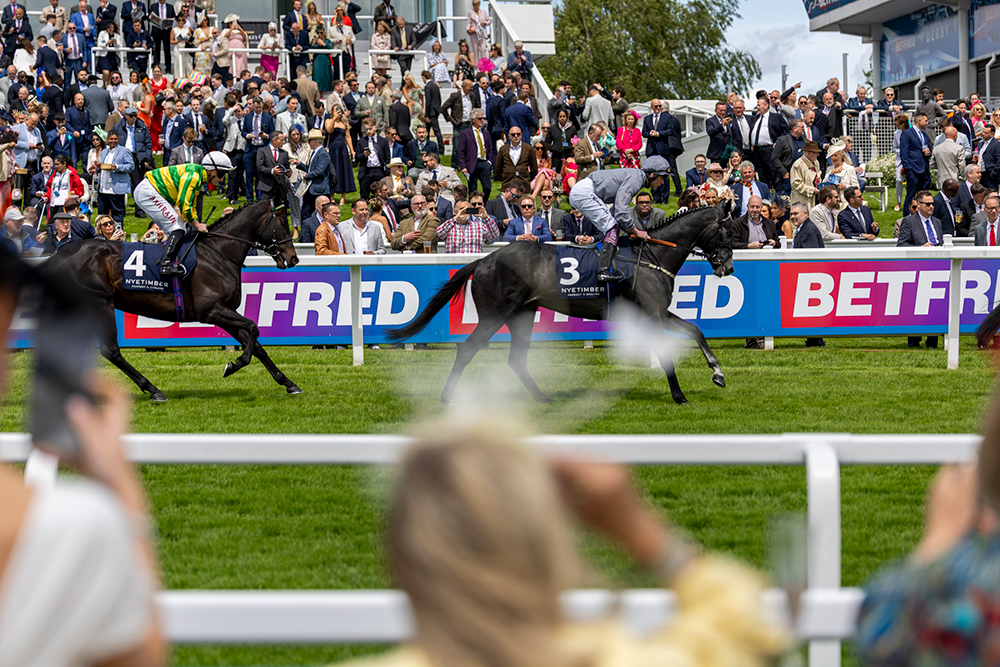
But if Maltese Cross, currently the third favourite for the Derby, wins on Saturday week, he will be the first Englishman to outright own a Derby winner for over a decade. He will be a collector’s item.
His pride and joy, specifically bought to try and win the classic, is by Sea the Stars out of a Camelot mare. And he has won his only two races this season, including the Lingfield Derby trial. ‘I’ve been watching Sea the Stars’s races since Lingfield, and he never won by far,’ George says. ‘And there is plenty of stamina on both sides of his pedigree.’ He also concedes to Nigel that he’s had a couple of big offers since the Derby trial win. You can assume they were seven figures. Whoever made those offers will almost certainly have looked at the data of Maltese Cross’s last win. His average stride frequency was 2.15 strides per second and his average stride length was 24.1 feet. When the favourite for this year’s Derby, Benvenuto Cellini, won his trial at Chester, his numbers were 2.06 and 26; last year’s Derby winner Lambourn’s stats were 2.14 and 24.9 at Epsom, according to Total Performance Data.
A rough rule of thumb is that a slow stride frequency and a long stride are good over a mile and a half at Epsom. In the early stages of the race, the climb from the starting stalls to the top of Tattenham Hill is comparable to the height of Nelson’s column. It’s vital that energy is saved at this stage of the race, so a long rhythmic stride is essential. A naturally short stride will require too high a frequency and energy burn. Interference and block-ing by other runners will also empty the tank.
Calves’ liver and bacon were washed down with a bottle of excellent Nuits Saint Georges and we had a thorny discussion on the use of pacemakers. Opinion was divided over whether they are fair and useful, stopping the race becoming a crawl with a subsequent pile-up as happened in 1932, or an unfair advantage that tilts the outcome in favour of the horse the pace is set for.

The two things we could all agree on were firstly, that we weren’t going to have a glass of port – Nigel had to go and pick up a pair of trousers from his tailor – and secondly, we all believe that the horse-owners, who pay for literally everything in racing, should have more say about how the sport is run. Definitely more than the racecourses, which are the beneficiaries of the horses racing there.
Nigel chuckled at the prospect of that, presumably with his ex-Hong Kong Jockey Club cap on. ‘Owners are only allowed to own three horses each there,’ he advised. George Waud will be buying a lot more than that if Maltese Cross wins the Derby.
Join us at the Betfred Derby Festival at Epsom on Friday 5 June from 11.30 a.m. We’ll start with a fine picnic before former trainer Charlie Brooks and Spectator opinion editor Rupert Hawksley take
us through the race card. For more information, go to spectator.co.uk/tastings.



Comments