Given my longstanding disgust with America’s lawlessly interventionist and self-destructive foreign policy, I should be outraged by Donald Trump’s cavalier remarks justifying – and weirdly minimizing – his surprise attack against Iran in collaboration with Israel. After all, a president stupid enough to mock the new Supreme Leader as “damaged” and only “alive in some form” – while simultaneously urging sitting-duck oil tanker captains to “show some guts” by running the Iranian blockade of the Strait of Hormuz – is someone who logically should be rebuked in the firmest possible terms.
But this wildly unstable solipsist is very different from other politicians. Moreover, I can still find the President, in his latest manic phase, laugh-out-loud funny, especially when he turns new-age confidential with reporters; for example, asked on Fox radio when he might halt the war, the President replied, with uncharacteristically emotive language, “When I feel it my bones.” This was in the same vein as his comment after the bombing of the Kharg Island oil-export terminal, which he described as “totally demolished,” even though “we may hit it a few more times just for fun.”
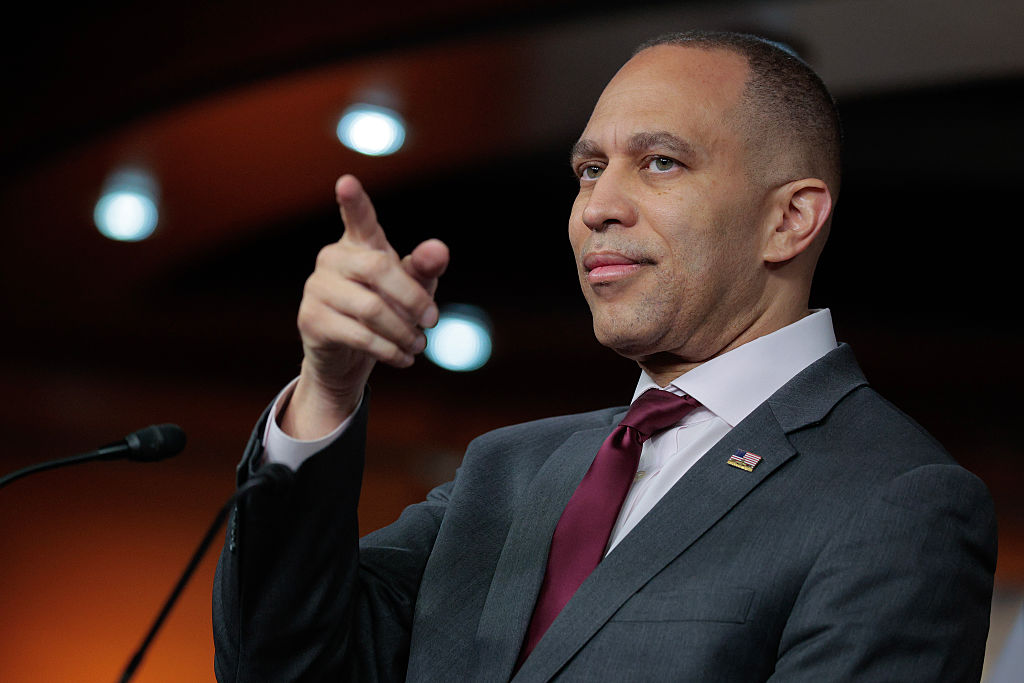
Trump is incorrigible, and unreachable, so outrage is a hopeless tactic and calling him a hypocrite largely useless. If you want to express true outrage, it would be better to focus on the feeble, more politically sensitive opposition party known as the Democrats. The party’s latest act of outrageous cynicism occurred on March 5, when the House Democrats, led by the impeccably attired and pusillanimous Hakeem Jeffries, voted on whether to invoke Section 5(c) of the War Powers Act, which would have required Trump to stop the Iran war immediately and forced him to request permission from Congress to renew his unconstitutional action – unconstitutional because Article I, Section 8 of the Constitution grants Congress, not the President, the power “To declare War.” Curiously, given the unpopularity of the war across most sectors of the country, the resolution failed 219-212 with four Democrats voting no and two Republicans voting yes. Add the four Democrats to the “yea” column and the resolution would have passed 216-215. True, the resolution had already failed the day before in the Senate (where the Republican majority is larger than in the House), but a “yes” vote in the “people’s house” would have sent a symbolically powerful political message to Trump, and to the whole country. So why did the four Democrats vote nay, against the overwhelming tide of 412 of their political brethren, as well as opinion polls showing strong anti-war sentiment – from the Bernie left to the MAGA right – that would have backed up their positions?

In both political parties discipline is the rule, not the exception. It’s why the members of Congress assigned the job of rounding up votes on a proposed law or resolution are called whips. Rest assured, when something really matters to the party chieftains, they usually get 100 percent compliance from their caucus, especially on a close vote. There are myriad ways to punish recalcitrant members: removal of patronage and access to party-controlled campaign money, stripping or delay of assignments to powerful committees – and in extreme cases of disobedience, the launching of primary opponents in what were previously safe districts for the incumbent. In this case, the party leadership – Senate Minority Leader Chuck Schumer and House Minority Leader Jeffries – range from ambivalent to supportive of anything that involves military intervention or “regime change” in hostile countries. If these war measures please Israel and its powerful American lobbying front AIPAC, all the better. But sometime it suits the party leadership to put on a show of protest (say, against Trump’s reckless endangerment of the whole world), so it “releases” a few members to vote the “wrong way” in order to ensure that a resolution or proposed law fails with no fingerprints from the top. This time the party bosses appear to have done it more expertly than usual. It’s depressing, I acknowledge, but it’s worth reading the hollow explanations of the four Democratic “no” voters, starting with Representative Juan Vargas of California, who decried Iran’s sponsorship of “terrorism” and threats to “global security.” Indeed, “while I have serious concerns about the administration’s decisions and approach, we need to have flexibility when service members are actively engaged… and options available to respond to such bad actors and humanitarian abuses.” By all means, we need the flexibility to kill hundreds more schoolgirls in order to stop the Iranian government’s bloodbath against its own population.
Worse was Maine’s Jared Golden, who stated preposterously that “the President has so far acted within the authorities given to him by Congress through the War Powers Act of 1973… He has been briefing Congress… This is not an illegal war, but it could become one.” Greg Landsman of Ohio simply supported preemptive, unsanctioned war initiated by the President: “I support targeted strikes to destroy Iran’s missiles and bombs to stop the regime from taking more lives.” So far, he said, we were hitting “all military targets” except, of course, for the ones containing more than 1,200 dead Iranian civilians. Then there was Henry Cuellar of Texas: “Abruptly restricting military operations risks undermining operational realities and sends the wrong signal to our adversaries.” I don’t know what “operational realities” means, but the “wrong signal” sounds a lot like Lyndon Johnson’s concern about creating a “credibility gap” in Vietnam by weakening American resolve against “communist aggression.”
All four of these terrifically principled congressmen take AIPAC campaign contributions, from Cuellar at $48,600 up to Golden at $555,996 during the 2003-04 campaign cycle. But so do plenty of other Democratic House members who voted for the War Powers Resolution. The point is that the Democratic party, still in the grip of Woodrow Wilson’s messianic and moralistic phoniness (the torch of Wilsonian piety is now carried by Bill and Hillary Clinton and former Secretary of State Antony Blinken), does not institutionally oppose the war in Iran, any more than it did the illegal kidnapping of Nicolás Maduro, George W. Bush’s invasion of Iraq or George H.W. Bush’s invasion of Panama. The Venezuelan dictator was a “bad guy,” we are constantly reminded, just like the bad Saddam Hussein, Manuel Noriega and Ayatollah Khameini. As a former Senate staffer told me, “The war powers resolution vote shouldn’t have been delayed. It seems like the [Democratic] leadership slow-walked it until Trump launched the strike, so it would have nil effect.” And further, “There is a decent minority of House/Senate Dems who are fully beholden to AIPAC and the war machine.”
The Democrats essentially threw the vote on war powers and possibly reigning in the Mad King Trump. So what’s a sovereign people to do? Start another party? Run Ro Khanna and Thomas Massie on an independent line for president? Or are we satisfied with the moral bromides of Juan Vargas and Greg Landsman?



Comments