
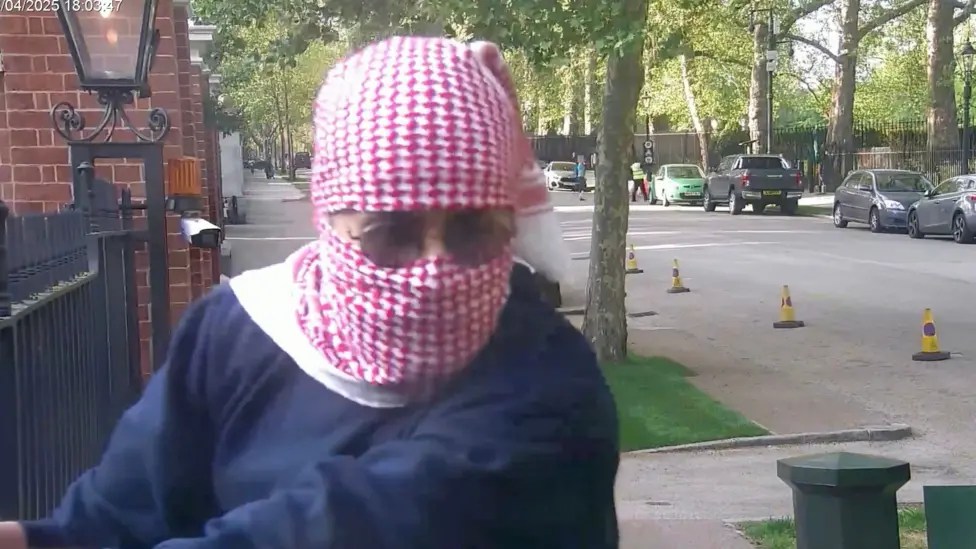
If anyone needs proof that jihadism is for losers, they need only look at the case of Abdullah Albadri. He was found guilty yesterday at the Old Bailey of preparation of terrorist acts and two offences of possession of a bladed article in a public place. On 28 April last year, he travelled across London to the Israeli embassy in Kensington, wrapped his head and face in a red-and-white shemagh, put on sunglasses, armed himself with two knives, and tried to climb the perimeter fence. Armed diplomatic protection officers stopped him within seconds.
That was the whole grand operation. An hour of theatrical pilgrimage through London, a martyrdom note, two knives, a costume, a fence, and then the ground.
Albadri was a would-be refugee who had entered the United Kingdom illegally by small boat from France. Twice. The first time, in August 2021, he claimed asylum. But he was so stupid he then deported himself accidentally while waiting for his asylum decision by hitching a lift in a lorry he thought was taking him to Manchester. Instead, he found himself back in France. Even as an illegal infiltrator he was a failure.
He came again on 12 April last year. The next day he was taken to the Crowne Plaza Hotel in Basingstoke, a four-star mid range business hotel just 20 minutes’ drive away from the 17th-century house where Jane Austen spent her later years, now a museum. Free hotel – result! However, three days later he was told that because he had already applied for asylum, his new claim was being treated as a ‘further submission’, and he did not qualify for accommodation. Out he went. At least this insane free accommodation for illegals system has rules, no doubt designed to teach the traditional British value of fair play.

Clearly disappointed by his failure, and disillusioned by his own mental simplicity, he turned to religion to seek reward. That is where jihad comes in. As a religious concept, it takes damaged men, humiliated men, thwarted men, bored men, men with grudges against the world and disappointment in themselves, and gives them a script in which failure becomes sacrifice. The nobody becomes a martyr. The drifter becomes a soldier of God. The man sleeping rough and washing in mosques (though none of them raised the alarm) becomes, in his own mind, an actor in sacred history.
The Israeli criminologist Anat Berko has spent years excavating that psychology. Her book The Path to Paradise is based on interviews with failed Palestinian suicide bombers and their dispatchers, and shows how suicide terrorism often recruits from the terrain of shame, humiliation, social failure, wounded pride and fantasy. She later wrote The Smarter Bomb, which explored how women and children could also benefit from this warped ideology, showing how pressure, dishonour, manipulation and the promise of spiritual elevation can be fused into a machinery of death for them as well.
In her research, Dr Berko sat for many hours with would-be bombers and dispatchers, listening to the gap between the cosmic language and the squalid human material underneath it. Berko and others in the field describe how Islamic martyrdom offers redemption of honour for those who are homosexual, have been raped, sexually abused, committed adultery or failed in some other way. One dispatcher spoke of looking for ‘sad young men’ and approaching them with promises of paradise. Then the sacred script arrives.
A man who had made a mess of his life found a language in which the mess could be made magnificent
Albadri’s own Arabic suicide note, photographed to send to his mum beside the knife he intended to carry into the embassy, fits that pattern almost too neatly. It is full of Islamic religious phrases about martyrdom, the worthlessness of this world, returning to God, honour belonging to God, and the martyr living with his Lord. Some of it echoes Quranic language directly or closely. Some of it is devotional paraphrase. The rest is his own drama queen farewell theatre.
It’s not that the letter is intellectually serious. It is the opposite. Its seriousness lies in what it reveals. A man who had made a mess of his life found a language in which the mess could be made magnificent. ‘This world has become worthless to me’, he wrote. That is the key sentence. Jihadism offered him a way to convert personal collapse into metaphysical importance. Zero to hero in one easy step.
Then came the target. Prosecutors said his phone showed repeated location searches for the Israeli embassy in the days and hours before the attack. He arrived armed, masked, and ready to climb into a diplomatic site representing the Jewish state.
Even here he proved incompetent. He chose one of the most heavily guarded embassies in London, walked up to its front perimeter fence, saluted two diplomatic protection officers, and tried to climb it in front of them. Predictably, he was stopped almost instantly. Poor Albadri: even his martyrdom had a slapstick ending.
Perhaps less funny is the fact that this loser walked from Kilburn to Kensington with his face wrapped in his red and white shemagh like the infamous Hamas spokesman Abu Ubaidah, sunglasses on, prayer beads and phone in hand, apparently praying as he went. His behaviour and attire were apparently now so normal in 21st century London that nobody seems to have intervened before he reached Kensington Palace Gardens. The theatrics of a knife-carrying jihadist no longer disturb the surface of the city.
Thank goodness two brave police officers stopped him, preventing yet another Islamic attempt to kill Jews with knives. Just this week, another man was more successful in his mission to stab Jews in Golders Green. This is starting to look like something of a pattern. Perhaps someone should look into the ideology that offers an escape from loserdom through this barbaric route.


Comments