These days, the 1990s seem to be regarded – especially by people too young to remember them – as a prelapsarian idyll. In Britain, London swung again to the sound of Britpop. In America, good-looking twentysomethings lived cheaply in large apartments, wisecracking and hugging their way through solvable problems. And all without the tyranny of social media.
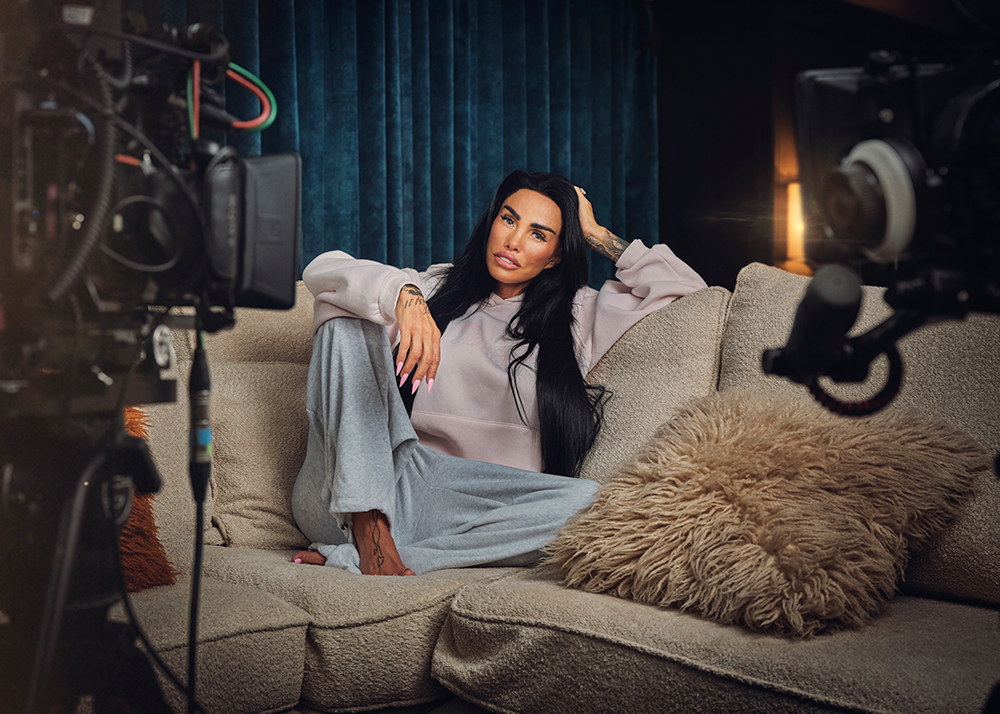
A rather less rosy picture, though, emerged in the opening episode of the four-part Katie Price: Nothing to Hide, in which Price added to her nine autobiographies and numerous documentaries and/or reality shows by deciding to ‘reflect on my life’ for the first time. The result was both a revealing social history and not unlike a novel by Martin Amis at his most blackly comic.
In Price’s defence, there’s plenty to reflect on. Eager for fame from her early teens, she soon realised that attracting male attention was the key to getting it. Luckily, this was something she loved doing, beginning with looking hot in Brighton clubs. Her big break – those Gen-Z fans of the 1990s might find hard to believe – was appearing topless at 18 in a national newspaper that sold millions of copies a day. ‘The excitement was ridiculous,’ said Price; but, in what became something of a mantra, ‘I wanted more.’
The ‘more’ in question duly included trading in her local boyfriend, a mere celebrated face around Brighton, for a pop star: Dane Bowers from the aptly named Another Level. It also included bigger breasts. In fact, when Sun readers were invited to vote on whether she should get them (‘My boobs are in your hands’), 80 per cent thought she should stay with her ‘natural born thrillers’. But she went for them anyway, the only problem being that they didn’t look unnatural enough – so she upgraded to ones that were unmistakably ‘stuck on’.
Sadly, however, Dane wasn’t keen on other men ogling her and so issued a cruel ultimatum – either she wore more clothes in photographs or he’d leave. Much to her shame now, she initially chose the more-clothes option. (‘When I’ve been in love, I’ve been blind,’ she lamented.) But after a while she cracked and put out an unambiguously sexy calendar. At which point, Dane, who also appeared in the programme, proved as good as his word.
After he departed, Price took ‘a load of pills’ – much to his annoyance. Feeling obliged to visit her in hospital, he found her unconscious with a picture of him on her chest and, by his own account, thought, ‘She’s taking the piss.’ Then again, as she acknowledged in her usual unblushing way, she kind of was: ‘I didn’t want to kill myself. I just wanted him to want me back.’ Once this plan failed, she consoled herself with another boob job and a new footballer boyf.
But even this is just scraping the surface of what Price described at the start as the ‘ten fun years’ she enjoyed before her life turned ‘turbulent’ – as we’ll no doubt hear in succeeding episodes. (You have been warned.)
Nonetheless, perhaps the strangest thing of all is that Price is undeniably engaging company, looking back on everything with a winning blend of disbelief, ruefulness and amusement. Granted, you couldn’t help thinking that the makers of Nothing to Hide – along with her plastic surgeons – should have tried harder to protect her from herself. (They might, for example, have decided there were some things to hide.) On the other hand, good luck with that.
In Elle, normal 1990s service – i.e. essential niceness – is resumed. A prequel to the film Legally Blonde, the series opened in 1995 with Elle Woods (Lexi Minetree) celebrating her 16th birthday at her parents’ huge mansion in LA. But then disaster struck. Her plastic-surgeon father botched a celebrity’s nose job, and the family was forced to leave town and move to a huge mansion in Seattle. In an eerily similar fish-out-of-water plot to that of the film, Elle therefore brought her sunny Californian ways – and wide array of pink outfits – to a rainy city where the other kids were into grunge and cynicism.
And from there, you can probably guess the rest. Sure enough, a mean girl with a sycophantic henchwoman sneered at her a lot (but will presumably be won over). Her various attempts to make her scowling classmates like her backfired spectacularly (but will presumably work in the end). And, above all of course, nothing could crush Elle’s spirit.
The three episodes I’ve seen so far did contain a sprinkling of moderately funny lines and Minetree, straightforwardly channelling Reese Witherspoon from the movie, makes for an appealing heroine. Even so, the niceness increasingly curdles into the bland – and the whole thing feels badly underpowered, as if the motto in the writers’ room must have read: ‘Sod it, that’ll do.’



Comments