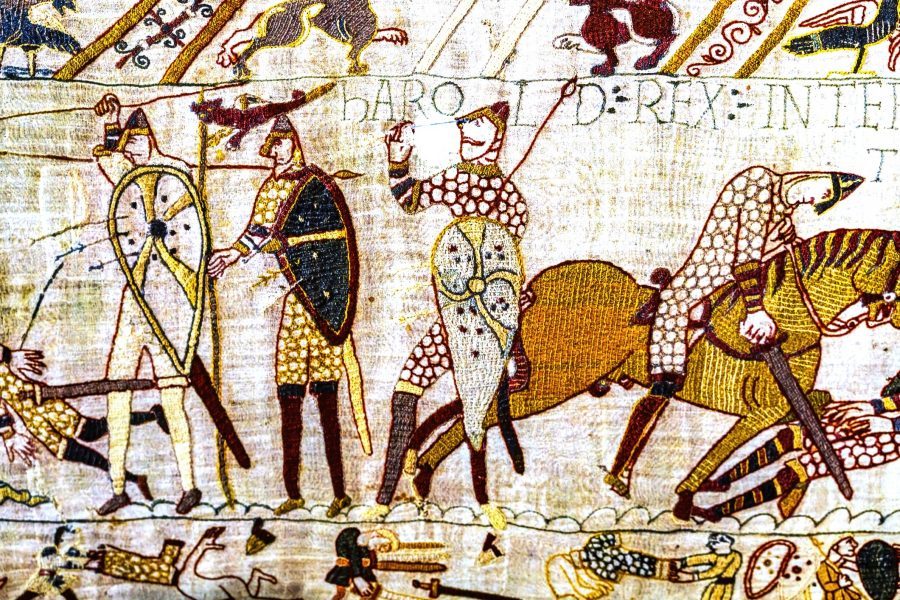
The Norman Conquest is a crime against humanity that remains, over a millennium on, entirely unsettled. The French still refuse to pay reparations for the 1066 genocide. And the rapacious Norman invader class remains firmly at the pinnacle of every aspect of public life in Britain. Indeed, the economist Gregory Clark has shown that, in some ways, the Conquest never truly ended because Norman last names remain overrepresented at Oxbridge some 30 generations on. Some of the nation’s most glittering buildings still wear their Norman Caen stone shamelessly; walk past many great ecclesiastical facades and the conspiracy is right there in plain sight, yet no one mentions it.
France owes us money and the math is fairly simple
So France owes us money and the math is fairly simple. By 1086, the Norman land-grabbers had helped themselves to roughly a third of England’s 12.5 million arable acres. At a conservative £8,500 an acre ($11,500), that implies a quite reasonable £35 billion ($47 billion) owed by France to the Anglo-Saxon population. Not a penny has been paid.
As always, the fault lies not in the stars but with Westminster. Parliament groans under the weight of hundreds of performative All-Party Parliamentary Groups, from champions of “responsible vaping” to advocates for “Afrikan reparations.” Yet no one has thought to establish an APPG for Anglo-Saxon Restitution, let alone a spicier judge-led inquiry into the Harrying of the North.
The institutional negligence is easily explained by self-interest. When the late Earl of Arran was asked why his bill to decriminalize homosexuality had succeeded where his bill to protect badgers failed, he noted that there were very few badgers in the House of Lords. The same, regrettably, cannot be said for the Normans.

It was against this sorry backdrop of institutional neglect that I noted the stately progress of the Bayeux Tapestry to London for the British Museum’s blockbuster exhibition. Arriving in the dead of a July night under police escort, the tapestry is now, movingly and fittingly, here. Though alas scheduled for return to Normandy next summer.
It must not go. Returning the Bayeux Tapestry to France is wrong, deeply divisive and possibly even illegal. The government must act before the inevitable fallout consumes it.
First, we must confront the uncomfortable truth about our neighbor: France is simply not a safe country. Try driving around the Étoile at 5 p.m. See if you can survive the total collapse of civic order from 12 avenues dumping traffic into one circle. Zero lane markings. Incoming cars get right of way. Sending anyone there is a recognized direct threat to human life. This is why once you flee the country on a rubber dinghy, international treaties make it virtually impossible to send you back. As an endangered 11th-century textile, the Bayeux Tapestry easily qualifies for asylum on the same grounds.
Second, returning the tapestry is almost certainly illegal. Under Section 149 of the Equality Act, public bodies must have “due regard” to foster good relations between persons who share a protected characteristic. So handing an 11th-century piece of hate speech back to the original colonizers, while something of a raw provocation, is not itself illegal, provided the British Museum agonized about it beforehand. Has it? A failure to have due regard is unlawful in its own right.
In any case, a tapestry that explicitly celebrates subjugation is also one liable to trigger a thousand years of unaddressed Anglo-Saxon trauma. Before a single thread crosses the Channel, right-thinking people everywhere must demand an immediate Equality Impact Assessment. Until then, the tapestry stays put.
Speaking of legal matters, the Bayeux Tapestry is indisputably the product of coerced labor. Meters and meters of forced needlework, executed by conquered Englishwomen to the spec of a man who conquered them, celebrating their own subjugation. It is, as they say, not a good look. Can we be so sure that this is not also a violation of Theresa May’s Modern Slavery Act? Can the British Museum hide behind the fact that the perpetrator was an 11th-century bishop not currently in a position to comply? A truly feeble defense.
Finally, returning the tapestry would leave the government hopelessly vulnerable to judicial review under current environmental law. The problem here is that woolen thread is protein and protein is one-sixth nitrogen by weight. Assuming the embroidery covers 40 percent of the linen surface, the Bayeux Tapestry is likely to have 3kg of nitrogen-bearing material traveling through the protected Stodmarsh catchment in Kent.
Because the Habitats Regulations operate on the strict precautionary principle, the onus is on the government to prove that the tapestry cannot shed nitrogen into the Stour. Hauling this massive biological hazard through Kent is therefore an obvious vulnerability to any citizen challenge under the Aarhus convention.
Even if the courts somehow cleared the move, the only statutory remedy for the nitrogen itself would be to “offset” it by taking English farmland out of agricultural production forever – a literal Second Conquest and a thought too horrible to contemplate.
We therefore need an urgent national conversation on what to do with the tapestry now that it is back where it belongs. Retaining it will not, of course, fully settle the £35 billion debt racked up by ten centuries of feudal extraction. But the English are famously magnanimous. With the textile indemnified at £800 million ($1 billion), accepting it as full settlement represents a generous 97 percent discount on Normandy’s historical liabilities. We accept the trade – and to show there are no hard feelings, we happily throw in Harry and Meghan as part of the settlement.






Comments