


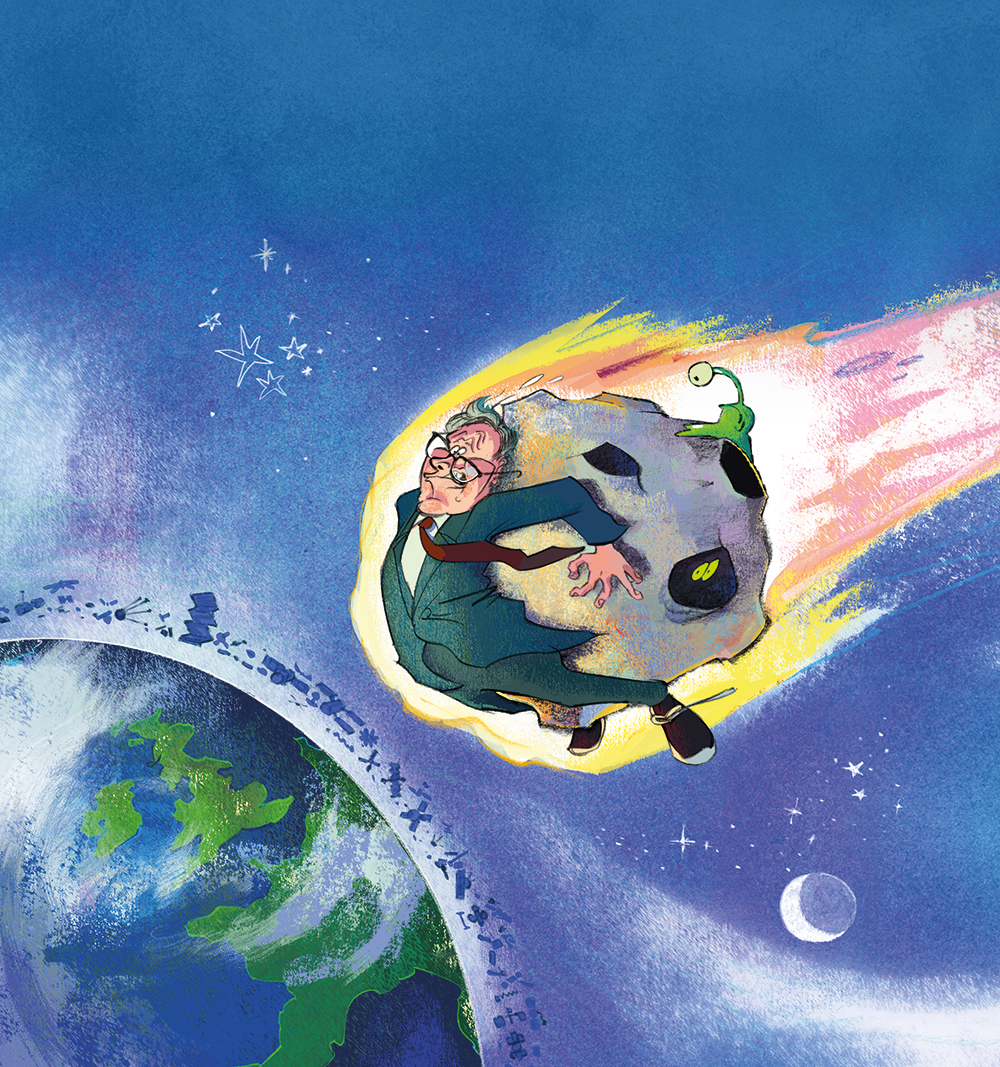
There’s a difference between climate and weather. Both change, but at very different tempos. Variations in the weather are seasonal and ephemeral. Alterations in the climate are longer-term shifts – epochal transformations – as we move from ages of warming to cooling to warming again.
I’m writing the day before the country goes to the polls to pass a midterm verdict on the Labour government. I can’t predict with precision exactly what will happen in every Scottish parliament constituency or London borough. The electoral weather will vary from region to region. But I can tell you that our broader political climate has already changed and these elections, in aggregate, will confirm it. Britain is becoming daily colder. For the enterprising. For the young. For the aspirational. For the Jewish community. For genuine liberals. A harder rain is going to fall.
What makes the shift so remorseless is the eclipse of what used to be Labour’s organised right
It may be the Prime Minister who feels most desperate and wrung-out this weekend. But whether or not Keir Starmer survives, the dynamic which will drive Labour for the rest of its time in government is clear – it is moving, injudiciously but inevitably and ineluctably, to the left.
It might seem illogical when Reform are the biggest winners of both seats and vote share for Labour to respond by becoming more Bennite than Blairite. But while defeat at the hands of Reform hurts Labour, the pain is nowhere near as acute as the losses to the Greens.
Labour is no longer a working-class party, heart and soul. It hasn’t been since Gordon Brown dismissed the Rochdale pensioner
Gillian Duffy as a ‘bigoted woman’ for expressing concerns about migration in the 2010 general election. There is, of course, an intellectual recognition among Labour’s strategists that they need Red Wall votes to sustain a majority, but there isn’t the emotional identification with their concerns that makes such an accommodation easy or natural anymore. Consider the vehement opposition which Labour backbenchers have mounted against the relatively moderate efforts by Shabana Mahmood to tighten migration rules. The very fact that Mahmood, the most intelligent member of the cabinet by some way, is considered a non-starter as a future Labour leader is telling in itself.
So defeats in Wakefield, Barnsley and Sunderland may be uncomfortable, but Green advances in Hackney, Haringey, Southwark and Lambeth and across inner London sear the Labour soul. Because these boroughs became the party’s genuine heartlands – the habitat in which Labour felt free from predators. Nowhere was safer for a Labour activist than a postcode where every male under 70 is in a chore jacket and the only drill you hear is Central Cee in your airpods. But what were once secure reservations have now become Labour’s killing fields – as the Greens advance across the capital.
It is the departure of young, idealistic, pro-European, anti-billionaire, sourdough-baking voters which will hurt most of all. The public sector professionals, the creatives – they were Labour’s extended family. They were being given new ‘rights’ – as gig economy employees, as renters, with votes at 16 and a Youth Mobility Scheme in preparation – but they still moved left. How sharper than a serpent’s tooth it is to have a thankless child.

Cool reason might dictate that pursuing these voters risks Labour drifting further away from the coalition which underpinned victory in 2024 and back towards the positions which led to defeat in 2019. But in politics reason is, as David Hume argued, a slave to the passions. And a Labour party that wants to feel passionate about its mission again will find all too many reasons to move even further to the left. Whether Keir stays or goes, Angie, Andy and Ed can be the troika harnessing the energy of every graduate without a mortgage and every public sector worker priced out of the property market.
What makes the shift, already under way, so remorseless is the eclipse of what used to be Labour’s organised right. Many signs of previous ‘centrist’ affiliation are now disabling convictions: association with the Epstein-friendly Mandelson, past sympathy with Trump-adjacent Blair, or membership of Labour Friends of Israel. Blairism is not just the love that dare not speak its name but a sin for which there is now no forgiveness.
The props that were once holding up an Atlanticist, pro-business, market-oriented Labour party are being hacked away. The principal organising group on the party’s right, Labour Together, is in near-terminal disarray. Its founder, Morgan McSweeney, and its former director Josh Simons, the MP for Makerfield, have been ejected from government. The Mandelson scandal, and an ill-judged response to internal leaks, emboldened their enemies on the left. And even though the Labour Together machine had propelled Starmer to power, he knew them not when the assassins came. Just as the luckless Charles I let his most loyal lieutenants, Strafford and Laud, be destroyed by his opponents, so Starmer allowed the men who built his majority to be sacrificed to the most radical voices in parliament. The organisation within Labour which has been the bulwark against any descent into sentimental soft-leftism is now a broken-backed husk. The other caucus broadly on the party’s right, Blue Labour, still has more intellectuals than foot soldiers in its ranks, and has also seen its influence diminish with the departure not just of McSweeney from Downing Street but his most able ally, Paul Ovenden.
It was already the case that the climate within Labour had shifted. On the economy, the initial talk of growth has become so subdued to be scarcely a whisper. Rachel Reeves inaugurated her chancellorship with promises to deregulate and prioritise pro-market policies. Now the Treasury flirts with rent controls, contemplates fuel rationing and shovels subsidies towards loss-making industries. Business leaders who once believed Reeves was serious about private sector investment now buckle under tax increases, labour market regulations and spiralling energy costs.
The only remaining area in which the g-word makes it into her speeches is in increasingly desperate appeals to the European Union for some sort of improved market access. Brussels can smell the desperation across the Channel and is readying to demand more and more for less and less: billions to enter a market which is already a global growth blackspot, restrictions on regulatory freedom in those tech areas which are one of our last remaining hopes of genuine innovation, access for Europe’s jobless young to employment opportunities our own school leavers are finding it ever harder to secure. Since a closer alignment with the EU is a cause which Labour believes can win back its lost progressive voters – a flag beneath which Greens, nationalists, Liberal Democrats and independents can gather – the price will be paid.
Even more seductive than the blue and yellow of Brussels will be the red, green and black of Palestine. No issue has the galvanic, energising, motivating power on the left as much as solidarity with the Palestinian cause. Many of those who have left Labour for the Greens, independents or even Scots and Welsh nationalists have done so for one reason – Gaza.
The way in which activism for that cause now manifests itself is all too apparent. Visiting family in Aberdeen this weekend, just days after the knife attack on two Jewish men in Golders Green, I was met with a poster from the local Palestine Solidarity Campaign depicting the Jewish actress Maureen Lipman as a devil – literally Satanic. The poster demanded Dame Maureen be barred from the city because she was an apartheid-abetting racist who supports genocide. Jews as devils. Jews as killers. Jews not wanted here. And all while Jews lie bleeding on our streets.
Even more seductive than the blue and yellow of Brussels will be the red, green and black of Palestine
Even as ministers have striven this week to empathise with the pain of Britain’s Jewish community, they seem unable to appreciate quite how their actions over time have made Britain a colder home for those citizens for whom the Star of David is a sign of hope. Ritual condemnation of Israel in international fora, restrictions on arms sales to the country’s government, a failure to oppose the anti-Semitic boycott of Jewish goods, support for a declaration of Palestinian statehood which rewarded Hamas aggression – all these have emboldened those hostile to the world’s only Jewish state and what it stands for.
I would like to think that the way in which we can now see how the demonisation of Israel and increased anti-Semitism have gone hand in hand would reverse this pernicious dynamic. But I fear that the casual way in which accusations of genocide are made, the elision of Zionist, Jew and oppressor in radical discourse and the electoral calculations of the Greens and others about the indulgence of this sentiment all generate a dark magnetic pull in the wrong direction.
In recent years it has been the Labour right – the Blairites principally but not solely – which have stood out against this malign trend. But as their influence wanes, so the internal forces holding back the move towards a more radical-left set of positions are weakened. And as Labour activists see their urban citadels fall to the Greens and Gaza independents, so the temptation to take positions which will win back those lost to parties further left becomes more seductive still.
It is notoriously difficult to make accurate predictions about climates changing, as Ed Miliband should know. But the transformation of the political environment in which Labour activists, members and MPs operate is becoming increasingly visible. As the compromises which power requires have become more uncomfortable, so the attraction of old left comforts has grown.
I may well, of course, be mistaken. Labour’s reaction to these elections could be that the Home Secretary toughens migration policy and tightens restrictions on indefinite leave to remain, that a new emphasis on growth prises the door open for a bigger role to be played in our economy by US tech companies and in the NHS by private providers, that taxes are cut to attract back entrepreneurs, that labour markets are deregulated to reverse rising youth unemployment, and an election-winning former PM is – once more – asked to become foreign secretary. But I suspect all those notions have had their seasons in the sun. For Britain’s economy, and our politics, instead winter is coming.





Comments