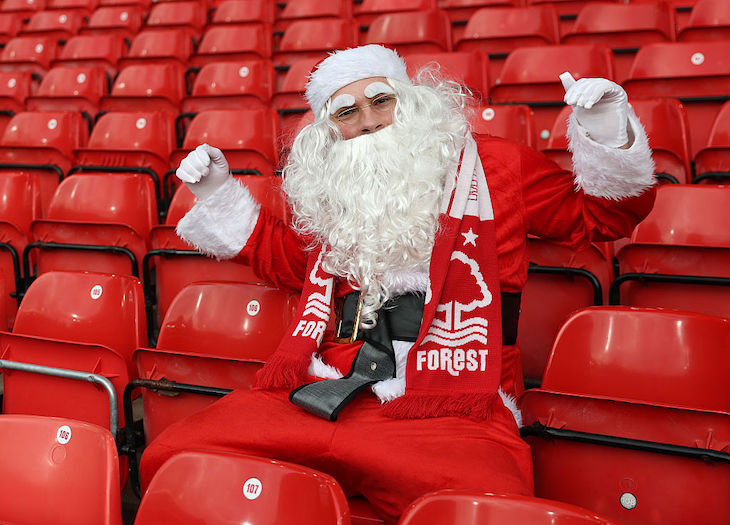
Football’s race to destroy the sport’s finest traditions has surpassed itself, yet again. For the annual Boxing Day feast of top-flight football – something which has been part of the game’s calendar since 1913 – has been all but wiped out. This year there is only one Premier League match: Manchester United vs. Newcastle United.
Once again, football fans are paying the price
We shouldn’t be surprised by the death of Boxing Day football. The last few years have seen TV bosses, club owners and the Premier League itself try and suck the joy out of the game for supporters, particularly those of us who actually go to matches.
Interminable VAR delays, the withdrawing of concessions for older fans, 8pm Saturday night kick offs, soaring ticket prices, and pre-match light shows were bad enough, but cancelling the festive fixture list? That’s tantamount to treason.
This Boxing Day blackout only applies to the Premier League; the lower leagues have a full schedule today, no VAR and, generally, much more fun it seems. But for those of us who have the misfortune to follow top flight teams – in my case, Spurs – the lack of a Boxing Day fixture is a sign that ‘the game’s gone’.
On Boxing Day, there is nothing like shaking off the previous day’s overindulgence by getting out of the house, escaping from the relatives and finding a way through the inevitable public transport chaos to meet up with your mates and watch what is often one of the most entertaining games of the season. The spectacle is partly helped by players who look like they would rather be at home watching a repeat of Chitty Chitty Bang Bang and, in the ‘old days’, often appeared to be hungover – thus having more in common with the supporters than they do these days.

But not this year. The Premier League’s official excuse for this Boxing Day debacle is this: ‘With fewer weekends to work with, the League is bound by how the calendar falls. The league can give an assurance that next season there will be more Premier League matches on Boxing Day – as the date falls on a Saturday.’
It’s really not a good reason. Once again football fans are paying the price.
Boxing Day has, after all, been a feast for football for generations, often producing some of the best games and craziest results.
In 1963, the ten games in the old Division One saw a staggering 66 goals, four hat-tricks and two red cards. Fulham beat Ipswich 10-1 – the Ipswich manager joked that his goalkeeper was the only sober player in the team – and West Ham lost 8-2 at home to Blackburn Rovers.
Go further back and teams played on both Christmas Day and Boxing Day, usually ‘double-headers’ – for instance in 1958 Spurs played away to West Ham on one day and home to them the next. Of course, Tottenham lost both.
But whatever the result, the atmosphere at these games was always special. As fellow Spurs fan Charlotte Henry wrote a year ago, it wasn’t just a regular match but ‘an occasion’. You met your mates, some wearing the replica shirt they’d unwrapped the day before, work had been put on hold for a couple of days or so and you were escaping the post-Xmas malaise.
Next year, Boxing Day falls on a Saturday so the tradition will return, but for how long? The richest clubs in the richest league are increasingly the playthings of foreign owners, from Middle Eastern states with dodgy human rights records to Americans, baffled that we complain about the price of tickets when the NFL teams they own charge hundreds of dollars to attend a single game.
As a result, older and poorer fans are being squeezed out to make room for tourists who spend more in the club shop and eat and drink within the ground, rather than join the throngs in local pubs and shops for a pint or a quick bite.
No one wants to get in the way of progress – too many cry ‘the game’s gone’ every time there’s a change. But cancelling football on 26 December isn’t a step forward. We need to save our Boxing Day football before it’s too late.




Comments