
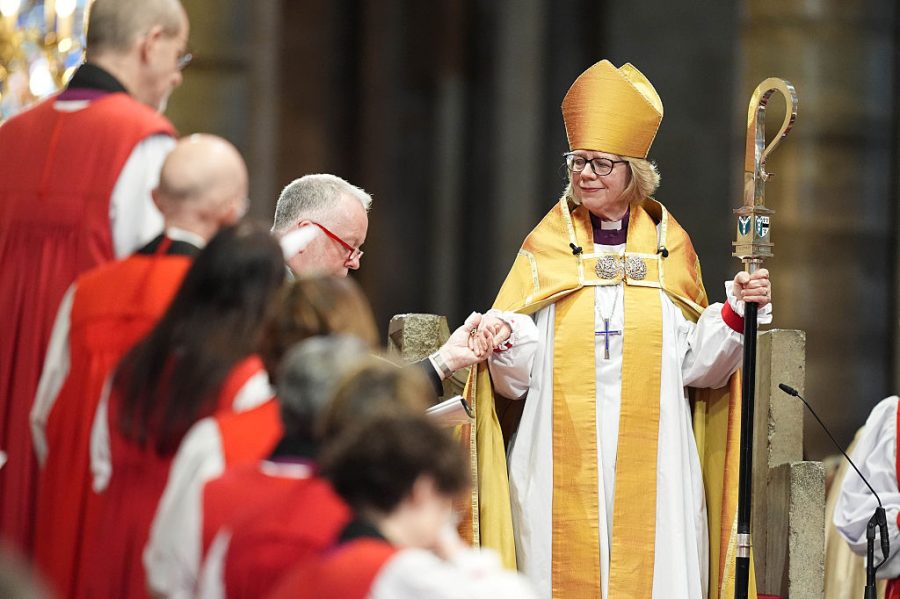
Granted, I was not the most obvious person to appreciate the installation of Sarah Mullally in Canterbury, even though I think her a splendid Christian pastor and indeed, an exemplary Christian. Her kind, homely face radiates charity and good will; the simplicity of her speech speaks of sincerity.
But as a bolshie Catholic, it’s not possible to spend long in Canterbury cathedral during this very Anglican celebration without the subversive thought surfacing that this cathedral is, by rights, Catholic, the Reformation being an unfortunate blip in the great scheme of things. If Sarah Mullally counts, as she says she does, Thomas Becket as one of her predecessors (which I happen to dispute), isn’t an apology due for those unfortunate events which saw his shrine destroyed and his bones scattered and desecrated courtesy of the founder of the Church of England (CofE)? The civilized Anglican answer to this issue is willful amnesia, but sometimes it becomes hard to stomach.
As well as articulating the claim to be the successor of Becket and St. Augustine (sent, let’s remember, to Britain by the Pope), the Archbishop also had to declare her assent to the historic formularies of the CofE. The Archbishop of York put it to her that:
The installation did little to restore my regard for the dignity of the Church of England
Led by the Holy Spirit, [the CofE] has borne witness to Christian truth in its historic formularies, the 39 articles of religion, the Book of Common Prayer and the ordering of bishops, priests and deacons. In the declaration you are about to make, will you affirm your loyalty to this inheritance of faith as your inspiration and guidance under God?
And so she did.
But I should be very surprised if she really did believe all the undiluted Protestantism in the 39 articles. I just don’t know in what possible sense she could have read and understood them to square with her own religious sensibility. John Henry Newman said that the articles were “patient” of a Catholic interpretation, but that was before the effort to see them that way drove him into the Catholic church.

Another problem to mar my appreciation of the celebration is that I don’t buy women’s orders. I don’t think any of the women cavorting through the cathedral were in fact priests or indeed bishops. Mind you, it shouldn’t have mattered in this case, because I don’t buy Anglican orders of any sort (I refer you to that unfortunate blip at the Reformation), so it shouldn’t have made any difference. But to the problems I have with a woman representing the male Christ (gender trumps ethnicity) there is added the difficulty of taking Anglican women clergy seriously. I am perfectly used to religious women; I was educated by nuns and so I am susceptible to female holiness where I find it.
Trouble is, none of the women I saw during the installation struck me as in any obvious way holy. Not the doll-like Lutheran bishop, a beautiful blonde with sparkly earrings; not the African women bishops in red lipstick; not the female curate with pink-dyed hair; not the procession of women clergy in makeup, velvet scrunchies and earrings. If you want to be taken seriously even as pastors, ladies, eschew the lipstick.
And then there was the insuperable impediment to appreciation of the event that it was presided over by David Monteith, the Dean of Canterbury cathedral. This was a man who radiated self-satisfaction during the ceremony yet was responsible as Dean for the abomination that was the “Rave in the Nave” – as great a desecration of the holiness of the place, you might say, as the Reformers scattering Becket’s bones. If Dame Sarah wants to get off to a good start with serious Anglicans, she could simply insist that the deans and chapters of English cathedrals respect the sacred character of their consecrated buildings. Threaten them with canon law, maybe?
The installation, in short, did little to restore my regard for the dignity of the Church of England. And yet, it is the established Church, and I am one of those who supports its position as the state church, even if it pays a heavy price in terms of intellectual coherence in its efforts to represent a largely secular nation. For the purpose of appealing to the widest possible constituency, including those like Prince William who don’t go to church much, Sarah Mullally was a good choice. But her installation made this Catholic grateful for the blessings of a male clergy.
Robert Hardman & The Rev’d Fergus Butler-Gallie join Damian Thompson on the latest Holy Smoke, to talk about Sarah Mullally’s enthronement – and Prince William’s faith:



Comments