Vladimir Putin likes good statistics. At a government meeting on April 15, even as he acknowledged that growth was slowing, he pointed proudly to Russia’s unemployment rate: 2.1 percent, a record low. Proof, he suggested, that the economy remains fundamentally sound despite everything the West has thrown at it. The Russian President would do better to worry.
A record low unemployment rate is not, in normal circumstances, cause for alarm. In Russia’s case it signals something closer to a slow-motion emergency. For the first time in its post-Soviet history, Russia has run out of workers.
The governor of Russia’s Central Bank Elvira Nabiullina said as much the day after Putin’s televised boast, telling the Moscow Exchange that labor shortages were the primary driver of the economy’s persistent overheating. Companies competing for a shrinking pool of workers are bidding up wages without any corresponding rise in output. Prices are following. To contain inflation – running at around 6 percent – the Central Bank has had to hold its key rate at 14.5 percent, more than twice the rate of inflation, to keep the price pressure at bay. That is not a sign of economic health. It is a tourniquet.
Russia is living with the consequences of its 1990s birthrate collapse
This worker shortage has four overlapping causes, all of which Putin’s war in Ukraine has made dramatically worse. The first is demographics. Russia is living with the consequences of its 1990s birthrate collapse. The cohort born between 1992 and 2002 – the leanest years – is now of working age, or rather, conspicuously not. In 2022 alone, the number of workers aged 25 to 29 fell by more than 720,000. Demographers had seen this coming: back in 2017, they predicted the economically active population could shrink by 6 to 7 million by 2030, and by as many as 23 million – roughly a quarter – by 2050. The war didn’t create this problem. It simply poured fuel on it.

The second is migration. Russia’s natural population has been declining since 1992 – a cumulative loss of 16.8 million over three decades. What kept the workforce tolerable was inbound migration: some 12.3 million people, mostly from Central Asia, filled three-quarters of that gap. Before the pandemic, Russia hosted roughly 4.5 million legal migrants. It now has somewhere between 3 million and 3.5 million. Workers from Kyrgyzstan, Uzbekistan and Tajikistan are going elsewhere – to Turkey, to the Gulf, to wherever pays better and shoots fewer of them. Migration from Ukraine, once significant, has, of course, stopped entirely.
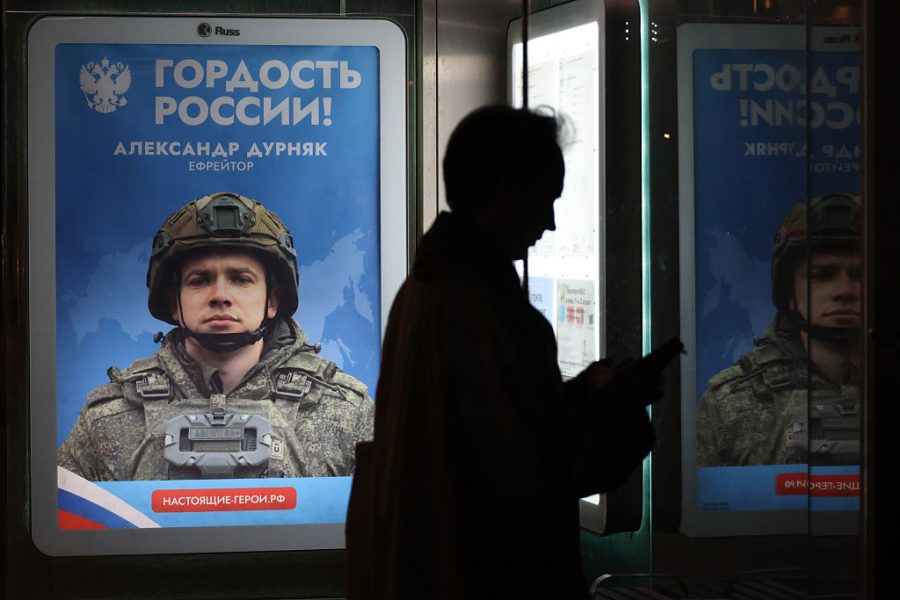
The third factor is military conscription – or rather, its shadow. Roughly 30,000 new contract soldiers signed up each month to fight in Ukraine over the past three years. That is approximately one million men, or around 1.5 percent of the working-age population, formally employed by the military. Add some 600,000 who emigrated in 2022 alone and the subsequent waves of departures, and you have removed well over 2 percent of the civilian workforce. Those who left might theoretically return. Those who came home in a zinc coffin will not.
The fourth is the defense industry itself, which has hoovered up what’s left. Military production, lavishly subsidized by the state, has expanded voraciously, bidding workers away from civilian manufacturing. The army needs men to fight. The arms factories need men to supply them. The result is a labor market so tight that ordinary employers can barely function.
None of this is likely to ease soon. The workforce will only loosen if the broader economy cools sharply enough to trigger mass layoffs – at which point the military and the arms industry would simply absorb whoever becomes available. It is a trap of the Kremlin’s own making.
This suggests an underexploited angle for Western policymakers. If the aim is to increase pressure on Moscow, the labor market offers a more effective target than luxury goods. Restricting the banks and payment processors that handle remittances from Russian migrant workers to Central Asia would dry up a financial lifeline that keeps those workers coming. Investing in education and employment in Tajikistan, Uzbekistan and Kyrgyzstan would give potential migrants reason to stay home. Maintaining – or expanding – visa pathways for Russians who want to leave would accelerate the brain drain that is already quietly hollowing out Russia’s technical workforce.
None of this is glamorous. It lacks the satisfying symbolism of a superyacht seizure. But banning the export of Hermès handbags to oligarchs’ wives has done precisely nothing to shorten the war. Squeezing a labor market that is already at breaking point might.





Comments