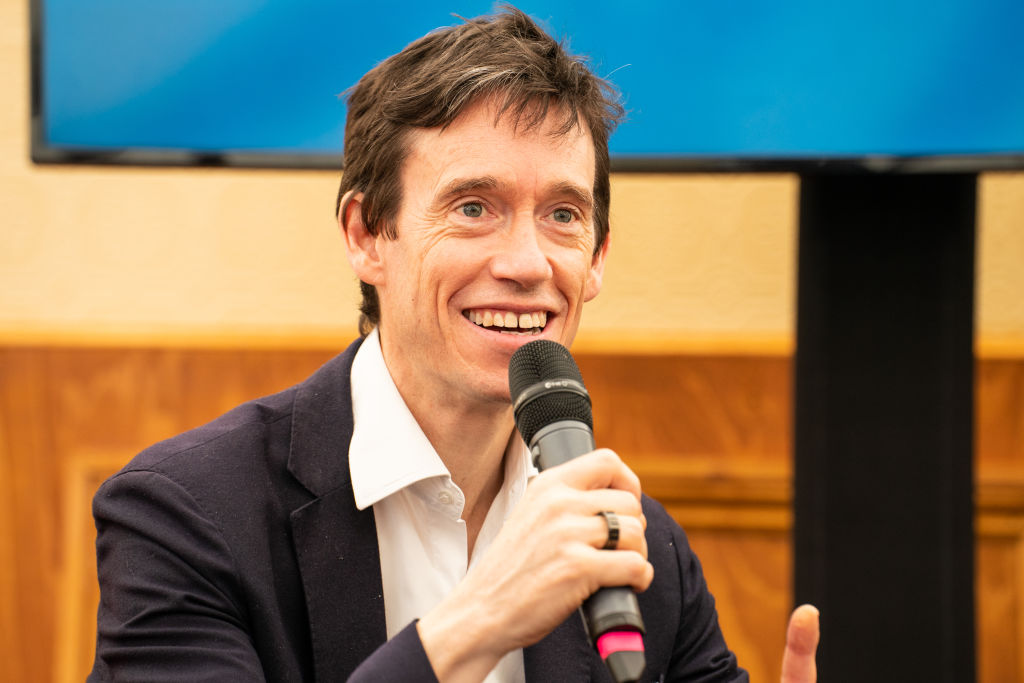
It’s not often noted that the taboo on discussing racial issues goes both ways. While critics of immigration must often tap-dance around their objections to multiculturalism, all but the most gormless of open borders advocates tend to be reluctant to accuse their opponents of racism in response. It’s therefore refreshing to hear a liberal flatly state that anybody who objects to Islam is engaging in what is ‘basically racism’. That was the claim of Rory Stewart, responding to an amusingly softball question from Oli Dugmore on a recent New Statesman podcast.
The irony is that Stewart’s attack on those critical of Islam hinges on exactly the sort of parochial ignorance that he accuses others of
Stewart had been invited to reflect on what Dugmore called ‘the animosity that exists in much of our politics’ towards Muslims. This is amid the backdrop of the war in Iran, but more proximately the shadow justice secretary Nick Timothy’s objections to mass Muslim prayers in Trafalgar Square, which had taken place as part of Ramadan.
While video has largely not been a worthwhile addition to podcasting, it is worth seeing Stewart’s lip curling in contempt at the question’s targets. ‘This idea that somehow Islam itself is a kind of inherently bad religion and other religions are sort of inherently good is completely demented,’ he says.
Particular targets for his ire were the ‘the far right in Britain or all those people on social media who are talking about “Judeo-Christian values”.’ This includes the AfD in Germany, who have been open in discussing a remigration policy that could see German-born Muslims removed from the country.
To be clear, there is more than a kernel of truth to Stewart’s arguments. Some of the critics of Islam will be motivated by prejudice, though one could quibble whether ‘racism’ is the right word to describe bigotry directed towards a religious group.
It is also a break with modern European ideals of citizenship to deport somebody from a country simply because their religious faith is unlike that of the majority. Many centuries of religious wars in this continent have gradually led us to the norm that all faiths should be tolerated within reasonable limits.
Yet the irony is that Stewart’s attack on those critical of Islam hinges on exactly the sort of parochial ignorance that he accuses others of. It is clear from political events and survey data that the faith frequently instils attitudes that conflict with those of mainstream British society.
The new prominence of Muslims as a voter group following the election of the Gaza independents in 2024 and the more recent rise of the Islamo-Green coalition are only the culmination of a problem that has been brewing for some years. Labour’s social cohesion strategy effectively concedes that integration of Muslim groups isn’t happening in some cases, even while the government seeks to appease these voters with an ‘anti-Muslim hostility tsar’ and a new definition of Islamophobia.
The document follows a string of events which have already eroded our ability to speak ill of Islam. This February saw the belated end to the Crown Prosecution Service’s efforts to prosecute Hamit Coskun for burning a Quran outside the Turkish consulate in London. Prosecutors were motivated over fears that Islam had been insulted, a concern justified by the fact a Muslim emerged from a nearby building during the stunt and tried to attack Coskun with a knife – resulting in a paltry 20-week suspended prison sentence.
Three years ago, several schoolboys damaging a copy of the Quran in Wakefield led to death threats and school suspensions, for at least one of the boys for his own safety. Most famously, in 2021 a teacher from Batley Grammar School in Yorkshire was forced into hiding following protests of him showing a Mohammed cartoon in class.
Such attacks on free expression are less serious than the many Islamist terror incidents, ranging from the murder of the MP David Amess to the Manchester Arena bombing. Counter-terror police say that three-quarters of their workload relates to Islamist extremism, despite Muslims making up about 6 per cent of the population, according to the 2021 census.
The counter to this would usually be that such incidents are not representative of Muslim attitudes, but what data we have on that is not entirely true. Polling from the Henry Jackson Society from spring 2024 showed that almosthalf of British Muslims had a more sympathetic view of Hamas than Israel, with only a quarter having a negative perception of Hamas. Meanwhile, only a quarter of British Muslims believed that Hamas raped and murdered Jews during the 7 October attacks.
When it comes to wider illiberalism, half of British Muslims believe it should be illegal to depict Mohammed and a quarter say that homosexuality should be outlawed. There are of course native Brits who would agree with some of these things – as well as Christian nationalists who would curtail wider civil liberties and white supremacists who MI5 is keeping a close eye on. And likewise, there are Muslims who are champions of established British legal rights and the majority culture.
Any religion contains multitudes. But the problem for Stewart and those who agree with him is that they deny Islam is a salient factor in shaping Muslim beliefs, as well as the corollary that certain groups are more or less likely to integrate into the existing culture that most Brits – and indeed, many immigrants – want to sustain.
Arguably, Stewart’s perspective borders on insulting towards Muslims, despite his years living in Malaysia, Iraq, Pakistan and Afghanistan. In an inadvertently telling phrase, he tells Brits who are uncomfortable with seeing ‘an alien religious culture’ that ‘if you get beyond the costume, here are warm, generous, funny, inventive people.’
Islam is surely more than a costume for most Muslims, much as Christianity and even modern progressivism are not garbs that their adherents shrug off like ceremonial dress. Stewart has even acknowledged as much when discussing his experiences in Afghanistan, where he ran an NGO for some years.
Describing a ‘fatal gap’ between policymakers and reality, Stewart poured scorn on the oft-repeated claim among clueless officials that ‘every Afghan is committed to a gender-sensitive, multi-ethnic centralised state based on democracy, human rights and the rule of law’, a concept he would struggle to even translate for the average Afghan.
Muslims have sincere beliefs that affect their behaviour, morality and politics, sometimes in ways that are incompatible with western ideals. That is true in Afghanistan, and it is unfortunately true of some groups that have made Britain their home. It is not racist to say as much.






Comments