Paris
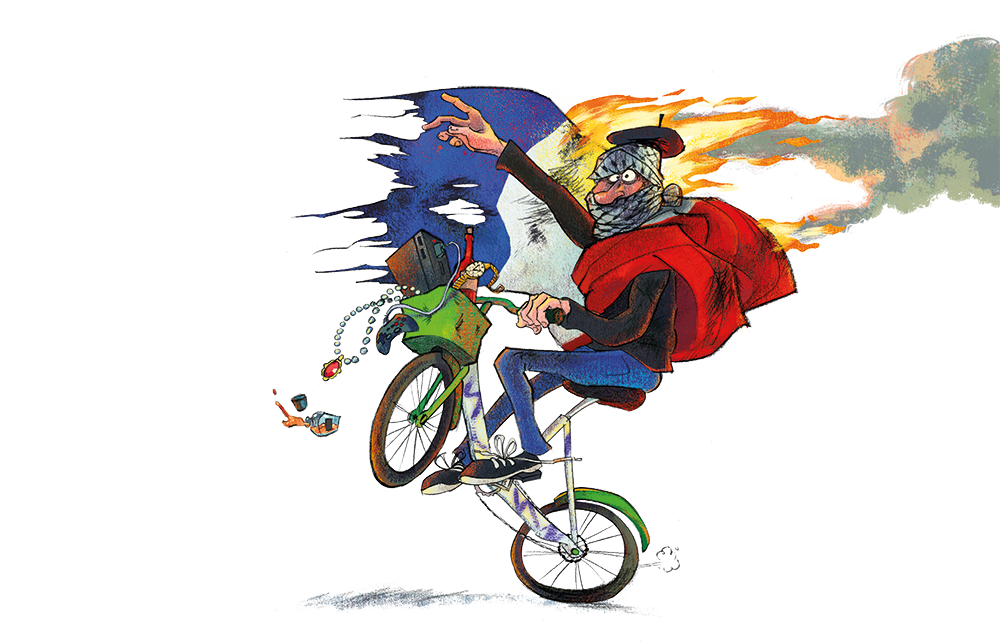
The wonderful thing about electric bikes, if you are fighting with French riot police, is the way they burn. You skid your Lime or Vélib’ into the middle of the Boulevard de Magenta, which leads from the Gare du Nord down to the Place de la République, and set it alight along with a pile of ordinary bikes, and soon you have a conflagration of rubber and battery chemicals.
During the weekend’s street protests, the fires provided cover for rioters breaking into mobile phone, vape and jewellery stores and the money-transfer shops which serve the many immigrants who work in eastern Paris. By Monday morning, a vicious guard dog stood outside an Intermarché supermarket, snarling at customers coming in one by one. A diagnostic lab had its windows smashed in; a children’s nursery was covered in graffiti. Outside the building where Louis Daguerre produced his first daguerreotype, three cars and a small delivery van were burned out, one of the cars flipped onto its roof.
President Macron gave a televised address with all the authority of a flustered cabin steward
The graffiti spoke for itself. ‘Revolution’. ‘Macron: Give Us the Money’. ‘No future, No Peace’. ‘The Kids Have Talent’. ‘Capitalism Kills’. ‘Nique Un Facho (Fuck a Fascist)’. ‘It’s Okay to Punch Nazis’. ‘Power = Paedophile’. The Monument to the Republic, the great statue at the centre of the Place de la République, was covered in similar slogans. Égalité looked like a zombie, her eyes and cheeks smeared in black paint. La République now wore a yellow worker’s vest with the words: ‘The Police Are Mutilating the Students’. In the smart shopping neighbourhoods near the Champs-Élysées, the rioters had gone for labels, Burberry, Dior, Kenzo, Celine. In the Lacoste store on Boulevard des Capucines, they left the message ‘Fauchés mais en Lacoste’ (‘Broke but in Lacoste’).
What happened was not a revolution, it was a failure of policing. What started in mid-September as a peaceful demonstration against the government for its failure to invest in schools and stop the upward spiral of fuel prices has turned into weeks of riots and street fights, with the police unable to keep up. Criminal gangs took advantage of the chaos, as they tend to. The kids stealing iPhones and handbags and yelling ‘Where’s Chanel?’ as they sprinted towards the Avenue Montaigne were clearly not the ones demanding more investment in the baccalauréat programme. There was nothing of the long-haired, tight-sweatered socialist spirit of 1968 Paris about them. The overwhelming number of looters caught by the police were men between 18 and 30, many with criminal records. For them, the protests were cover for a day of violence. For others, the chaos could be hijacked for a different cause, as evidenced by the large number of Palestine flags and keffiyehs.

In 2019, the French police created a special unit to deal with just this kind of situation, the Brigade de Répression de l’Action Violente Motorisée, a division on small fast motorbikes, capable of chasing rioters down narrow streets. But they were outrun and outsmarted by leaderless packs, seething across the city, merging and breaking up into larger and smaller groups. Why, exactly, the police failed has become a guessing game. Did the government allow the riots to let rip in order to make the left look bad? Was it a botched ploy to send shivers through the electorate and drive them in from the extremities of left and right, to the security of the emptied middle ground? Or were the police just too slow?
Whatever the reason, the chaos has been a complete humiliation for President Emmanuel Macron and a boon for his enemies. Marine Le Pen is still often described as a far-right leader, but the label is misleading. Her ideas and her party, the Rassemblement National, have become the centre of gravity in French politics. If next spring’s presidential elections were held this week, she would win easily. On Sunday, she spoke with that strong pub landlady vibe which seems to so resonate with French voters. It is closing time in France, and she is not having any of it. She called the riots ‘a threat to democracy’, blaming them on ‘decades of immigration’ and a weak government ‘incapable of doing anything other than commenting on its own impotence’.
President Macron, for his part, gave a televised address with all the authority of a flustered cabin steward, before setting off on Monday to the Gulf to plead for more diesel and oil. The word most often hurled at him now, and not just by Le Pen, is ‘powerless’. With six months left in his final term, he has run out of authority and ideas. It did not help that he spent Friday night with his wife at a Celine Dion concert, hardly the excursion of a leader in a time of crisis. He was accompanied by Hélène Mercier-Arnault, the wife of Bernard Arnault, the head of LVMH and France’s richest man. While the left was preparing its placards and Dion was singing ‘My Heart Will Go On’, Macron’s reputation hit new depths.
Very simply, France is in a deep financial hole. Successive governments have broken the country’s entrepreneurial spirit and the nation’s debts have piled up. It already has the second-highest tax to GDP ratio and personal income tax rates in Europe, after Denmark, as well as the most national debt. It has consistently breached the EU’s borrowing limits, and now the costs of that borrowing are rising as investors dump French government bonds. Arguing over the absence of white players on the national football team is a proxy for any serious discussion of France’s hopeless integration of its post-colonial immigrants, and it seems particularly pointless at a moment when rising inflation is exposing the country’s fundamental economic rot.
If next spring’s presidential elections were held this week, Le Pen would win easily
The student protestors are right to be furious that a third of France’s education budget goes on pensions. The kids, as the graffiti said, have talent. Silicon Valley and New York are full of clever young French people, beautifully trained in science and maths. But they have left France with good reason. All the early hopes that Macron would have the political verve and intellectual sophistication to reform the state fizzled out a long time ago. He promised that his policies would reinforce the centre and make the political extremes meaningless. Now the favourites for the final two candidates in 2027 are his old right-wing nemesis Le Pen and Jean-Luc Mélenchon, leader of the far-left La France Insoumise.
He promised the business class that he would make France more welcoming to the entrepreneurial and the aspirational. It is true that he cut corporate taxes, championed a French start-up culture and listened to the rich when they threatened to leave the country if he raised taxes on wealth. But under his presidency, economic growth has staggered along at around the EU average, far behind the US.
Macron has always been a solitary force, oddly friendless, convinced of his own brilliance. The weekend’s events were likely his tombstone, and he has no natural heir on his right. Lurking offstage, though, is another investment banker, like Macron, but this time on the left. Matthieu Pigasse has followed the classic route for the French ruling class. He is an énarque, educated at the École Nationale d’Administration, who spent his early career as an adviser at the Ministry of Finance, before joining Lazard Frères, specialising in sovereign debt restructuring and corporate mergers and acquisitions. Along the way, he invested in media, picking up stakes in publishing and radio. He is 58, ten years older than Macron, but said to be deeply envious of the President’s achievements.
Pigasse has drifted from the centre left of the Parti Socialiste to the hard left, while he spends his summer holidays on the Caribbean island of Mustique. He claims to be leading a necessary culture war against the extreme right and has encouraged his media outlets, notably his radio station, Radio Nova, to embrace controversy. A few days before the weekend protests, his hosts joked about kidnapping the business tycoons Arnault and Vincent Bolloré from their homes and dragging them through the streets by their silk ties. They also suggested protestors force the chief executives of France’s largest companies into a game of dodgeball, in which they hurled the ball at their heads. Pigasse has made a fortune as a conventional banker, but proposes that France solve many of its economic problems by unilaterally cancelling about 20 per cent of its public debt, held by the European Central Bank and the Bank of France. The idea is popular with the far left, but considered absurd by conventional economists. He is friends with Mélenchon and is said to have introduced him to Hugo Chávez.
Pigasse was excluded from the presidential primaries by the Parti Socialiste, but he has the resources for an independent run. He said recently that, with months to go before the election, nothing is off the table. His record is one of ambition rather than consistency. Emerging from the burned tyres and bike batteries of the weekend, he has the makings of France’s next insider outsider: a pure cynic, entirely of the system, leading another charade of change.
Philip Delves Broughton is a former Paris correspondent for the Daily Telegraph. His new book, Embargo, is out on 29 October.




Comments