Andy Burnham’s pledge to change our voting system – and his vow at last year’s Labour conference that ‘Proportional Representation’s time has come’ – will come back to bite Labour, and Britain.
There are any number of good reasons why PR would be a disaster, most of them well-rehearsed. But there is one specific issue which, in the context of Britain today, should send a clear warning of the danger in store should Labour change the voting system.
Whatever arguments there might be suggesting the ‘fairness’ of a system in which a party’s parliamentary seats represent its share of the vote, it is almost guaranteed that any government formed under PR will be a coalition. That means that manifesto commitments become meaningless: ‘The Lib Dems/ Greens/the SNP/Reform insisted on it’.
If Britain moves to PR, we can look forward to the advocates of Sharia law and other sectarian forms of Muslim politics taking a permanent place on government
Constructing – and, crucially, holding together – a coalition also hands far more power than their national support merits to smaller parties. Look at Israel for an example of the downside of PR, and of the power and influence handed to fringe parties represented by Itamar Ben-Gvir and Bezalel Smotrich, whose support has been vital to the existence of Benjamin Netanyahu’s coalition government.
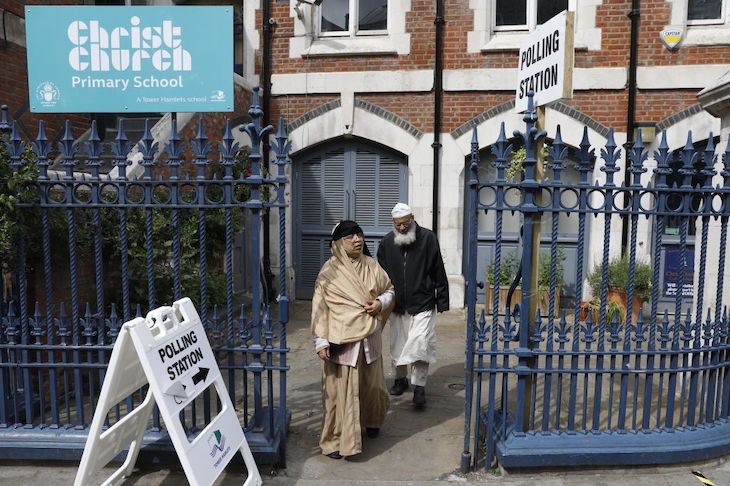
Labour today has a landslide majority. In theory, it need be beholden to no one. It needs no other parliamentary support to govern. But at the last election, the party lost four seats it would otherwise have won (Leicester South, Blackburn, Birmingham Perry Barr and Dewsbury and Batley) to so-called Gaza Independents.
Other seats showed that candidates running on their appeal to Muslims could secure enough votes to pose a real threat to Labour; constituencies such as Ilford North, where Wes Streeting only just held on by 528 votes; Bethnal Green, where Rushanara Ali clung on narrowly; or Birmingham Yardley, where Jess Phillips scraped home by 693 votes.
Labour MPs had a fit over their well-founded fear that this was just the beginning. To see the potential scale of this development, consider that there are 37 constituencies with a Muslim population over 20 per cent, and in a further 73 seats the Muslim population is between 10 and 20 per cent. Labour’s vote fell by over 14 per cent at the 2024 election from 2019 in those constituencies where the Muslim population was above 15 per cent.
Since those four seats were won, Labour has reshaped its entire Middle East policy in an obvious bid to stave off further losses to sectarian Muslim voting, from recognising a Palestinian state to imposing sanctions on Israel.
This is already a considerable victory for the influence of sectarian Muslim politics. But it is merely the start of what those behind the candidates intend.
That is not my assertion but the public statement of the umbrella group focused on a Muslim political agenda: The Muslim Vote, formed by 24 activist groups to promote selected candidates. It has a series of policy pledges such as targeting the police, demanding that their “structural and institutional Islamophobia” is addressed, along with increasing “cultural sensitivity across the justice system, including through mandatory unconscious bias training”. It wants Ofcom’s rules on extremism to be reformed, and for all public sector pension pots to include a proportion of “sharia-compliant investments and fund managers”.
Its website shows many other aims, such as rejecting the recommendations of the Shawcross Review of Prevent. The People’s Review of Prevent, whose recommendations the Muslim Vote wants to implement, is, in reality, a statement by Dr Layla Aitlhadj, a director and case worker at advocacy group Prevent Watch, and Professor John Holmwood, who campaigns against Prevent.
Under First Past The Post (FPTP) this new sectarian Muslim politics is already increasingly influential. But in a PR system, where The Muslim Vote will move from being the name of a lobbying organisation to a real bloc, there will be something close to guaranteed parliamentary representation for sectarian Muslim politics – and a strong likelihood that the bloc would be part of any governing left coalition.
PR seems, superficially, fairer than FPTP. In reality, it hands power to fringe parties and makes it near-impossible for centrist blocs to govern on their own. If Britain moves to PR, we can look forward to the advocates of Sharia law and other sectarian forms of Muslim politics taking a permanent place on government.






Comments