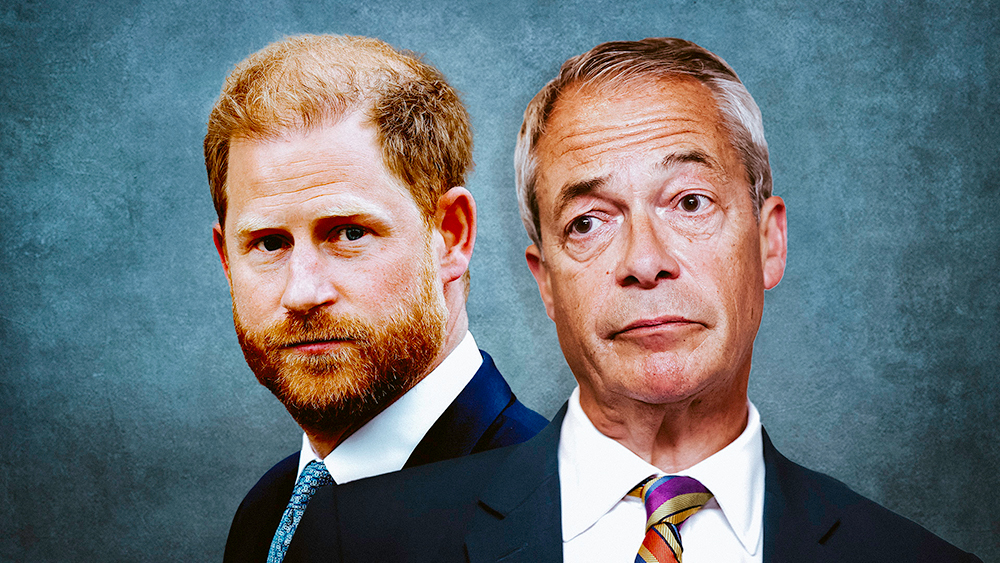
At about 2 p.m. on Tuesday, two cases with a common characteristic coincided. One was Nigel Farage’s long statement about why he would resign his seat to fight a by-election. The other was the defeat of the privacy action against the Daily Mail brought by Prince Harry and others. The link is not in content, but in attitude. In both cases, the main actors in the drama are paranoid and solipsistic. Mr Farage, trying to deflect questions about the men who give him money, spoke for about 20 minutes of the wrongs done him by the ‘Establishment’ and the media. He was particularly worked up about his security. The Prince’s case was that he had been intruded upon by dark and powerful media forces. It was all mixed up with his resentments against his father the King and his courtiers. He too is obsessed with his security. Both politician and prince felt the need to inflict their anger upon a wider public – Mr Farage by seeking unnecessary re-endorsement by the voters of Clacton, the Duke of Sussex by exhaustively litigating what was not, as the judge decided, a matter of law. Both men preferred emotion to evidence. Both sought the spotlight on the big day: Mr Farage by his declaration and Prince Harry by his botched attempt to get a berth in Buckingham Palace while in town. If the King had granted his son’s wish, the Prince might then have gained, conceivably in front of the palace gates, a stage set from which to reignite his stuttering insurgency. The Prince has now decisively failed. I suspect the politician will fail too. Many sympathise with Prince Harry over the fundamental sadness of his life. Many agree with Mr Farage’s bold attacks on the failures of successive Conservative and Labour governments. But most are also tired of men whose self-centredness hogs the public space.
One must hope that Andy Burnham, previously sympathetic to the litigious celebrities, is feeling a bit hacked off with Hacked Off.
Reform’s strange offer to pay for the Clacton by-election shows the stirrings of a guilty conscience. If the party really thought the escapade was in the public interest, why would it do that? On the other hand, I hope the government does not exercise its technically valid power of refusing Mr Farage’s application for stewardship of the Manor of Northstead. The histories of Wilkes, Bradlaugh and Tony Benn suggest it is unwise to try to keep duly elected people out. It would be equally unwise to insist on keeping them in.
My generation, born in the late 1950s, now begins to remember the famous words of Psalm 90: ‘The days of our years are threescore years and ten.’ Last week, 150 of us were privileged to attend an extraordinary party. It was given by James Stourton, distinguished author, former chairman of Sotheby’s and 6ft 8in in height. When I met him in his first year at Cambridge 50 years ago, he had contrived to occupy a don’s set and to have printed on his own press a beautiful anthology called A Watch of Nightingales. James, now 70, celebrated by giving us dinner at Syon which, though in west London, remains a country house surrounded by 200 acres, and by completing and printing his own memoir, The Nursery Screen. It includes an astonishingly powerful, though not bitter, account of his battles with his snobbish, alcoholic parents who tried to force him into the army and deprive him of inheritances. James is someone who, in current parlance, ‘curates’ his own life. But the birthday dinner had none of the complacency that can mar such events, because of two additional features. The first was that James has just married Dr Verity Mackenzie, a Cambridge art historian 30 years his junior. The second is that earlier this year he contracted a rare blood cancer, with what he calls a ‘not terribly thrilling life expectancy’. Verity nobly shares his isolation in Guy’s Hospital for the course of his chemotherapy. Their wedding took place there. James says she gives him the greatest happiness of his life. It had been doubtful whether they could attend their own party, but they did, sitting together and, to avoid infection, not moving among the guests. James was too weak to speak, so his words were read out by his cousin Edward, the broadcaster. Nicholas Coleridge was called best man. As dinner finished, James made to leave, leaning on Verity. The great doors of Syon’s hall were thrown open and suddenly a rushing mighty wind dispersed the stuffiness of the heatwave. We cheered as the couple, silhouetted against the last rays of day, waved and went off into the sunset. The moment was filmic: I imagined the words ‘THE END’ projected on to the walls. Yet not the end: we saw confirmed, in ‘real time’, the old message that while there is life, there is hope.
When the Blair government inaugurated the 21st century by expelling most hereditary peers from the House of Lords, Lord Salisbury, leader of the Tory peers, kindly gave a ‘wake’ for them and made space at Hatfield for the commemorative planting of a ‘Wake Wood’. Now that the previously ‘exempted’ minority of hereditaries has been ejected by Sir Keir Starmer, the same Salisbury gave them a farewell lunch, joined by friendly life peers of all parties and none, on Monday. It was symbolically appropriate that the house, currently being used as a filmset for a drama in which Hatfield plays the Cecilienhof at the Potsdam Conference of 1945, had a Soviet flag waving over us as we entered. The only Labour peer present was the magnificent Lord Glasman, whose ‘Blue Labour’ ideology puts him firmly to the right of everyone else present. Lord Salisbury quoted Burke on the contract between the dead, the living and the unborn. Lord True, current leader of the Tory peers, presented him with a single commemorative oak. This Quercus robur should outlast the levelling spirit of the age.




Comments