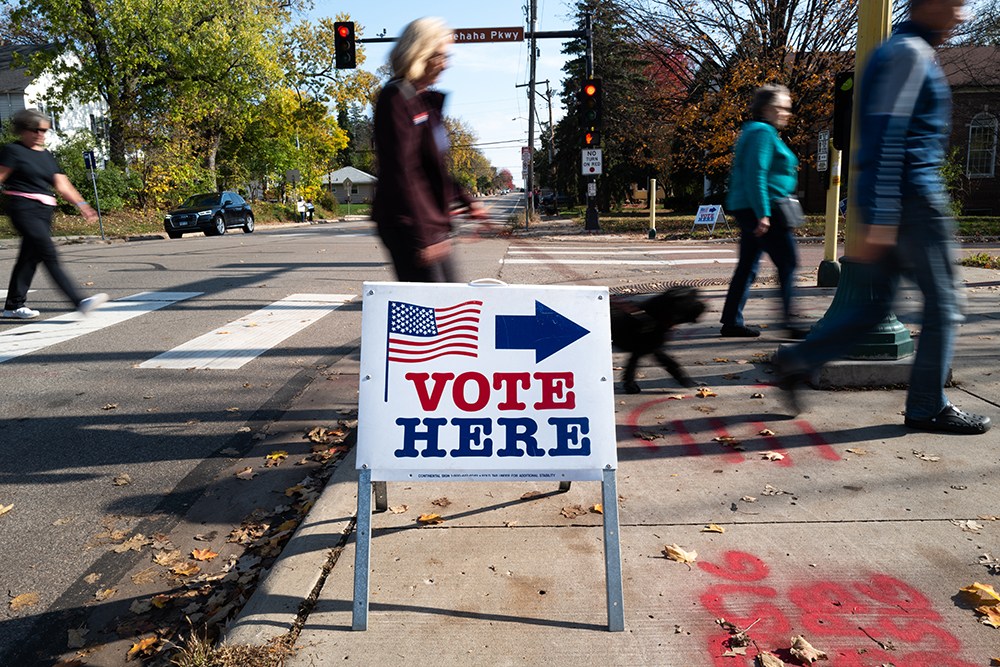

In the fall of 2017, Virginia was going through its quadrennial tradition of giving the nation an electoral check-in on the president by holding an off-year gubernatorial election. The nation’s mood was, to say the least, heated.
Four months earlier, at a baseball field in Alexandria, a radicalized and mentally imbalanced left-wing activist had nearly killed House whip Steve Scalise and three others in a shooting. So it was with some recklessness that Latino Victory Project, in an ad supporting Democrat Ralph Northam, ran with the message that his Republican opponent Ed Gillespie (a moderate) wanted to hunt and murder brown children. The group’s “American Nightmare” ad featured a white man in a heavy-duty pickup sporting a Gillespie bumper sticker and Confederate flag chasing down and (it implied) running over four children, then labeling the lurid scene as “Ed Gillespie’s American Dream.” Northam went on to win by nine points and have a four-year term of office that was interesting, to say the least.
So it’s hardly correct to say that Vivek Ramaswamy’s recent ad targeting Amy Acton in the Ohio gubernatorial race is a particularly egregious low point of American politics. The Trump era has been, virtually since its inception, an age of political aggression and ugliness and will continue as such – largely because all sides are content to keep it that way.
Ramaswamy had little reason to retract or apologize for the ad,no matter how clumsy it was
The details of Ramaswamy’s ad have already been hashed out at length. In the video, Donna Arthur, Acton’s estranged mother, called her daughter a liar, disputed stories that she briefly lived in a tent as a child and said she needs to get help. Sadly for Ramaswamy, Arthur turned out to be a far more credible villain than her daughter. Acton said her mother protected a sexually abusive stepfather and her brother backed up that claim, as did contemporary legal proceedings and her stepfather’s decision to flee the state to escape justice. Is the ad ugly because it involves Acton’s mother? No. It is ugly because its core story comes from someone who is completely discredited – and would be just as ugly if the attack came from anyone else following the same fact pattern.
It’s not as if the Ramaswamy campaign lacked other crude ways to attack Acton, including via her private life. In 2019, she had a domestic argument with her husband that was so serious it prompted police intervention. Former staffers have said she has severe mood swings and would sob in the bathroom at the prospect of simply speaking to the legislature. She went missing from daily Covid meetings during the pandemic and reportedly had to be coaxed out of lying in the fetal position on the floor to attend one of them. It is not promising for Dr. Acton that even her own campaign website displays a press release noting that she was “huddled on a hallway floor before an emergency meeting, [not] during the meeting.”
But with the race a dead heat, Ramaswamy’s team apparently couldn’t resist going for a dramatic attack. To paraphrase Talleyrand, Napoleon’s infamous foreign minister – and a cannier operator than any current Republican – Ramaswamy’s ad was worse than offensive: it was a blunder.
Yet Ramaswamy had little reason to retract or apologize for the ad, no matter how clumsy it was. The bolt has been fired, the bomb detonated, the attack made; to repudiate would mean meekly accepting that it was beyond the pale and taking all the backlash on the chin. An apology wouldn’t win him charity from Democrats. It wouldn’t win him admiration from Republicans. And it wouldn’t bring him absolution from the press. It would merely be decent, and decency has a perilously thin constituency in a sharply polarized year such as this.
The Trump era holds no rewards for such self-accountability. “Never apologize and never back down” is political advice that has helped Donald Trump survive many political catastrophes. So, offensive or not, Ramaswamy’s, President Trump’s and Vice President Vance’s defense of the ad was emphatically the correct strategic play.
Accepted norms of decency – such as “don’t use your opponent’s estranged mother for an attack ad” – are for societies that have accepted norms at all; America increasingly resembles two parallel societies in perpetual conflict, both of which have developed their own justifications for behaving badly.
Half a century ago, the hard left might dismiss a general standard of politeness as a bourgeois sensibility. Today, basic manners are more likely to be mocked as vaguely racist. California’s state government, for instance, promotes an educational worksheet that characterizes valuing “politeness” over honesty as a form of white supremacy.
On the right, meanwhile, grassroots activists have developed a sadly justified suspicion that politicians who emphasize decency and readily apologize after controversies are political limp noodles, eager to fold on substance as well. And of course, partisans on both sides embrace the pragmatic opportunism that views any apology as an admission of weakness, which invites further attacks rather than reconciliation. So, sometime in the near future, a Democrat will attack an opponent through their family. Republicans will feign outrage, Democrats will stick together, and the cycle will continue. This is easy to predict, because the cycle has already started.
The Jerry Springer Show, that notorious pioneer in turning low-class family drama into trashy television, went off the air in July 2018. Its retirement was well-chosen, because the political trashiness of fall 2018 left Springer’s content in the dust, and not much has changed since then.
In 2018, not one, not two, not three, but six members of Arizona Representative Paul Gosar’s family were trotted out to star in an ad condemning their brother. Politico celebrated it as “2018’s most brutal campaign ad,” yet nothing of the ad’s substance was brutal at all. Gosar’s siblings simply whined that he didn’t care enough about healthcare, Social Security or the environment. If the same lines had been delivered by six random voters, it would have been a snoozefest. The only hook to the ad was that Democrat David Brill got the six Gosars to publicly embarrass their family in order to get at their brother.
The use of family members as political weapons transcends TV advertisements, though. Two months before the Gosar ad, Politico ran an article titled “Stephen Miller is an immigration hypocrite. I know because I’m his uncle.” The “hypocrisy” the article exposed was, unsurprisingly, nothing of the sort; the piece instead made the facile point that Miller’s great-grandfather was an immigrant. It called him a “hypocrite” for opposing immigration a century later. Much like with the Gosar ad, there was essentially no content to the article at all. The only justification for even publishing it was that one of Miller’s relatives was attacking him. The same theme was rehashed during Trump 2.0, when one of Miller’s cousins branded him the “face of evil” after Renee Nicole Good was shot in an ICE operation in January.
On it goes. It was insufficient to attack peripheral public figure Natalie Harp for being excessively (or creepily) devoted to the President. The Washington Post rolled out her brother for an article in which he said that he was estranged from his sister, that their dad had committed suicide and that he himself would like to die a violent death defending the Sandinista regime in Nicaragua. Mary Trump, the President’s niece, has built an entire second career out of being the Donald’s closest family member who publicly hates him. Besides being the person who allegedly leaked his tax returns to the New York Times, Mary has converted that proximity into three books and continues to go on whatever show or podcast will give her a platform to dump on her uncle. Last month, she was on The Rest is Politics speculating that Trump’s jokes about the physique of Ohio Senator Jon Husted prove that the President has dementia.
The Kennedy clan, being famous and theatrically inclined already, has in recent years supplied extra spice by expelling Robert F. Kennedy Jr. from the family for aligning with Trumpworld. RFK Jr.’s cousin Caroline labeled him a “predator” and dredged up a claim he used to put mice into a blender, then feed the resulting mush to his pet hawks. That was a bid to scuttle his nomination to run the Department of Health and Human Services.
There is now even more enthusiasm for simply refusing all contact with wrong-thinking relatives
For good measure, Caroline said her “Uncle Teddy” would be “disgusted” with his nephew, making it plain that Robert’s political crimes far exceeded a petty misdemeanor like Uncle Teddy’s negligent homicide. In a polarized and hyperpolitical America, ideological offenses carry more weight than personal ones.
This is the world that created Ramaswamy’s ad. It is remarkable because Vivek’s effort was an inept stunt that hurt him more than his opponent – but by now family is well-established as fair game and the public seems to relish the drama. The only way to escape the cycle would be to rebuild, and enforce, a norm that family should be a private matter and above politics. But that view is in retreat everywhere. Liberals lecturing their backward family members over turkey is an annual tradition. And now there is even more enthusiasm for simply refusing all contact with wrong-thinking relatives.
Last year, New York magazine’s Sarah Jones argued: “It’s okay to go no contact with your MAGA relatives.”
She wrote: “Sometimes the act of knowing a person leaves you with no choice but to move on without them. If my parents liked Alligator Alcatraz, I’d no longer speak to them. If they were rude to my LGBT friends, I’d block their numbers. Though shunning won’t work as a political strategy, there are still natural consequences for the way we speak and behave. It’s good, actually, to have values and draw lines accordingly.”
Nearly half of American liberals say they’ve ended a friendship, broken off a relationship or terminated contact with a family member over politics. A quarter of conservatives have done the same. If Americans see politics as transcending the bonds of family, why would they expect family ties to win out? Blood is thicker than water. But these days it isn’t thick enough to withstand hostile politics.




Comments