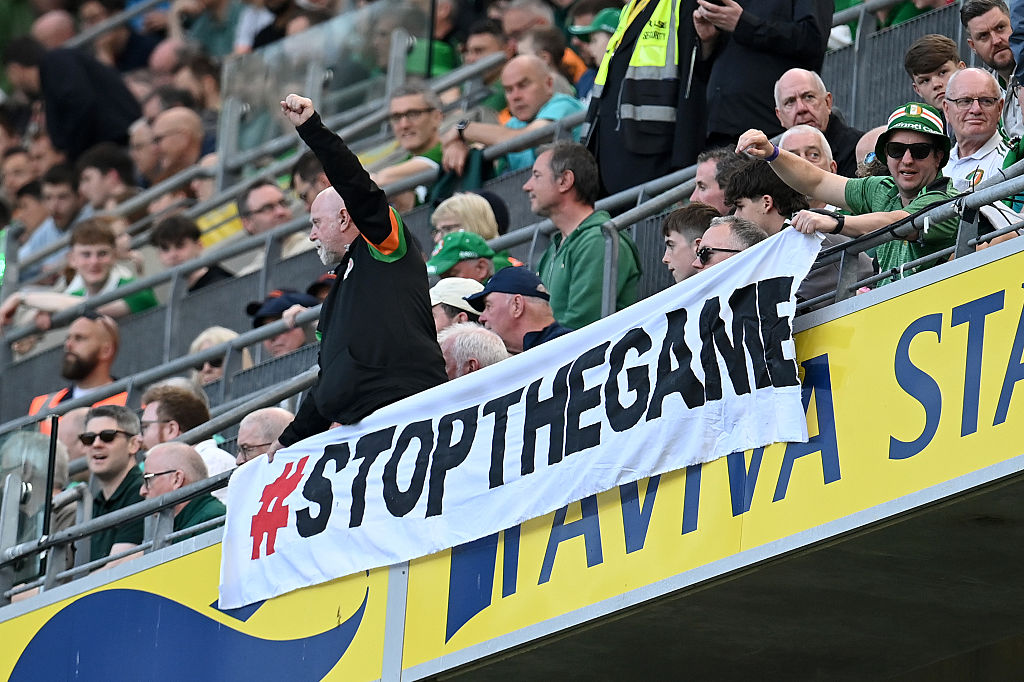
After their spectacular own goal over Eurovision, surely sulking Irish activists would think twice before launching yet another attempt to exclude Israel from apolitical spaces? Irish politicians and broadcasters boycotted the contest last month over Israel’s participation – only for the public vote to propel the Jewish state into a very respectable second place.
The message beaming back to Dublin was unequivocal: fans of the world’s largest (and loopiest) music competition weren’t interested in importing anti-Israel animus into the ditzy absurdity of Eurovision.
When it comes to Ireland’s near-hysterical obsession with ostracising Israel no platform is considered off limits
Yet here we go, here we go, here we go again. Ireland is attempting another act of exclusion, this time through football. Sinn Féin and the Social Democrats are pressuring the government to cancel the Republic’s upcoming Uefa Nations League fixture against Israel in Dublin this September. Sinn Féin will table a motion today, with the Social Democrats following on Wednesday.
Obviously, when it comes to Ireland’s near-hysterical obsession with ostracising Israel no platform is considered off limits. And this is why the boycott is absurd: international sport, like music, is supposed to exist outside day-to-day geopolitics.
Athletes may represent their countries but they are not proxies for government decision making. If every fixture becomes a referendum of foreign policy then sport loses its purpose. Both Fifa and Uefa take the formal position that football should not be used as a vehicle for political disputes between states (even if in practice that line can become blurred).
Football in particular has historically been regarded as one of the few spaces where rival nations can meet peacefully. This is perhaps best symbolised in the Christmas truce of 1914 during which soldiers from both sides had spontaneous kickabouts in no man’s land.
Anyway, what do sporting boycotts actually achieve, other than punishing players and supporters while allowing politicians to virtue-signal from the touchline.
Sinn Fein and the Social Democrats surely know this. But such is the fanaticism of anti-Israel sentiment within sections of Irish political activism that it defies rational debate. Israel must be excluded. Gesture politics and geopolitics are one and the same.
What disturbs even more is that attempting to ban Israel from participating in international football goes far beyond legitimate criticism of Benjamin Netanyahu or the country’s government. It hints at something much darker. Earlier this year, Ireland’s tiny Jewish community reported 143 anti-Semitic incidents – ranging from verbal abuse and threats to vandalism and digital hate – had occurred within just a six-month period.
Irish politicians of course insist anti-Israel hostility is not anti-Semitic. But repeatedly deploying inflammatory and often baseless accusations against Israel while barely acknowledging the atrocities committed against the country on October 7 inevitably fuels the anti-Jewish hatred now spreading across parts of Ireland and Britain alike. Meanwhile barely any acknowledgement is made of Israel’s precarious security. In Irish political discourse the sympathy is entirely one-sided
Last year, for example, then-presidential candidate Catherine Connolly said, ‘What happened on October 7, I’m on record for condemning, but history did not start on October 7’ and described Hamas as ‘part of the fabric of the Palestinian people.’
The great irony is that Ireland in many respects, should recognise something of itself in Israel. Both nations emerged after railing against British rule, creating their own identities as they fought for self-determination. Indeed early Zionists openly admired aspects of Irish nationalism, and the ideological blueprint that later shaped Israel’s Likud movement is partly influenced by Irish republicanism.
Yet modern Irish nationalism increasingly views Israel not as a successful post-colonial state, but as a stand-in for Britain itself. The Jewish state is an occupier, an oppressor and so symbolises all of Ireland’s grievances.
It is, of course, a warped and deliberately myopic view. Israel is the Middle East’s only liberal democracy. In shaking off colonialism the country has emerged as a thriving, multicultural society that protects free speech, women’s and LGBT rights. All while consistently fighting enemies dedicated to its destruction. Something the Republic should surely admire.
None of this, however, matters. The detestation among Irish nationalists has become so entrenched that attempts are made to shatter even symbolic links. Last year there were calls to rename a Dublin park dedicated to Chaim Herzog, the Irish-born sixth president of Israel.
Criticising Israeli policy is, of course, entirely legitimate, as it is of any government. At present opinion is divided, even among Israel’s allies, over aspects of its military conflict with Iran.
But attempting to exclude Israel from international sporting or cultural life – be it through a song contest or a football match – does not fall within this remit. Instead it is performative ostracism toward the Jewish state and loathing of all it represents.
Let’s hope when it comes to the vote, good sporting sense gives the laughable grandstanding of Sinn Fein and the Social Democrats the kicking it deserves.




Comments