
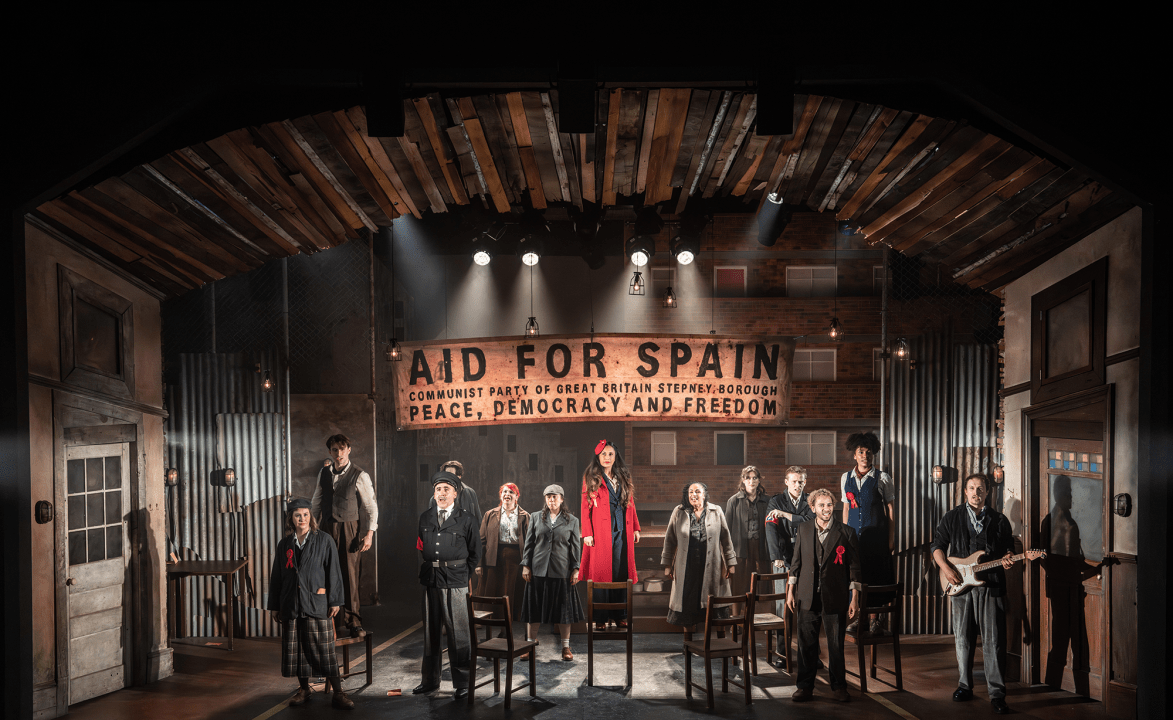
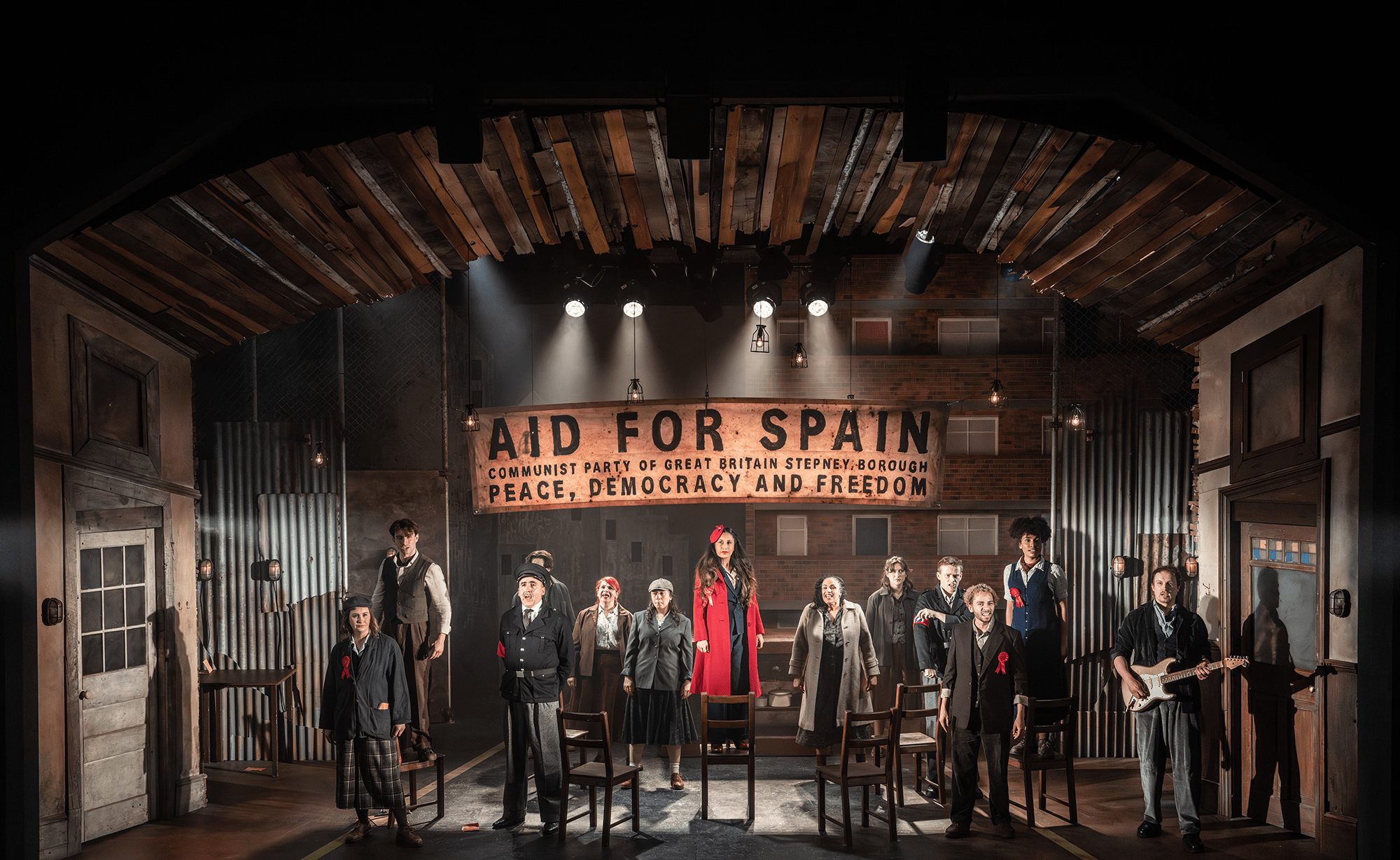
Cable Street is a musical that premièred last year at the Southwark Playhouse and has now migrated to the Marylebone Theatre. Fans of beautiful staging will be instantly smitten by the amazing achievement of the designer, Yoav Segal.
The script by Tim Gilvin and Adam Kanefsky tells the story of a violent stand-off in October 1936 between cockney activists and Oswald Mosley’s British Union of Fascists.
The authors treat the East End during the depression as a panto or a moral fairy tale. It’s good vs evil. The socialists are hard-working, golden-hearted heroes who rise up against the wicked landlords and their cruel rent hikes. The fascists are angry, misshapen losers led by a waddling baldie in a stick-on moustache. The socioeconomic background is hard to decipher. Rents in London are soaring and the population is growing and yet wages are falling and job opportunities are drying up. It’s difficult to see why newcomers would choose to enter this economic quagmire and cause rental values to climb.
The show opens in the present day with a group of tourists being led around Cable Street by an elderly historian. After a quick change of costume, the 13 performers reappear as cockneys in the 1930s. Each actor plays several roles which blurs the focus. We meet two large families, one Jewish, one Irish, who support the left-wing cause. Sammy is a charming young Jew who falls in love with an equally charming Irish poetess name Mairead. Both are on the same side politically which reduces the scope for conflict in their predictable, sparkless romance.
Their young neighbour, Ron, is an angry, unemployed misfit who joins Mosley’s black shirts in despair. His personal problems are presented as the cause of his far-right delusions. He’s poor, talentless and ill-educated, and he lacks the emotional support of family members apart from his wretched mother who drinks gin all day. Both Ron and his mum speak with Yorkshire accents, even though they live in the East End. This odd detail appears to suggest that northerners are proto-Nazis.
The script wants to recount every aspect of the story including the Spanish Civil War whose emissaries use the battle of Cable Street as an opportunity to sign up foot soldiers for the conflict against Franco. The writers’ desire for completeness leaves very little room for the three central characters to develop. We just don’t know enough about them.
Sammy is energetic and rebellious. That’s all. Ron is a scowling cyber-fascist. Mairead is too self-righteous to be lovable. Her poetry attracts the interest of an American talent scout who offers her a job on the New Yorker, and she faces a life-changing decision. Become a literary sensation in America or stay in the East End slums and shriek through a megaphone about violence and anarchy. Her choice is the only surprise in the show.
Ron (played by Barney Wilkinson) withers into despair and contemplates killing himself by leaping from a rooftop where he delivers an amazing aria. Wilkinson’s voice is a revelation. The equally gifted Preeya Kalidas (who plays Elizabeth and Edie) doesn’t get the exposure that her talent merits. The pair might have been given a duet.
Ultimately the show feels like a government pamphlet urging Britain to embrace sweetness, harmony and inter-racial co-operation. What a marvellous idea. You’ll find plenty of people who reject this cosy message if you visit the East End today. Cable Street is an ultra-conservative show that wants to preserve a false and reassuring picture of the past.
Mrs President is a brave attempt to tell the story of Lincoln’s widow through her relationship with a photographer, Matthew Brady. In real life, Mrs Lincoln was known to be an emotionally unstable spendthrift but this show simplifies her story and sanitises her reputation. She’s presented as a misunderstood victim whose only crime is to care too much about her dead husband and her four children.
The photographer (played by Hal Fowler) comes across as a mischievous poser who wants to forge America’s identity using ‘my soul’. He means ‘my camera’. The script focuses on Mrs Lincoln’s sentimental response to her life in the public eye and Keala Settle’s performance reinforces her impulsive, brattish character. After her husband’s death, Mrs Lincoln spends five minutes screaming like a chainsaw in Brady’s studio. Director Bronagh Lagan evidently believes that fine acting means maximum vocal amplification. Keep your ear plugs handy. In the subsequent scenes, Mrs Lincoln appears in court wearing a straitjacket fashioned from her black mourning frock. This is a marvellous piece of costume design but it doesn’t make sense to the viewer. Is Mrs Lincoln a certified lunatic or a dignified widow? The script shies away from such indelicate questions and the costume cleverly maintains that ambiguity. Despite its faults, this 90-minute show was received rapturously by the audience.





Comments