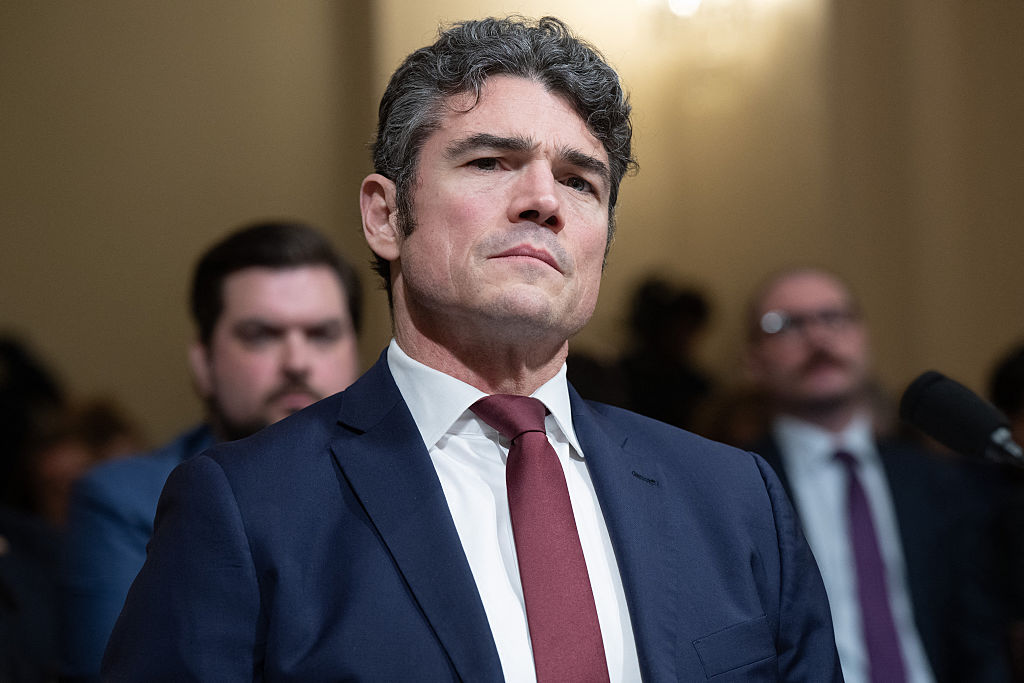
Reflecting on the resignation of Cyrus Vance, James Thomson, the American historian and journalist, wrote in the Washington Post that the former secretary of state “has done us all a great public service.” In doing so, Thomson argued, Vance gave “new life and spine to a somewhat rare and weak convention in our nation: resignation in protest of an issue of principle.”
The year was 1980. Vance had resigned in protest over the Carter administration’s decision to authorize Operation Eagle Claw, the ill-fated mission to rescue American hostages held in Iran after the Islamic revolution. The mission ended ignominiously. President Carter pulled the plug after equipment failures and a deadly helicopter collision killed eight service members. Vance was vindicated.
Like Cy Vance’s resignation in 1980, Joe Kent’s high-profile departure may come to signify more than a break in principle. More pointedly, it may mark the moment when internal dissent collided with an escalating war. Politically, it may symbolize a moment of reckoning for the Republican Party and accelerate the fight over “America First.”
The failed rescue mission in Iran did not single-handedly end Jimmy Carter’s presidency but it was totemic of perceived political weakness. The incident crystallized public perception that the president had lost control of inflation, the economy, and the Iran hostage crisis.
A plausible parallel exists for the current Trump administration. A partisan war in Iran that produces a butcher’s bill of American casualties, higher costs from the gas pump to the grocery store and escalation rather than victory would be a political disaster. It could wreck Republican hopes in the midterms and turn Trump into a lame duck. Democrats will be quick to revive impeachment efforts while would-be Republican successors will position themselves for a post-Trump future.

Kent may have cast his lot on precisely this scenario. In this rendering, his resignation is not simply a matter of conscience. Rather, for the two-time congressional candidate, it is also an act of political positioning. When the reckoning comes, voters and elites will distinguish between those who embraced the war and those who refused.
One can imagine several scenarios, none mutually exclusive, that prompted his resignation. First, he may have resigned from conscience. He simply could not abide escalation in the war that would needlessly risk the life and limb of American service members. As he wrote in no uncertain terms: “I cannot support sending the next generation off to fight and die in a war that serves no benefit to the American people nor justifies the cost of American lives.”
Second, he could not stomach the expectation that his boss, Director of National Intelligence Tulsi Gabbard, make the case that Iran posed an imminent threat to the United States. Kent’s resignation letter makes his opposition to that point unambiguous. For her part, Gabbard explained at Wednesday’s hearing: “The IC assesses that Iran has previously demonstrated space launch and other technology it could use to begin to develop a militarily viable ICBM before 2035, should Tehran attempt to pursue that capability.” By her own account, the threat was not imminent but deferred by nearly a decade.
Third, he perceives a public break from Trump on this war, arguably the defining act of this still-young administration, as politically prescient. There will be a Republican Party after Donald Trump and Kent has drawn his line in the sand. Here, his account is revealing. Kent touched the third rail in American politics when he claimed “It is clear that we started this war due to pressure from Israel and its powerful American lobby.” To tell the story of the Iran war without mentioning our co-combatant would be an exercise in invention. But whatever one makes of his account of Israeli pressure, it does not alter the decisive fact of executive agency. No foreign government can compel an American president to launch a US military operation. Trump is the decider, to borrow the Bush-era aphorism. The choice was his, the buck stops there, and he owns responsibility for the war’s success or failure.
This makes Kent’s resignation politically significant. He would not have left his position if he thought the president was close to declaring victory and winding things down. Thus, he did more than dissent. He exited the administration to distance himself from what comes next.
Within hours of his resignation, Kent was reportedly set to appear in both Tucker Carlson’s orbit and on Mark Levin’s show. For the online right, these broadcasts represent the magnetic poles of the contemporary conservative ecosystem. Their audiences may not agree but they recognize the stakes. A dividing line is emerging on the American right between those who wanted this war and are willing to own it and those who warned against it. Kent appears determined to be counted squarely among the latter.



Comments