Labour is moving closer to Europe, at speed – except for one significant topic where it could really learn something from our Continental partners: the ever-thorny subject of how to do counter-extremism. There, the pace of convergence between Britain and the EU is glacial, at best.
The current Government’s approach towards political Islamism is not just light years removed from that of the Trump Administration, which has designated select chapters of the Muslim Brotherhood as terrorist organisations; it is also far less robust than the postures adopted by many distinctly un-Trumpian EU member states.
Britain’s security establishment has effectively decided that non-violent Islamism is not their problem
Both the political classes and the permanent security systems of many Continental countries now treat political Islamists as adversaries to be called out and confronted, both ideologically and at law.
Thus, Sinan Selen – the Istanbul-born Director-General of the Bundesamt für Verfassungsschutz (BfV, the Federal Office for the Protection of the Constitution, Germany’s equivalent of MI5) – recently addressed a private breakfast in the Bundestag.
Referring specifically to the Muslim Brotherhood, he warned that Islamists were seeking deliberately to influence Germany’s political parties in order to change both society and the state. Such actors obey Germany’s laws, he cautioned – but only those they judge compatible with the Shari’a. Their long-term aim is the creation of an Islamic society.
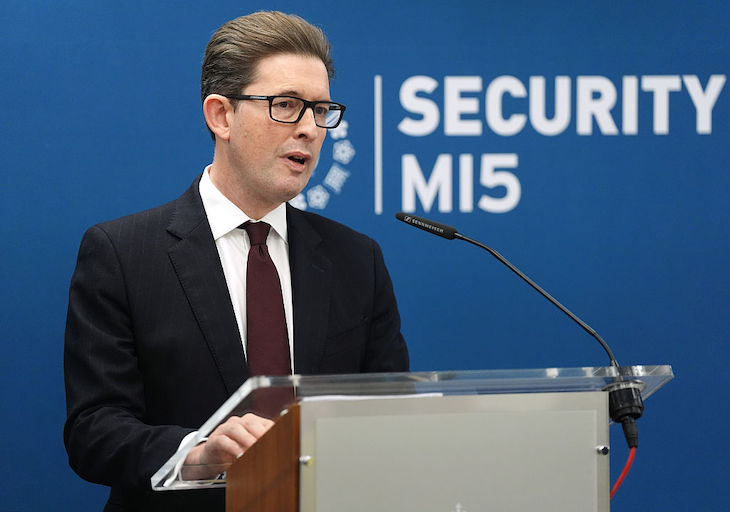
Variations of that analysis now issue routinely from interior ministries and intelligence agencies across the Continent. But can anyone imagine MI5’s Director General, Sir Ken McCallum – or any of his recent predecessors – making such a pronouncement about political Islamism per se?
Likewise, in France this week the Administrative Court in Nantes upheld the local Prefecture’s ban on the “Annual Meeting of the Muslims of Western France” – which the state deems to be part of the national branch of the Muslim Brotherhood. Again, can anyone imagine the mandarins within the Home Office’s Homeland Security Group even aspiring to do anything remotely like it?
Britain’s security establishment has effectively decided that non-violent Islamism is not their problem. MI5’s public account of its work is revealing: its counter-terrorism pages name Daesh and al-Qaeda but make no mention of the Muslim Brotherhood, nor indeed of non-violent Islamism tout court.
Sections of the security system regards non-violent Islamists as “credible” bulwarks against the violent Islamists of al Qaeda and Isis; the best-known public exponent of this view was Bob Lambert, previously a leading light of the Metropolitan Police’s old Muslim Contact Unit, who was admired in his heyday at the highest levels of Thames House. Certainly, engagement with those non-violent Islamists comes at a price – but many in the Deep State regard that as a price worth paying. In the words of one security official, they constitute a kind of “Islamic Sinn Fein”, who can then persuade the putative hard men and women of violent Islamism not to take a walk on the wild side.
The current crop of Labour ministers are scarcely Corbynites – indeed, the very reverse. But for that reason, they are not much inclined to challenge the long-standing pathologies of the permanent security system. And insofar as they do call out extremism, they are for the most part rather more at ease with addressing the iniquities of right-wing populism.
Thus, last September, the Prime Minister spoke of a “battle for the soul of the country” against Reform UK – condemning its “grievance politics”. Islamist grievance culture is, however, not addressed with anything like the same clarity.
Why can’t Thames House spare a few desk officers to address non-violent Islamist extremism?
Certainly, within Labour, there remains a now-diminished grouping which grasps that non-violent Islamism represents a real threat to liberal democracy. This might still be termed the McSweeney wing and its policy approach reached a high-water mark earlier this year, when the Government launched its new social cohesion and counter-extremism strategy Protecting What Matters: Towards a more confident, cohesive, and resilient United Kingdom.
This retained the previous Conservative government’s definition of extremism as put forward in 2024 during Michael Gove’s tenure at MHCLG (the Ministry of Housing, Communities and Local Government) – and promised that public bodies would not “confer legitimacy, funding or influence on extremist groups.”
It also did not shy away from using the word “Islamist,” though some of the language it employed was tortured. Islamism is described as “a predominant threat” – a curious formulation that edges towards saying “the predominant threat” without quite doing so.
Even so, the strategy made at least one important commitment. It promised “an annual State of Extremism report setting out the nature of the foreign and domestic extremist threat” – thus potentially bringing Britain into line with key Continental partners that already publish such documents.
Yet much of the Home Office machine appears, so far, to be in no hurry to implement this – partly because of what it deems to be a lack of resources, but also because of the lack of appetite for any legal risk in “naming and shaming”. All that is without taking into account the slow, asphyxiating effects of the Government’s new anti-Muslim hostility definition.
In consequence, there remains a very appreciable gap between the UK and many of its most important European allies:
- Austria’s Chancellery, through its in-house integration portfolio, backs a Documentation Centre for Political Islam – explicitly tasked with mapping these networks.
- Belgium’s VSSE state security service devotes pages of its annual report to the Brotherhood’s “attempts to exert covert influence on government policy”.
- Denmark’s approach to wider immigration and cohesion issues is much admired by the present Home Secretary. The official Centre for Terror Analysis (CTA) is a fusion centre comprising staff from four agencies – the Danish Security and Intelligence Service, or (PET), the Danish Defence Intelligence Service (DDIS), the Ministry of Foreign Affairs and the Emergency Management Agency. Its reports cover what it calls ‘Militant Islamism’ and includes a section on ‘Insults to Islam’ – namely the legacy of the Muhammad cartoons.
- France’s Interior Ministry produced a weighty report in May 2025 on the Muslim Brotherhood and political Islamism, and the National Assembly has since voted for the movement’s inclusion on the EU terror list. This flagged two Muslim Brotherhood-adjacent entities in the UK – the Muslim Association of Britain (MAB) and the Islamic Forum of Europe (IFE, now renamed the Muslim Community Association). But there appears to have been no official British response to this so far.
- Germany’s BfV publishes an annual estimate of Muslim Brotherhood adherents in the country. It classifies and monitors Muslim Brotherhood networks and other foreign Islamist influence structures – and treats them as long-term threats to the democratic constitutional order.
- The Netherlands’ AIVD intelligence agency stated Hamas (the Palestinian branch of the Muslim Brotherhood) was involved in organising protests against the war in Gaza, propaganda, and raising funds in Holland.
- Spain’s Annual Security Report 2025, approved by the National Security Council, notes some Islamist organisations have disseminated messages that justify the use of violence. It considered noteworthy two fatwas issued by the International Union of Muslim Scholars, perhaps the most influential Muslim Brotherhood organisation, which is hosted by Qatar.
- Sweden’s then Employment and Integration Minister Mats Persson responded to the French Interior Ministry report by pledging that the government would set up a commission to map “Islamist infiltration.” This is still going ahead.
It is now over twelve years since then-prime minister David Cameron commissioned two senior civil servants, the late Sir Charles Farr and Sir John Jenkins, to review the Muslim Brotherhood’s activities here and abroad – an exercise which was meant to seed lasting expertise within Government to address this challenge. It did not succeed in doing so. That report also recommended a fusion centre based on what is now the Danish model.
The pattern recently repeated itself on antisemitism
When the Government was asked earlier this year on the floor of the House of Lords why Britain had become “an outlier in not giving a proper analysis to the country of what threat this organisation constitutes,” the Home Office Minister Lord Hanson replied simply that “we are not an outlier”.
The pattern recently repeated itself on antisemitism. Pressed by me on the 2015 Farr-Jenkins finding that the Muslim Brotherhood is one of the largest drivers of antisemitism in this country, Hanson stated on the floor of the Upper House that it “undertakes activity that directs antisemitism” – and that this was “not acceptable.” He made a welcome pledge to report back further on this important pronouncement.
However, Hanson swiftly pulled back from this – and in his follow-up letter to me sought refuge in the formulation that the Government “does not routinely comment on specific groups”, though “if a group or individual is acting in the extremist space, action will be taken.” This was followed by the truism that “extremism drives antisemitism”. Extreme what? Extreme Mormons? Extreme Scientologists? Extreme Zoroastrian relatives of the late Freddie Mercury? Such vagueness does not bode well for any future State of Extremism report.
So between the distinct pathologies of the contemporary Labour party and the permanent State, non-violent Islamism tends to be lost in what one No. 10 insider terms “a valley of death” between MI5, the Home Office and the MHCLG – and a plethora of relevant “operationally independent” regulators such as Ofsted and Ofcom. Ministers are frequently told by Mandarins they cannot pre-empt the deliberations of these bodies, which then become part of what one Whitehall veteran called the “learned helplessness of the system”.
Where the State does act, it acts narrowly and on the cheap. For example, there is currently a dedicated police operation directed at Hamas in Britain; but despite the proscription of both the political and the armed wings of Hamas, this operation is accorded a low high priority – a casualty of the security establishment’s settled posture of dealing first with what then-MI5 Director General Jonathan Evans termed the “crocodiles closest to the boat” rather than more “upstream” ideological challenges.
Where the State does act, it acts narrowly and on the cheap
That instinct is understandable. Finite resources should go to the most immediate threats to life. But it is also a false economy. The surging attacks on Jews – as at Heaton Park, or in Golders Green – did not emerge from nowhere. They are the “downstream” consequence of an ideological climate that has been allowed to fester, in which the Muslim Brotherhood and, no less importantly in this country, its sub-Continental cognates incubate the antisemitism that later erupts into violence. To ignore the upstream generation of a threat because it is not yet lapping over the boat is to guarantee a steady supply of further crocodiles.
Nowhere is British timidity clearer than in the simple act of saying out loud who is not welcome. In Denmark, the immigration service publishes a list of overseas clerics banned from the country; fifteen names appear on it, two of them from the UK.
During the Home Secretaryship of Jacqui Smith in the Gordon Brown era, the Home Office named those excluded. However, the Home Office has published no such list since 2009 – for fear of legal challenge. Indeed, in 2014. a Coalition Home Office Minister confirmed to the Commons that the then government would not resume identifying those it had barred.
Why, a dozen years down the line, should the current crop of ministers have their options curtailed in the present very different set of circumstances – by a policy commitment made back in the lifetime of the Coalition?
There is a growing consciousness in Whitehall that sections of insurgent movements, such as the Taliban in Afghanistan, have “gone political”
This forms the background to today’s Oral Question in the Upper House from Lord Goodman of Wycombe – a significant voice in the debate – asking the Home Office whether it intends to identify any individuals, groups or organisations in the State of Extremism report it has promised.
Goodman contends that counter-extremism has thus long been the poor and unglamorous relation of counter-terrorism. After all, the Home Office’s Homeland Security Group employs well over a thousand people. Can it really be the case that this behemoth really has no capacity to address these issues? And if not, why not?
Indeed, why can’t Thames House, whose numbers have risen from under 2,000 officers during the Cold War to over 5,500 today, spare a few desk officers to address non-violent Islamist extremism – when in the pre-War, wartime and Cold War eras, tackling both non-violent fascism and non-violent communism (and other far left movements) were its stock-in-trade?
The subject is ripe for re-examination in the light of wider global developments. There is a growing consciousness in Whitehall that sections of insurgent movements, such as the Taliban in Afghanistan, have “gone political” in some measure, entering their respective governments; moreover, Afghanistan has a substantial diaspora community here.
So does the “inclusion-moderation” hypothesis apply to Islamists in the UKin this era – and at what price? The key conclusion of the Farr-Jenkins review was that engagement with political Islamists has been tried many times and has never worked; we do not shape their views – rather, they shape ours.
At last, a real debate about the future of conventional and nuclear defence is taking place in this country. It’s now high time we had one on non-violent threats within our borders as well.
Lord Godson is the Director of Policy Exchange. This is the first in a series he is writing for The Spectator on European approaches towards extremism and immigration



Comments