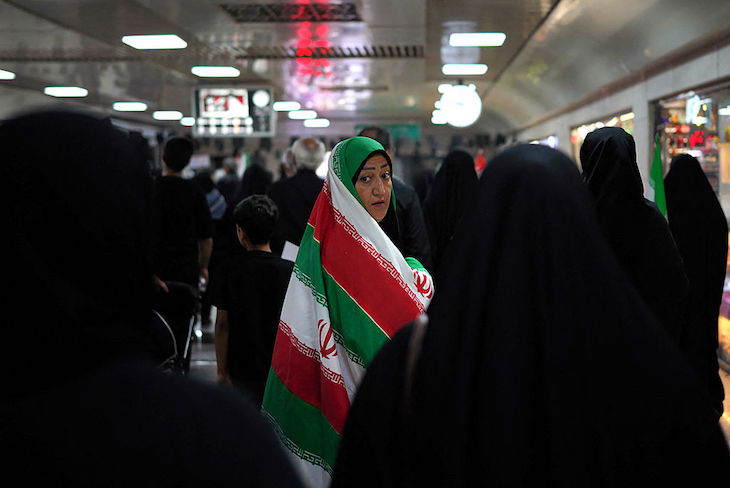
The Islamic Republic of Iran has made many concessions in its long decline. Until now, it stood firm on one rule: women must remain covered. The veil, it has insisted since the 1979 Revolution, was a divine instruction. But apparently divine instructions can lapse.
This summer, a young woman appeared at a pro-government rally in a pink top and acid-washed jeans, her hair loose on her shoulders. She addressed the camera while standing among a crowd of women veiled from head to toe. Rather remarkably, the footage went on state television. Five years ago, that footage would have been evidence for a prosecution. Now, it is propaganda.
The veil used to divide the pious from the impious. It now divides the loyal from the disloyal
At a similar gathering in Rasht, in the northeast of Iran, the Friday prayer leader Rasoul Fallahi said that unveiled women stood against “the system and the Qur’an,” and that their fathers and husbands were “dishonorable.” If the public chose to confront them, he said at that meeting in May, they would not dare to leave their homes again.
So does, or doesn’t, the regime, still demand that women wear the veil? There is a cold logic behind the apparent contradiction.
The women the regime has spent years punishing are now being enlisted as proof that the nation is united. Uncovered hair has been the clearest act of dissent in Iran for years. Rather than lose that argument, the regime has put it on television and called it patriotism. No other regime has co-opted its own opposition quite so shamelessly. The cynicism of it is almost impressive. Take off the scarf, then. Reject the dress code as much as you like, so long as you don’t reject the state.
The compulsory hijab was never solely a matter of piety. In 1936, Reza Shah’s police pulled veils off women in the street: it was modernity enforced with a truncheon. In 1979, the Islamic Republic made covering one’s hair compulsory in the name of God. The rule about woman’s hair was a loyalty test administered in public every day, at no cost to the state. What has changed is what the test sorts for. The veil used to divide the pious from the impious. It now divides the loyal from the disloyal. The same uncovered hair that may be seen as a provocation when on a street corner is an asset to the regime when it is on state television.
The clerics have been working hard to give reasons for the situation being acceptable. Asked whether unveiled women should be kept from rallies, Ayatollah Mohammad Javad Fazel Lankarani said that they should not. He argued that while the hijab remained a religious duty, it has become a second-tier question with the Islamic Republic in danger. So much for divine instruction.
The Supreme Leader’s representative in Kurdistan province put it more kindly, saying the government should not make “people already dealing with war also have to answer for their hijab.”
The Head of the Judiciary was not as kind, casting unveiled women as tools for foreign actors who are behind the country’s social ills. The offense used to be a sin, and a sin can be repented. It is now, in certain situations, a security matter, and there is no repenting your way out of one of those.
The Islamic Republic’s softening towards the veil may be tactical. It could simply be a brief suspension during the war, with the IRGC vans returning to public squares once the war is over. That is roughly what happened after 2022 and may be a tactic that the regime is replicating.
Most likely of all, however, enforcement simply fell apart under the weight of millions of brave women declining to comply, and the rallies are an attempt to dress that defeat as a decision. If a woman is going to walk through Tehran with her hair uncovered regardless of what the law says, better that she does it holding a flag. None of this is good news for the woman with the flag. There has been no improvement in the rights she has been afforded. Rather, she has been given permission, which can easily be withdrawn. What is allowed at the rally may soon not be tolerated in the café.
What is emerging in Iran is an Islamic Republic that is becoming less Islamic in appearance, yet more nationalist and authoritarian. The veil goes and the flag comes out. The clerics take a position at the back of the platform while the missiles move to the front. The theocracy seems to be dissolving into something no safer to live in. The clerical state at least had the decency of a rule you could see and break. A woman may now walk down Valiasr street with her hair uncovered, not knowing what interpretation of the law will decide her fate. Iran’s theocracy has mislaid its theology, but kept its cruelty.



Comments