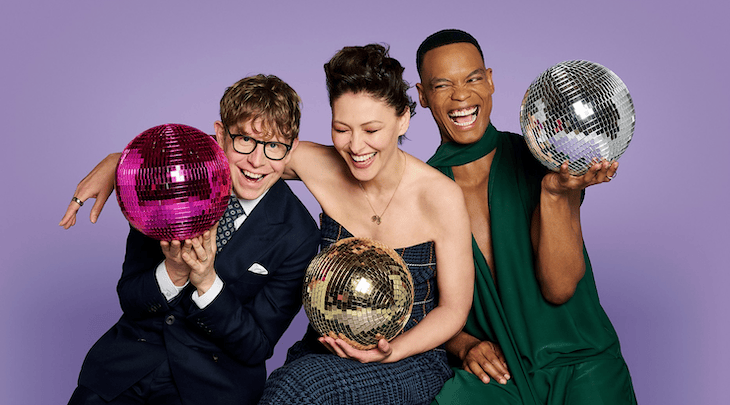
What did the BBC think would happen if its all-conquering Strictly Come Dancing show recruited ‘stars’ no one had heard of, shunned the elements that made it entertaining and replaced its popular presenters with a gormless trio that appears to have been picked by a HR diversity committee?
Corporation bosses ought to be asking themselves this question in their post-mortem of the current car-wreck season of the celebrity dance competition. Clearly, they’re not, given their apparent vexation over viewer dissatisfaction and mediocre ratings.
The Saturday night entertainment show has kept millions of licence fee payers on board for two decades. It’s now speeding its own demise with woke casting and a stultifying fear of causing offence
The Saturday night entertainment show has kept millions of licence fee payers on board for two decades. It’s now speeding its own demise with woke casting and a stultifying fear of causing offence.
Dim but highly-paid execs are said to be ‘bereft’ that their cherished ‘Premier League product’ is now operating at a ‘League One standard’. It’s the substitutions, stupid!
When the deft presenting duo of Claudia Winkleman and Tess Daly quit last year, producers replaced them with profiles they thought we needed to see on our screens. TV presenter Emma Willis, a woman: tick. Johannes Radebe, a gay, black man: two ticks. Josh Widdicombe, a straight, white bloke: a necessary evil.
Good chemistry and charisma were deemed superfluous. Actually, Josh Widdicombe isn’t necessary at all. Small and bespectacled, he appears lost. He might have wandered in from the set of a Harry Potter film.
Johannes, a personable ex-Strictly professional, is very camp, darlink! In case you miss that, he dresses like a 50-year-old aunt at a wedding. Emma has wisely lowered the decibels following the frenetic series opener. Her voice still sounds like nails on a blackboard.
The trio’s attempts at bonhomie make you wince. Their hopelessness is cruelly emphasised in the sign-off routine when they declare: ‘Keep on dancing!’ while assuming an awkward dancefloor throuple. This throuple was never meant to be.

They should have picked Zoe Ball as the main presenter, with Johannes twirling in front of the judges’ bench. Ball is a personable, articulate and talented broadcaster. But diversity apparatchiks probably dismissed her as too middle class.
It doesn’t help that this season’s ‘stars’, including a dog-trainer and a celebrity hairstylist, might be the weakest list of D-listers the show has ever seen. No one was expecting Tom Cruise or Nicole Kidman, but they might have at least hoped for a few celebrities they’d heard of.
Add the tacit ban on poking fun at participants, and you have a ratings disaster. Much of Strictly’s appeal came from the car-wreck performances as well as the bravura ones. Spectacles such as the late Ann Widdecombe being dragged around the dance floor like a sack of potatoes by Anton Du Beke, and the judges’ amiably cruel reactions, provided the highlight reel.
But teasing is frowned upon these days. It might trigger someone, you see. Producers prefer mawkish love-ins. There are lots of “I love yous” to fellow contestants known for just a few weeks. Supportive environments are nice, but Strictly is starting to feel a bit nauseating.
At its peak, the show had two of the four judges – Craig Revel Horwood and Bruno Tonioli – who’d punish a flaccid paso doble with an acid put-down. Of the current bench, only Revel Horwood calls a spade a spade, and even he seems to have been told to go easy.
The BBC appears unaware that we’re past peak woke, and that the public is bored of lectures – especially from broadcast execs whose opulent salaries it funds. The producers, cushioned in their showbiz bubble, have no idea what much of the country thinks of diversity and inclusion.
The programme’s positive influence was obvious in the Winkleman-Daly double act. Replacing the trad TV presenting combo of a hoary old man and a deferential dolly bird with two women broke new ground.
The show has also done wonders for promoting disabled people. But whether it was placing Claudia Winkleman in a man’s role or allowing Hamza Yassin and Rose Ayling-Ellis to show us their dancing skills, the show worked because these people were talented, not because they were female, black or hearing-impaired per se.
Unfortunately, the country’s biggest prime-time show is, like the BBC itself, taking its audience for granted. Viewers want fun, not re-education. Strictly used to provide it. Now it’s the butt of jokes, and no one’s laughing anymore.



Comments