
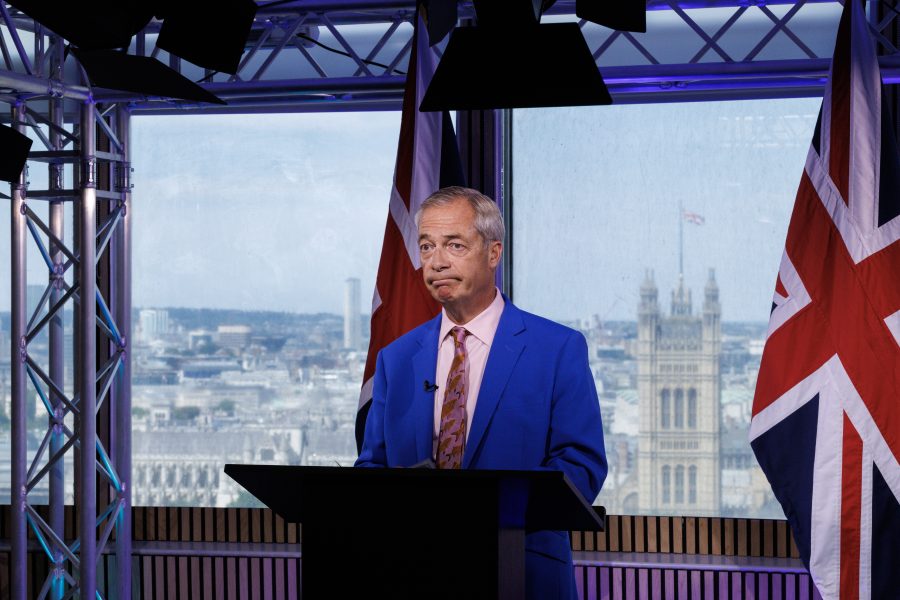
He probably won’t want to hear this but there is an air of General De Gaulle about Nigel Farage. De Gaulle came to define French politics through a mix of deliberate play-acting as being anti-establishment, a narrative of his own sacrifice and a series of exceptionally well-coordinated tantrums. Now, if that doesn’t sound familiar, I don’t know what does.
Nobody could ever accuse Mr Farage of being under-dramatic
Farage possibly hoped today was a ‘De Gaulle’s style moment. As the General was wont to do, Farage decided to circumnavigate the official investigations and the media and instead to broadcast directly to the general public. Flanked by two flags, he sought to address the question of his future in light of the allegations about dodgy financial dealings which have dogged him for weeks.
There was a lot of reference to ‘the way I’ve been treated’. Farage’s basic premise in the first half of his statement was that he is a uniquely ill-used politician, who has to suffer indignity everywhere he goes. Some of this may be the result of jealous mainstream parties and a corrupt media establishment as he claimed, but it is quite hard to work out exactly where Farage’s line for humiliation actually lies given that he was willing to go into the Celebrity Jungle and, perhaps worse, share a stage with a singing, sequinned Andrea Jenkyns.
This was all an issue of safety; he claimed that he had been the victim not just of successive Home Secretaries refusing to protect him, but also Parliament itself who had cut his security funding. It was all a little tricky to follow: After levelling specific accusations at Sky and the Times – who seemed to have been competing to randomly churn out as much of his personal information into the public sphere as possible – Farage veered into a general grievance-fest. On more than one occasion he elided all the bad behaviour of the press with that of the establishment more generally. The basic premise appeared to be that this was Nigel versus the world and that it wasn’t fair.
The lack of protection and the attacks on his family, both seemingly legitimate gripes, somehow got melded into the accusations about his financial situation being, er, irregular. Farage denied this was the case but also managed to make it part of the same campaign against him. Quite how Farage did this wasn’t clear or necessarily convincing but like The General, he made clear that there were two options available for those listening: his way or the wrong way.
It all culminated in a declaration that he was going to resign to trigger a by-election in Clacton. He framed this as a little like it was the Battle of France – a key moment in terms of the grand justification of history. But then nobody could ever accuse Mr Farage of being under-dramatic. The people of Clacton would – he declaimed, with the faintest whiff of an Am Dram production of Julius Caesar – be the judge. We might in fact better sum up Farage’s speech with a line from Carry On Cleo: ‘Infamy, Infamy, they’ve all got it in for me’.
There were reactions from other parties. Rupert Lowe immediately struck with a lengthy and confusing tweet in which he said Restore would stand in the by-election but then clarified it would be the ‘second one’, in which Farage got done for dodgy dealing. The Postmaster’s Friend Ed Davey hoped this would be the end of Mr Farage’s role in public life. Absolutely hilariously, Andy Burnham claimed that trying to change the narrative while standing in a by-election was ‘a gimmick’. Who will stand, who won’t, who knows, who cares. A lot of Reform’s appeal was based on the idea that they were going to be different; today suggests they’ve simply become the main act at the Circus.





Comments