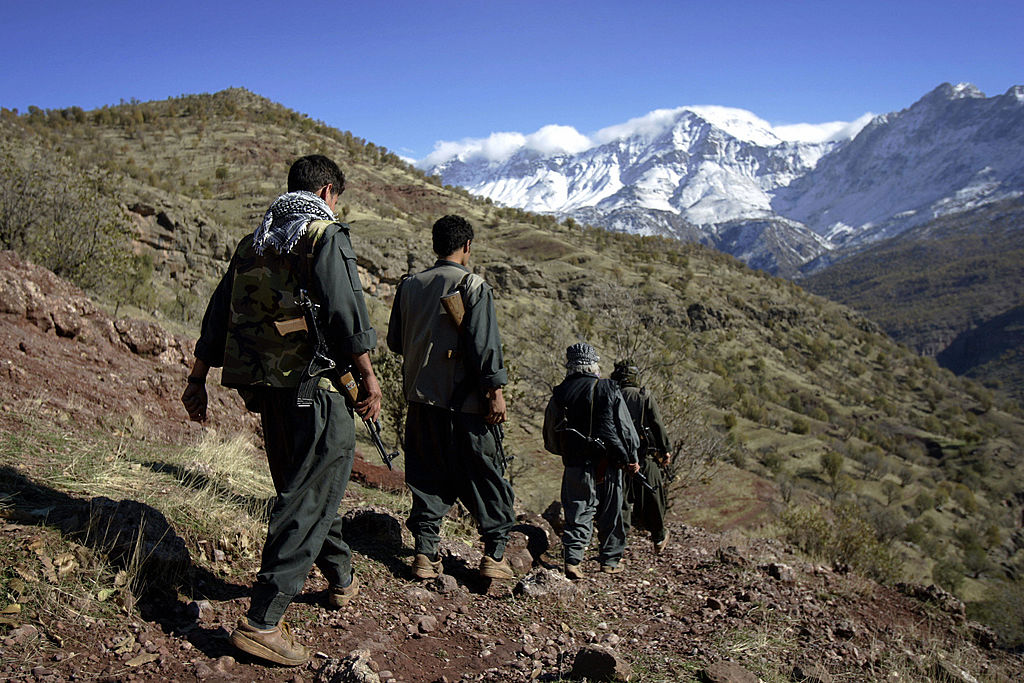
The hopes of the United States and Israel to bring about quick regime change in Tehran – whether through millions of Iranians taking to the streets or through an internal coup by moderate elements within the Revolutionary Guards – have been disappointed. Attention therefore has increasingly turned to another possibility: organising an uprising of Iran’s ethnic minorities, led by the Kurds, against the rule of the ayatollahs.
According to various reports, these groups have received training and logistical support from intelligence agencies including the CIA and Mossad
Although more than half of Iran’s population consists of Persian Shiites, the country is a mosaic of roughly ten ethnic minorities. Among them are Sunni Baloch, who live mainly along the border with Pakistan (about 2 per cent of the population); Sunni Arabs near the Iraqi border (around 3 per cent); the Lurs, who are predominantly Shiite (about 6 per cent); Sunni Turkmen (around 2 per cent); and the Azerbaijanis, the largest minority group, who make up roughly 20 per cent of the population, The Kurds, who are based in north-western Iran, are mostly Sunni and account for up to 10 per cent of the population.
Because of their ethnic and religious affinity with the Persian majority and their deep integration into Iranian society, the Azerbaijani minority is not expected to organise against the ayatollahs.
In the past, however, a Baloch underground movement operated against the Iranian security forces. It received assistance from Mossad, the CIA and Pakistan’s intelligence service, and carried out acts of sabotage and assassinations of government officials, mainly in the border regions with Pakistan. More than a decade ago, Iranian security forces succeeded in suppressing this militia; its leader was captured and later executed in Tehran.
Iranian Arab groups have also been involved in acts of sabotage and assassinations, including mass-casualty attacks that the Iranian authorities classified as terrorism.
The largest and most active opposition movement among Iran’s minorities, however, has been the Kurds. Like their brethren in Turkey, Syria, and Iraq, the Kurds of Iran have, since the early twentieth century, aspired to establish an independent state, or at the very least to obtain political and cultural autonomy.
One of the most dramatic attempts occurred in 1946, when Kurdish leaders proclaimed that a republic had been created in the Iranian city of Mahabad. The republic was supported by the Soviet Union but survived for less than a year before Iranian forces moved in and reasserted control.
Relations between the Kurdish regions and the central government in Tehran have been strained ever since, but became more tense after the establishment of the Islamic Republic in 1979 following the revolution led by Ruhollah Khomeini. Kurdish political activity and separatist aspirations have since been tightly restricted, and Kurdish activists have frequently faced arrest and imprisonment.
Whenever Kurdish political groups have attempted to campaign for greater freedoms or even limited cultural autonomy, the authorities have often responded with repression. Kurdish dissidents who fled into exile in Europe were pursued by Iranian intelligence operatives, and in several cases assassinated.
One of the most notorious incidents occurred on 13 July, 1989 in Vienna. During secret negotiations with Iranian representatives, the leader of the Kurdish opposition movement, Abdul Rahman Ghassemlou, was shot and killed. Two of his colleagues were also murdered during the meeting.
According to unconfirmed reports circulating in Iranian opposition circles, IRGC colonel Mahmoud Ahmadinejad, who would years later become president of Iran, was personally involved in the Vienna operation. These claims, however, have never been substantiated. Incidentally, at the beginning of the current war there were reports that Ahmadinejad had been killed during one of Israel’s airstrikes, but Iranian media denied the claim two days later, stating that he had been moved to a secure location. Another dramatic episode occurred in 1992 in Berlin, when Kurdish opposition figures were assassinated at a Greek restaurant.
More recently, Iranian Kurds were highly visible during the nationwide protests of 2022 to 2023 that erupted after the death of Mahsa Amini, a young Kurdish woman from Saqqez, who had been arrested by regime’s morality police. Kurdish regions were among the most active centres of protest and resistance.
Yet despite their long tradition of political activism and defiance, Kurdish areas in Iran are not today in a state of open, large-scale rebellion.
Instead, any revolt would likely originate across the border in Iraq. Tens of thousands of Iranian Kurds have sought refuge in Iraqi Kurdistan, accessible only through rugged, mountainous terrain. Some of these refugees have formed armed militias. According to various reports, these groups have received training and logistical support from intelligence agencies including the CIA and Mossad, and from Iraqi Kurdish forces.
At the outbreak of the current conflict, US President Donald Trump contacted several Iranian Kurdish leaders, urging them to rise up against the regime. According to different accounts, the CIA began arming these groups and preparing them for the possibility of crossing into Iran to harass the Islamic Republic’s security forces.
One of the most prominent figures among them is Peyman Viyan, a Kurdish-Iranian female guerrilla commander and one of the senior leaders of the Party for a Free Life in Kurdistan (PJAK). She serves as co-chair and senior commander of PJAK, which operates primarily along the Iran-Iraq border. PJAK actively fights the Iranian government and is considered by many analysts to be one of the most effective Kurdish guerrilla movements opposing the Islamic Republic. The organisation has ideological ties to the Kurdish movement associated with the jailed Abdullah Öcalan and the Kurdistan Workers’ party (PKK) in Turkey.
A few weeks ago, Viyan was interviewed in an underground cave by Israeli journalist Itai Anghel for Channel 12. In that interview, she stated that cooperation between Iranian opposition forces and Israel could help bring about political change in Iran. She has repeatedly emphasised women and Kurds as potential catalysts for change in Iran. Tehran considers Viyan one of the most wanted Kurdish militant leaders.
The perceived US-Israeli connection to the Iranian Kurds in Iraq, and fears of a potential Kurdish incursion into Iran, has prompted the IRGC and the Iranian army to launch missiles and drones toward Kurdish targets in the central city of Erbil.
However, the Iraqi Kurdish leader Masoud Barzani clarified just two days ago that his forces are not involved in any military action inside Iran and are intent on maintaining peace. A former senior Mossad official told me that while the idea of a Kurdish invasion sparking regime change in Tehran is a ‘fantasy’, it could certainly tie down regime forces and create chaos, further weakening the ayatollahs’ hold on power. It is unclear though if the Kurds are willing to take the huge risk of rebelling when it is still not a certainty that the Iranian regime will fall.

Comments