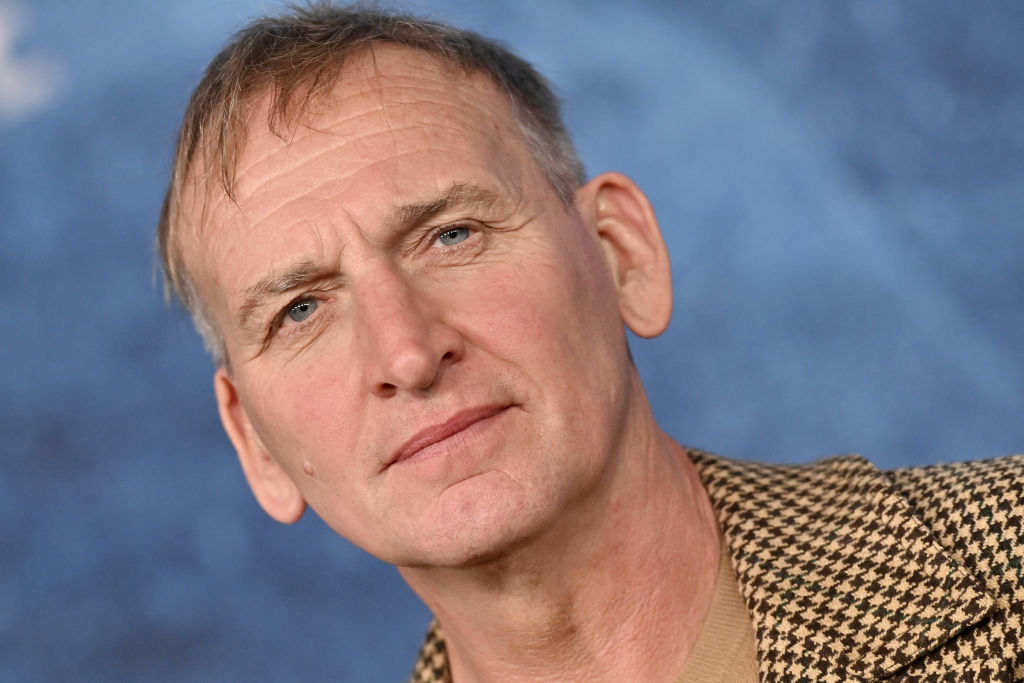
It’s not often that actors talk sense or deviate from liberal-left orthodoxies when speaking on politics, so when they do so, we ought to take notice. And when a thespian makes not one, but two, reasonable points in a single interview, it’s really time to sit up and pay attention.
To borrow the hideous jargon of hyper-liberalism, it can plausibly be argued today that anti-white and anti-male prejudice have both become ‘systemic’
In an interview in the latest edition of Radio Times, Christopher Eccleston, best-known for his starring roles in Doctor Who, Our Friends in the North and Hillsborough, talks of ‘a great trend in drama at the moment for antagonists who are toxic, white, apparently heterosexual, late-middle-aged men.’
This trend isn’t particularly new, of course. The worlds of stage and screen have forever had an abundance of toxic, white middle-aged men playing villains – with memorable performances from Alan Rickman, Anthony Hopkins, Gary Oldman and the like – and it’s not as though Eccleston is seeking to defy this trend: in his new Netflix series, Unchosen, he plays the leader of a sinister cult.
Yet this archetype is particularly apposite for our age, in which whiteness and masculinity are both demonised. As Eccleston remarks elsewhere in the interview, which touches on various subjects, such as the dumbing-down of TV drama and the unoriginality of script-writers today: ‘Masculinity is in crisis, and it seems it’s particularly white, working class boys who are being neglected, left to rot by governments and targeted by the far right.’
It doesn’t take a genius to make a link between the two observations: that white males are vilified in fiction and stigmatised in real life. And one could argue that there is a cause and effect relationship taking place here, one that has become a self-sustaining vicious circle.
Recent fictional television dramas, notably Adolescence, and Louis Theroux’s recent documentary on the manosphere, have helped to entrench the idea that it’s not so much that something has gone wrong with masculinity, but that there‘s something inherently wrong with being a man in the first place. ‘Toxic masculinity’ is understood less as an aberration and more the logical endpoint of manliness. Strength, fortitude, autonomy, stoicism and taciturnity are no longer valorised as masculine virtues, but regarded with suspicion as problematic modes of thinking, ones which inevitably lead to repression, aggression and rage. These former virtues are antithetical to a society in which the traditionally feminine virtues of compassion, consensus, collaboration and sharing one’s feelings are now the norm. Society condemns males as ‘toxic’ simply on account of their male behaviour. It damns boys for not behaving like girls.
To be white today is seen as similarly problematic. The term ‘whiteness’, a word and concept derived from Critical Race Theory, propounds that white people can’t help being bad people, because racist thinking and the desire to oppress ‘the other’ are baked into their very being. This alarmingly irrational notion, formerly the preserve of hyper-liberals in the cloistered world of university campuses, has firmly established itself in the popular lexicon. We were reminded of this in February, when it was reported that an annual music festival in London now bans white people from its top ranks. Decolonise Fest, which aspires to undo the damage of colonialism and ‘dismantle white supremacy’ in the punk scene, boasts that ‘white people cannot join the organising group’.
To borrow the hideous jargon of hyper-liberalism, it can plausibly be argued today that anti-white and anti-male prejudice have both become ‘systemic’. To be both white and male now is to be at the nexus of an altogether different and wholly unfashionable kind of ‘intersectionality’: you are demonised both because of your skin colour and your chromosomes, denounced by righteous types who present themselves as victims of your inbuilt and irredeemable racism and sexism.
It’s appropriate that it’s Christopher Eccleston who has reminded us of this state of affairs, given his most famous on-screen role reflected the transformation of society’s thinking on sex and race. First the Doctor stopped being a man, then he stopped being white.
Eccleston has unwittingly hit the nail on the head. There is a crisis in masculinity because society and culture – in this case through the medium of screen – consistently conveys the message that white men are abnormal or abhorrent. This feeds into an already established narrative, picked up by educators and passed on by teachers, that to be male is inherently problematic, and to be white is to be intrinsically racist or privileged. So this negative message is transmitted once more, and continues to perpetuate itself. This vicious cycle needs to be broken.



Comments