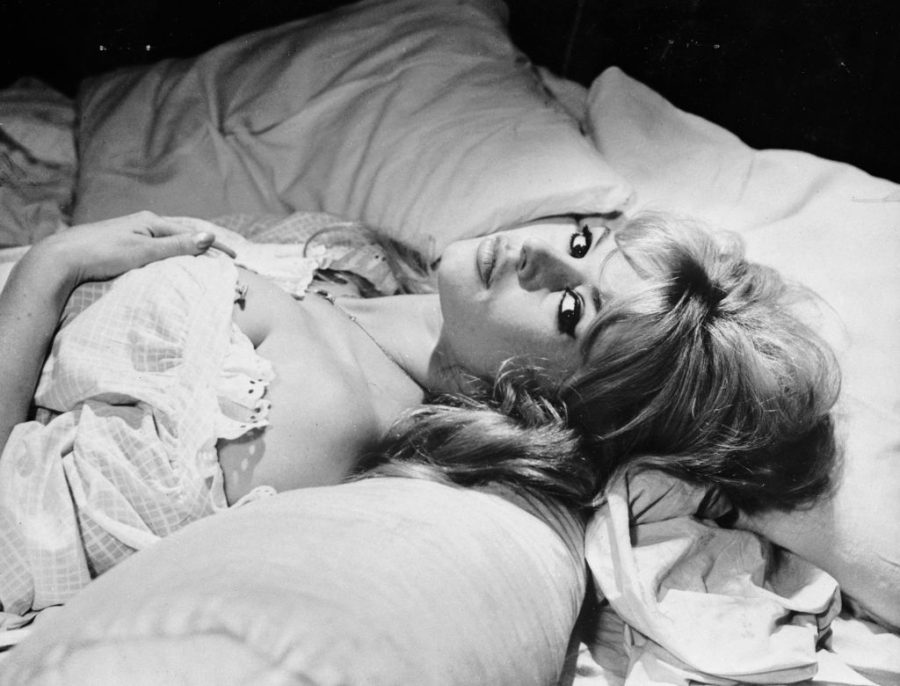
In 1956, Brigitte Bardot was invited to the Royal Command Film Performance in London, where she would be presented to Queen Elizabeth II. She was thrilled – not only to meet our queen, but the other one too: Marilyn Monroe would also be present.
Bardot later recalled the evening with a mixture of awe and amusement. Monroe, she insisted, was the real star: radiant, charming, fragile. This brief encounter between the two most famous blondes in cinema history captured, in miniature, a fork in the road between two kinds of fame.
Six years later, Monroe would be dead. She was found nude in her Los Angeles home, killed by a drug overdose, aged just 36. Even in death, her body was not left alone: a photograph was released to the press, as if the spectacle required one last offering. Bardot, by contrast, would live for nearly seven decades more. Monroe was absorbed entirely by the fame machine until it destroyed her. Bardot, improbably, would walk away.
Bardot never wanted to be admirable, she just wanted to be free
Bardot belonged to the first generation of truly global celebrities – recognisable across continents, relentlessly photographed, increasingly commodified – yet she lived in a world where fame still had edges. One could, with sufficient stubbornness, step outside it. She accepted obscurity as the price of survival.
By the time of that London evening, Bardot was already an icon. In the climactic scene of her 1956 film And God Created Woman, directed by her then husband Roger Vadim, mambo music swells in a St Tropez beach bar. A young woman dances, hair loose, movements untrained, instinctive. She is provocative, shameless, mesmerising. Men from the conservative village stare, transfixed and furious, aroused and powerless.

The scene’s blatant sensuality catapulted Bardot to international fame and permanently altered what female sexuality could look like on screen. Paris Match called her ‘immoral from head to toe’. Simone de Beauvoir declared her a ‘locomotive of women’s history’. The New York Times, more primly, described her as a ‘voluptuous little French miss’.
At first, Bardot enjoyed the attention. Then she began to loathe it. At 39 – when she was arguably the most recognisable woman in the world after the Virgin Mary – with more than 50 films behind her, she quit the movie industry cold turkey. Not a strategic farewell tour, not a teasing ‘final role’ designed to leave the door ajar. When Bardot quit, she quit for good.
Her last film was Don Juan, or If Don Juan Were a Woman, directed once again by Vadim, her by then ex-husband who had launched her into stardom. Almost as suddenly as she had appeared on screens, she vanished from them.
‘When I left the world of cinema, I couldn’t stand it anymore,’ she later wrote. ‘The other side of the stardom coin was too heavy a burden to carry. Popularity is a poison. It kept me from living my life.’ She described being pursued by paparazzi, held hostage by rumour and insult, suffocated by what she called ‘this worship of celebrity – a life perpetually centred around myself’.
Artists’ self-portraits, particularly autobiographical ones, should always be taken with a pinch of salt. Bardot also wrote of devoting herself to patience, silence and kindness in her later years, but the public record is less serene: multiple convictions for hate speech, repeated fines, and a tendency to express herself with the same raw, unfiltered energy she once brought to the screen.
She escaped at the precise moment when celebrity was becoming total, but before it became permanent. Today, fame is no longer episodic or geographically bounded; it is continuous, monetised, algorithmic. It is addictive and almost impossible to quit. What Bardot refused, instinctively rather than philosophically, was this logic of perpetual access fans demanded of their stars.
From her 40s, animals became the centre of her life. ‘Animals and the choice I made to live with them and for them have been my guarantee of survival,’ she wrote. ‘My love for them gave me back my desire for life.’ Perhaps this is the secret to her longevity. She lived among a small menagerie in her St Tropez beach house, La Madrague – her escape from the world. These creatures, she noted with relief, ‘couldn’t care less about B.B.’ With them, she found relationships that were natural and untheatrical. They did not adore her image or punish her contradictions. They simply existed with her.
It is here that the later controversies intrude. Her devotion to animals hardened into ferocity; her language curdled; her politics drifted towards the French far right. These facts cannot be ignored – but neither do they negate the farsightedness of her original refusal of fame or the body of work she leaves behind. Bardot never wanted to be admirable, she just wanted to be free. To the end, she was unapologetically herself and didn’t care what the world thought.
‘So when I take stock of it all,’ she wrote toward the end of her life, ‘I can say that my earlier success did not make me happy. This constant blinding light never suited me.’ The only exposure she ever enjoyed, she said, was sunlight on the terrace at La Madrague. From there, she watched the Mediterranean change with the seasons, fed pigeons in the morning, and observed – quietly – the beauty of the world. ‘I cannot possibly doubt my decision.’
In the end, Brigitte Bardot did not fade. She vanished from film deliberately, stubbornly, and on her own terms. In a culture that treats attention as oxygen, her refusal remains the most radical thing she ever did. Her death offers a timely chance to examine what might be gained – and what it might still cost – to walk away from the crowd.

Comments