Biden picks Brown Jackson
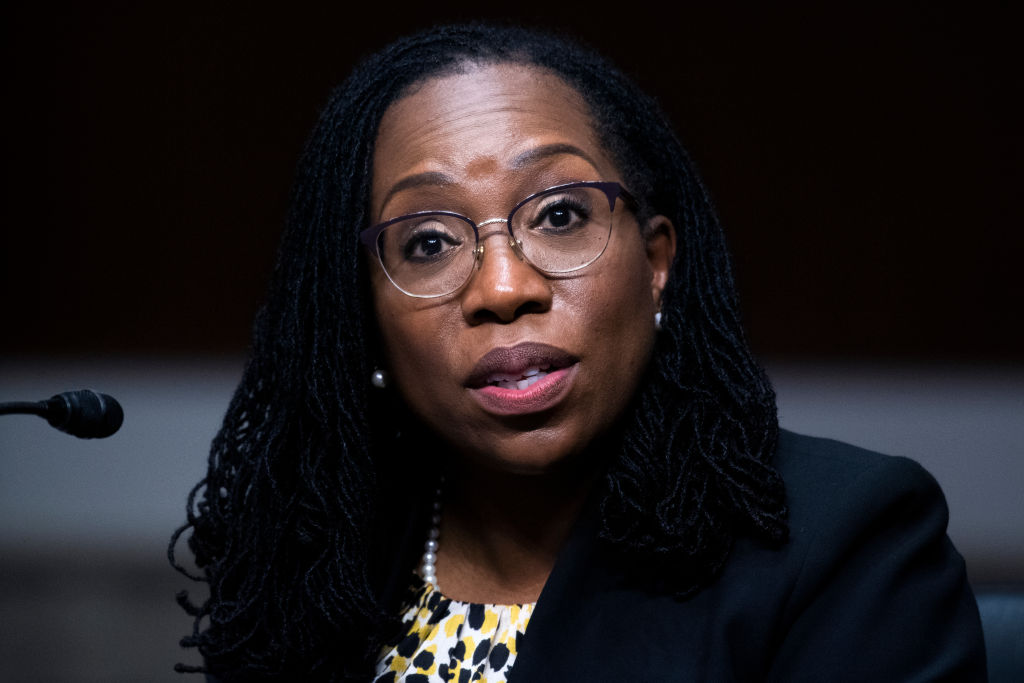
The president has chosen Ketanji Brown Jackson, a judge on the Court of Appeals for the DC Circuit, to fill the vacancy on the Supreme Court, multiple outlets have reported. Biden had interviewed two other candidates: Leandra Kruger, a judge on the California Supreme Court, and J. Michelle Childs, the South Carolina judge backed by Jim Clyburn and Lindsey Graham.
With Russian troops laying siege to the Ukrainian capital, some will question the timing of this announcement. And with all eyes on Eastern Europe, the ceremony promises to be one of the most low-key in recent memory.
The White House has good reason to expect a reasonably smooth nomination process. Brown Jackson was confirmed to her current DC Circuit position last June and received the support of three Republican senators: Graham, Lisa Murkowski and Susan Collins. Although as news of the pick leaked, there were some signs of trouble. “If media reports are accurate, and Judge Jackson has been chosen as the Supreme Court nominee to replace Justice Breyer, it means the radical Left has won President Biden over yet again,” said Graham of the selection of a justice he approved less than a year ago.
*** Sign up to receive the DC Diary in your inbox on weekdays ***
Biden the bystander
Taking the words of an American president either seriously or literally is dangerous business these days. To do so during Biden’s speech on the US response to Russia’s invasion of Ukraine was to be bitterly disappointed.
For all the expressions of regret over Putin’s escalation, the forlorn yet disengaged tone of Biden’s public remarks on the Ukraine crisis reveal not a president who thinks he has the power to steer events and minimize the damage done by an invasion of world historic significance, but a bystander who views the tragedy as a regrettable but unavoidable development with an inevitable ending.
At times, Biden appears almost to revel in the impotence of his response. Asked about the effectiveness of sanctions yesterday by ABC reporter Celia Vega, he said, “No one expected the sanctions to prevent anything from happening. This is going to take time… It’s not going to occur, he’s going to say, oh my God, these sanctions are coming. I’m going to stand down.”
Those words run directly counter to what the White House has been telling the world for weeks. And they are an astonishing admission of futility at such a crucial moment. (Jen Psaki later clarified that the president “didn’t mean it.”)
One need not think America should or could guarantee Ukraine’s defense to wonder: is this the best we can do? Biden billed the fresh round of sanctions as a tough set of measures. But the administration has not sanctioned Putin personally, nor is there any sign that the assets of those who have profited from and enabled the Putin regime are about to be seized. And the administration has been unequivocal about the fact that it will not be hitting the Russian economy where it would hurt the most. “To be clear, sanctions are not designed to cause any disruption to the current flow of energy from Russia to the world,” said deputy national security advisor Daleep Singh at the White House yesterday.
Time and again, Biden has been dishearteningly passive. Explaining why the fresh package of US sanctions did not include excluding Russia from the SWIFT international payment system, Biden said, “Right now that’s not the position that the rest of Europe wishes to take.”
First, this isn’t really true. Many European leaders want to take action on SWIFT. Ukrainian President Volodymyr Zelensky has called for such a move. Others, like Germany, were opposed but are now reportedly reconsidering. Why does the leader of the free world insist on taking a back seat?
Contrast Biden’s passivity with the British government. They have said they will “work all day” to try to persuade their allies of the need to move on SWIFT. As Europeans haggle over cowardly carveouts — the Italians have secured an exemption from sanctions for luxury goods; the Belgians have wangled the same for diamonds — a US president turning up the heat would make a big difference.
Missing from Biden’s short speech — and the administration in general — is a sense that the situation is anything other than hopeless. The conversation goes no further than sanctions. As discussed in yesterday’s diary, American interests are best served by a long and costly conflict for Putin. That means urgent cooperation with allies to make sure Ukraine has all the arms it needs. And the lack of urgency isn’t limited to the question of military hardware. On sanctions, Biden asks that we check back in a month. Over the long run, he must offer more than incremental sanctions that he has admitted do nothing. Rather, he must offer the American people, and the West, a strategy that adjusts to the fact that Russia is transforming into an outright enemy before our eyes.
Meanwhile, Ukraine’s future is being decided over the course of minutes and hours, not weeks and months. Zelensky has vowed to stay in his country’s capital, even as Russian troops close in, a heroic act given Putin’s bloodlust. In a video call with European leaders last night, Zelensky identified himself as Russia’s number one target and reportedly told his counterparts, “This might be the last time you see me alive.”
What will Putin do next?
Will Putin stop at Ukraine? Given the shock even among those close to him over his decision to launch a full scale invasion of Ukraine, it’s reasonable to wonder where he will stop. In an interview with the BBC this morning, British Defense Secretary Ben Wallace suggested he may even consider moving into the Baltic states. Perhaps the UK minister is speculating, but after the attack on Ukraine these are the once outlandish scenarios which the West must now take seriously.
Read this
Harry J. Kazianis: Let Russia choke on Ukraine
Slavoj Zizek: Was Russia’s ‘rape’ of Ukraine inevitable?
Ben Sixsmith: Eating donuts in Poland as the bombs fall
Jacob Heilbrunn, National Interest: Will Putin’s war go further than Ukraine?
Robyn Dixon and Paul Sonne, Washington Post: At great risk for Ukraine and Russia, Putin signals a dark endgame
Nahal Toosi, Politico: Putin was playing Biden all along
Poll watch
President Biden Job Approval
Approve: 41.3 percent
Disapprove: 53.5 percent
Net approval: -12.2 (RCP Average)
Percentage of Americans with an unfavorable view of Russia
2014: 50 percent
2019: 73 percent
2022: 85 percent (Gallup)