
In 1989, as tanks rolled into central Beijing to crush the pro-democracy protest in Tiananmen Square, Australia’s then prime minister, Bob Hawke, spontaneously offered asylum to all Chinese citizens who happened to be in Australia. Thousands took up his offer and made lasting contributions to the country that gave them shelter.
Last Tuesday, the women showed personal courage by taking a silent but very public stand against a regime that stops at nothing to punish open disloyalty
On Tuesday, Hawke’s successor, Anthony Albanese, granted five women of Iran’s national soccer team asylum, and offered it to all those in the team’s party. Unlike Hawke, however, Albanese did the right thing only after being pressured by Australian public opinion and, if you accept his version of events, President Donald Trump.
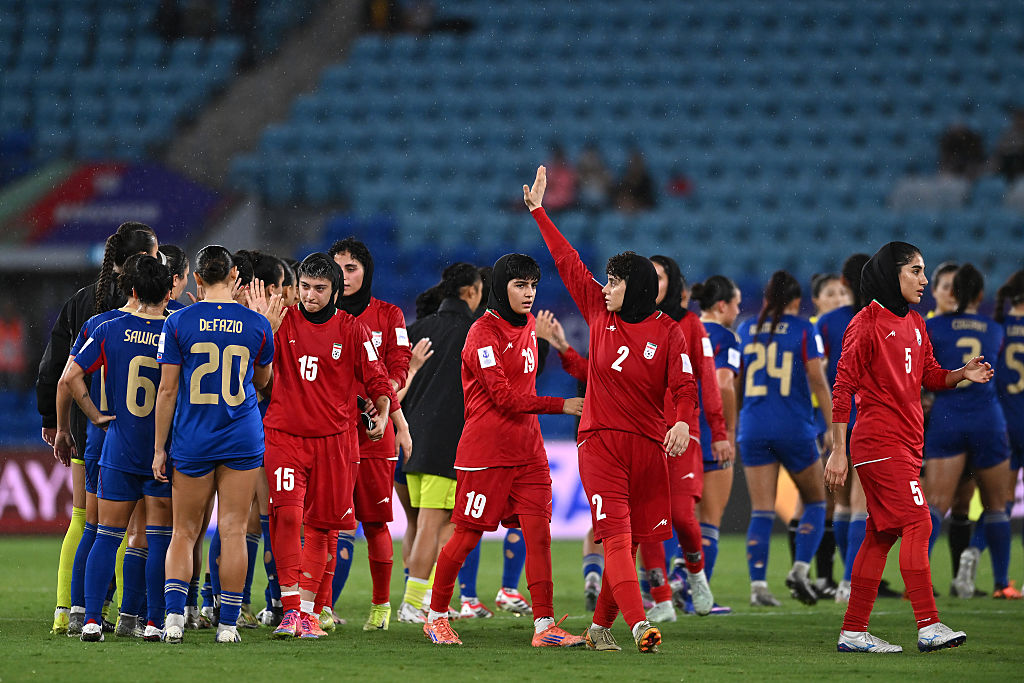
The footballers were in Australia to play in the regional Asian Women’s Cup tournament on Queensland’s Gold Coast. They didn’t expect their presence would coincide with the US-Israeli Operation Epic Fury but, last Tuesday, the women showed personal courage by taking a silent but very public stand against a regime that stops at nothing to punish open disloyalty: they remained stonily silent during the regime’s anthem when it was played before their first match. Australians applauded the footballers as the team’s burly minders, thought to be linked to the Islamic Revolutionary Guard Corps, watched on.
Back home, Iranian state television denounced the team as “wartime traitors” and accused them of treason, a capital offense. In their next match, against Australia last Thursday, the women sang the anthem and saluted stiffly – but looked sullen and tense. Even that was not enough to placate the Iranian authorities. Footage emerged of the fanatical presenter Mohammad Reza Shahbazi calling for the squad and coach Marziyeh Jafari to be “dealt with more severely.” Even with drones and missiles raining down on Iran, its Supreme Leader killed and in the midst of a power vacuum, the regime still harassed and threatened female footballers who dared defy it.
With the team’s defeat in their third and final pool match on Sunday, their moment of reckoning arrived. The women were expected to fly home before their visas expired, to an uncertain fate for them and their families. Their minders isolated them in their hotel, denying them outside contact. But their stand pricked Australia’s conscience. Calls to give the footballers asylum grew louder, political leaders called for the Australian government to act quickly, and an online petition supporting asylum gathered almost 50,000 signatures.
In spite of this, however, Albanese’s government initially remained reluctant to intervene, just as it refused to condemn some Australian Islamic leaders mourning the elimination of Ayatollah Ali Khamenei. As late as Sunday, a junior foreign affairs minister declared “there’ll be no special circumstances granted to anyone who’s competing in the Asian Women’s Cup.”
But overwhelming public pressure to do something eventually was heeded. By Monday, Australia’s home affairs minister and immigration authorities had belatedly grown a backbone and set the wheels in motion to assist any women that wanted to defect before the team left the country. Activists and Iranian diaspora staked out the team’s hotel, determined to let the women know they had friends, to help them make a break if they could. Some encouraging messages were smuggled through to the women.
On Monday night, five footballers, including the team’s captain Zahra Ghanbari, succeeded in getting away, fleeing to an underground car park with panicked minders in close pursuit. Taken to a safe house, they were greeted by Australia’s home affairs minister, Tony Burke (who incidentally holds a Sydney constituency with a very large Muslim minority). Burke approved their asylum claim then and there, in the middle of the Queensland night. Photos showed the minister surrounded by five obviously happy women, ditching their hijabs as a visual statement of their newfound freedom. Burke said they chanted “Aussie, Aussie, Aussie, oi, oi, oi!” as he signed his approval.
But one person still needed convincing that the courageous Iranian women were not being abandoned by Australia: Donald Trump. Having posted on Truth Social that Australia was failing the footballers, Trump rang Albanese at 2 a.m. on Tuesday, Canberra time, ready to berate him if Australia wouldn’t do its humanitarian duty to protect the footballers from jail, torture or death back home.
A presumably drowsy Albanese was able to tell Trump the defection operation had just been carried out without publicity, and that if any other members of the team and staff also sought asylum, they would be welcomed. “He’s on it!,” Trump personally posted moments after the conversation, effectively taking credit, as only Trump could, for what had already been done. Claimant to the Iranian throne, Reza Pahlavi, similarly rushed out to tweet his approval and praise the women.
But this drama is not over yet. On Tuesday morning, the rest of the team party hurriedly prepared to fly out to Sydney, then Malaysia, before arriving in Iran. One player appeared to be pulled by the wrist aboard the bus by a teammate, before the bus was buffeted and hindered by protesters in chaotic scenes.
All these women showed courage and dignity in defiance of a brutal and fanatical regime. As in England, Iran’s national women’s team is known as the Lionesses. In taking the stand they have, these brave women lived up to that noble name.




Comments