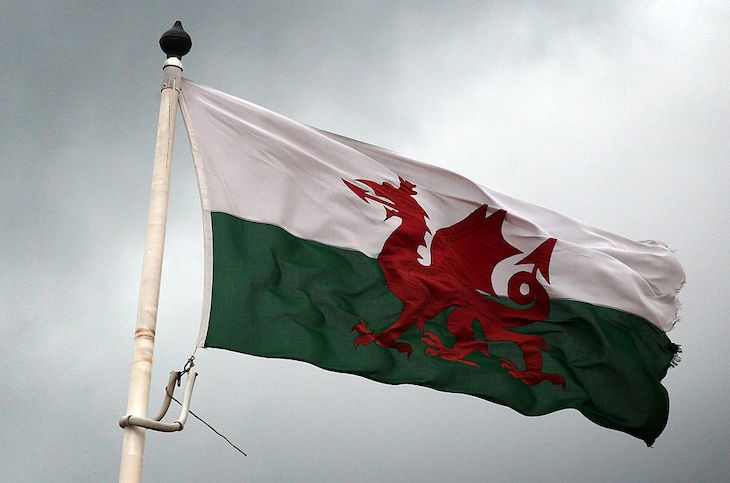
The first ministers of Scotland, Northern Ireland and Wales have a clear message for Westminster: Your ‘time is coming to an end’. For the first time since devolution began, all three pro-independence parties – Sinn Fein, the Scottish National Party and Plaid Cymru – are in power in their home nations at once. Irish nationalism has already produced an independent state and, in Northern Ireland, helped fuel decades of bloody sectarian conflict. The prospect of Scottish secession remains a serious and enduring political problem for Prime Minister Andy Burnham. But do we take the prospect of Welsh independence as seriously?
For all the derision levelled at Welsh militants by the British establishment, the movement’s history is no joke
Perhaps it does not attract so much attention as the issue is simply not as pressing. A 2023 YouGov poll found that just a fifth of the Welsh public would vote to leave the UK, with 54 per cent wishing to remain. Besides, the idea of Wales (population of 3.1million, 3.4 per cent of UK GDP) seceding feels less like the dissolution of a centuries-old union and more like a small child announcing that they are leaving home, taking only a change of socks and two oranges. We smile indulgently, wish them well and try not to look too concerned. After all, they’ll be back when they’ve run out of sweets.
The notion, therefore, of actual terrorism associated with Welsh nationalism has generally been regarded as a punchline. Ben Macintyre’s 2012 wartime espionage history Double Cross delights in the fact that German intelligence swallowed reports of a completely fictitious Welsh Aryan Fascist brotherhood, supposedly poised to rise up against the British state. A Guardian review of the book even labelled the notion “absurd”. (There have, in fact, been Welsh Nazi sympathisers, both during the war and more recently).

Meanwhile, a recent ‘The Rest is History’ podcast series on The Troubles featured Dominic Sandbrook and Tom Holland chuckling at how the IRA reportedly sent weapons to the pro-independence Free Wales Army (FWA) revolutionaries. The presenters presumably believed such an action held as much strategic logic as providing a parish council with a tank.
Yet the raillery risks obscuring a more serious history. Welsh nationalism has, in fact, produced political violence. In 1936, founders of the Welsh National Party – the forerunners to Plaid Cymru – set fire to a Royal Air Force bombing school to protest its construction at Penyberth, a cultural site on a route used by pilgrims. They were received home from prison by over 15,000 supporters. The incident has now been turned into a Welsh-language opera, ‘The Flames of Penyberth’, soon to tour.
John Barnard Jenkins, leader of pro-independence paramilitary group “Mudiad Amddiffyn Cymru” (MAC, or Movement for the Defence of Wales), identified two events as particularly important in radicalising nationalists and fostering the perception that democratic methods offered little prospect for addressing local grievances.
The first was the flooding of the Tryweryn Valley in 1965 to create a reservoir supplying water for Liverpool. The scheme went ahead despite local protests and 36 Welsh MPs voting against. The second was the 1966 Aberfan disaster, in which a coal waste tip collapsed on to a school, killing 116 children and 28 adults. An inquiry found the National Coal Board responsible, with evidence demonstrating the lack of safety measures and no actions having been taken despite prior warnings about the tip’s instability. However, no one from the Board was prosecuted, demoted or removed.
Targets of MAC’s bombing campaign included water infrastructure, tax offices and monuments. Jenkins, a non-commissioned officer in the Royal Army Medical Corps, claimed that he received offers of assistance from Libya and East Germany, with the IRA’s cell system based on the one he created. He was sentenced to ten years in prison in 1970 for his role in a campaign of bombings intended, he said, to disrupt Prince Charles’s 1969 investiture as Prince of Wales. Jenkins further claimed to have resisted considerable pressure from fellow radicals to assassinate the young prince and bragged that he could have shot him. Two MAC members involved in the investiture plot were killed when a device detonated prematurely, while a ten-year-old boy was left seriously injured after discovering another.
The movement did not end there. Between 1979 and 1991, Meibion Glyndŵr (Sons of Glyndŵr, named after the leader of a rebellion in 1400) launched their own revolt by committing 228 arson attacks, mostly against holiday homes belonging to English people. Nobody was killed, but the campaign was sufficiently embedded in the national consciousness to inspire a ‘Not the Nine O’Clock News’ sketch parodying the National Coal Board’s campaign about the pleasures of coming home to a blazing fire. There was rather less comedy involved for firebomber Sion Aubrey Roberts, who was sentenced to 12 years in prison in 1993 for possessing explosives and sending incendiary devices to officials and police. Westminster was not immune; a letter bomb was sent to Wales Secretary David Hunt.
But a 2004 Guardian article derided them as “the Postman Pats of international terrorism”. A 1969 Time article claimed the investiture plotters “couldn’t blow the skin off a rice pudding”. One historian claims “the FWA were a running joke amongst members of the British security establishment”. Meanwhile, a 1967 security services report into subversive organisations described its leader William Julian Cayo Evans as ‘a small farmer of good family who mentally is scarcely an adolescent…His Army consists of himself and a handful of associates of much the same calibre’”.
“The dismissal”, says Dr Wyn Thomas, a historian and biographer of Jenkins, “is likely based on the false assumption that Meibion Glyndŵr and MAC styled themselves on the IRA and sought to engage in a paramilitary offensive with the British state along similar militant lines, which they certainly did not”. Besides, although MAC lacked the necessary financial and personnel resources to halt the investiture, the intent was to demonstrate opposition in Wales. “The militant protest certainly changed the nature of activities surrounding the investiture and ensured that the occasion was not the carnival and jamboree of celebration that the UK authorities hoped and expected that it would be”.
A 2004 Guardian article derided them as “the Postman Pats of international terrorism”
The firebombing campaign was intended to expel people rather than kill them. Second homes had left parts of rural Wales largely empty for much of the year, which destroyed local businesses, while their popularity helped drive up property prices and so forced young people to move away. Thomas notes that arsonists watched properties for weeks to establish that they would be unoccupied at the time of the attack. Both Meibion Glyndŵr and MAC tried to adopt a “hearts and minds approach”, which successfully gained the “acquiescent support of the broader Welsh community”.
Following the campaign, rising home insurance for second properties, especially those purchased by a buyer from England, discouraged many. That, in turn, lowered house prices which, along with the advent of the housing association programme, ended the campaign. However, some owners of failing businesses did deliberately set their establishments on fire before blaming Meibion Glyndŵr.
For all their destruction, terrorists in Wales did not gain significant press attention, according to Thomas. “The British media at the time had little interest in why the campaigns were being carried out and seemed intent on simply comparing the groups and their protests to the IRA, but Welsh militancy was not about mimicking the IRA. In some ways it was cleverer – being more considered and undertaken with a greater degree of care and attention to detail”. Dr Martin Johnes, Professor of Modern History at Swansea University, agrees: “MAC and Meibion Glyndwr didn’t get a huge amount of media attention because they were not murdering people and because, frankly, the English media is not very interested in Wales”.
During a 1944 parliamentary debate, Welsh Labour politician Aneurin Bevan argued that there were no problems unique to that nation, explaining that he did not know the difference between a Welsh sheep, a Westmorland sheep and a Scottish sheep. The answer, as the stereotype would have it, is that the latter two endure far less harassment from locals. (Sorry, couldn’t resist. As many a farmer has said himself). But, in seriousness, for all the derision levelled at Welsh militants by the British establishment, the movement’s history is no joke. Behind the humour lies a long tradition of violence, resistance and demands for recognition – one that cannot simply be laughed off.



Comments