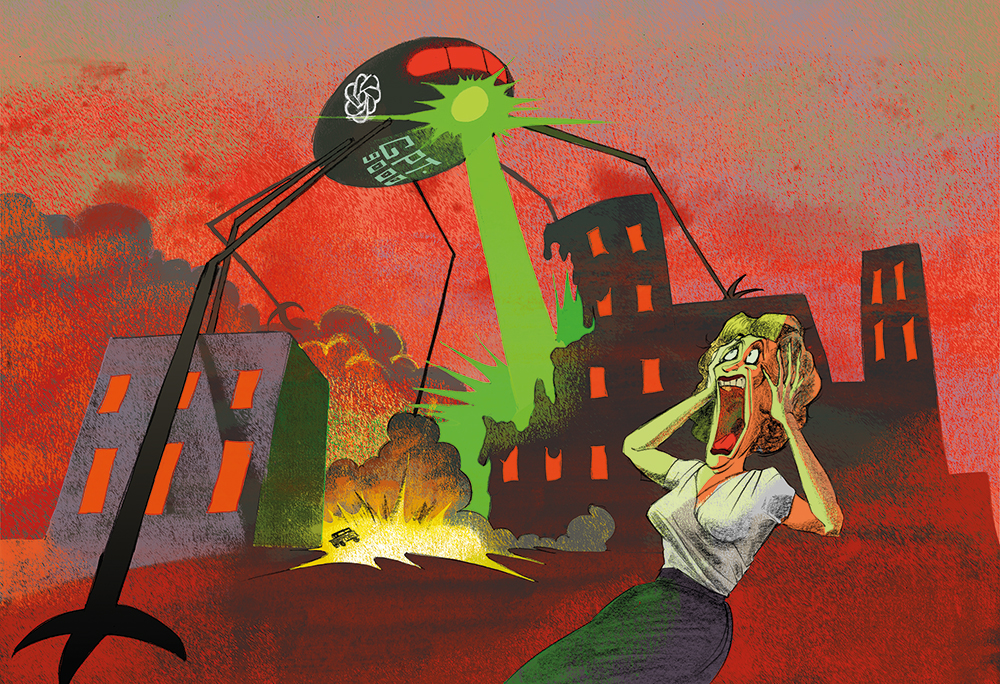
Forgive me. I am going to begin by quoting two prominent left-wing Londoners – and agreeing with one. In a speech recently, Sadiq Khan warned that artificial intelligence could become ‘a weapon of mass destruction of jobs’. He did acknowledge AI’s potential to fight cancer and other evils, but his main point was that it needs to be controlled by bureaucracies like the one he leads. He has it the wrong way round. We don’t need bureaucracy to control AI, we need AI to cut bureaucracy.
Now Karl Marx: ‘Bureaucracy is a circle from which no one can escape. Its hierarchy is a hierarchy of knowledge.’ He was lucky never to see today’s vast British state, but he predicted its nature: a rigid system in which those at the top make abstract plans disconnected from those at the bottom. Meanwhile, everyone in the bureaucracy wrongly believes everyone else knows what they are doing. ‘Thus,’ concluded Marx, ‘they deceive one another.’ Marx has it the right way round: bureaucracies are never on the side of the people.
AI automates away drudgery while freeing human hands and minds for more valuable work
His insight is fundamental to understanding what AI will do to government, if we allow it. Our politicians spend a lot of time lamenting the fact that nothing they are in charge of works. They set policies that either never get started or, when they do, fail. Why does this happen? Sometimes it’s simply because the policies are bad. Just as often it is because of bureaucracies’ inherent and unshakable inability to process decisions accurately, effectively and swiftly. The public have come to expect as much. Politicians promise one thing, officialdom delivers another. The consequence of bureaucratic failure is the poisoning of trust in the possibility of doing better.
How can AI help? First, we need to understand what it is. AI is an infinite army of tireless and assiduous administrative worker bees, automating away drudgery while freeing human hands and minds for more valuable and more meaningful work.

What AI is not is a super-intelligent panacea for every problem. Anyone who has used ChatGPT to answer a general question can see that: systems that are set unguided tasks produce mediocrity or, worse, fiction. If we use AI uncritically, we can expect similar results.
Nor can AI help if we lock it away. Don’t believe those who tell you AI is a malevolent force that will replace human work, degrade art and destroy the environment. This is disproved daily by the many of us who use AI to accelerate drug discovery, improve manufacturing and much else. AI will help when we use it to solve specific problems in specific contexts. Any task that can be repeated or that involves sifting large volumes of information can be performed by AI.
When performed by humans, these tasks are slow and dull. When performed by AI trained for the purpose, they are nearly instant. Nurses already use AI to alert them to patients at high risk of sepsis. Police officers use it to build supercharged versions of the association charts we know from detective dramas.
Frontline workers will benefit most because they are closest to the bottom in the ‘hierarchy of knowledge’. With AI they can now do their jobs without being drowned in paperwork and so they will become more productive, more fulfilled and even more valuable. It is the lanyard class that has most to fear from this technology, because AI is better than any human when it comes to paperwork. Blue collar will replace white collar in the hierarchy of value.
Viewed this way, AI will challenge our politicians. Why do we need sprawling back offices, HR wallahs and byzantine regulations if frontline workers can deliver results safely without them? Why import millions of unskilled workers if technology can multiply the productivity of workers at home?
I suspect the public will welcome these questions, even if our political class does not. Our government is too big, too slow and too distant from the people to understand their problems or serve them well. Technology that takes away bureaucracy and makes things happen faster now exists – it is simply a question of how quickly we can get it into frontline workers’ hands. Maybe then we will discover that Marx’s collaborator Friedrich Engels was right all along: the state won’t be abolished, it will simply ‘wither away’.



Comments