
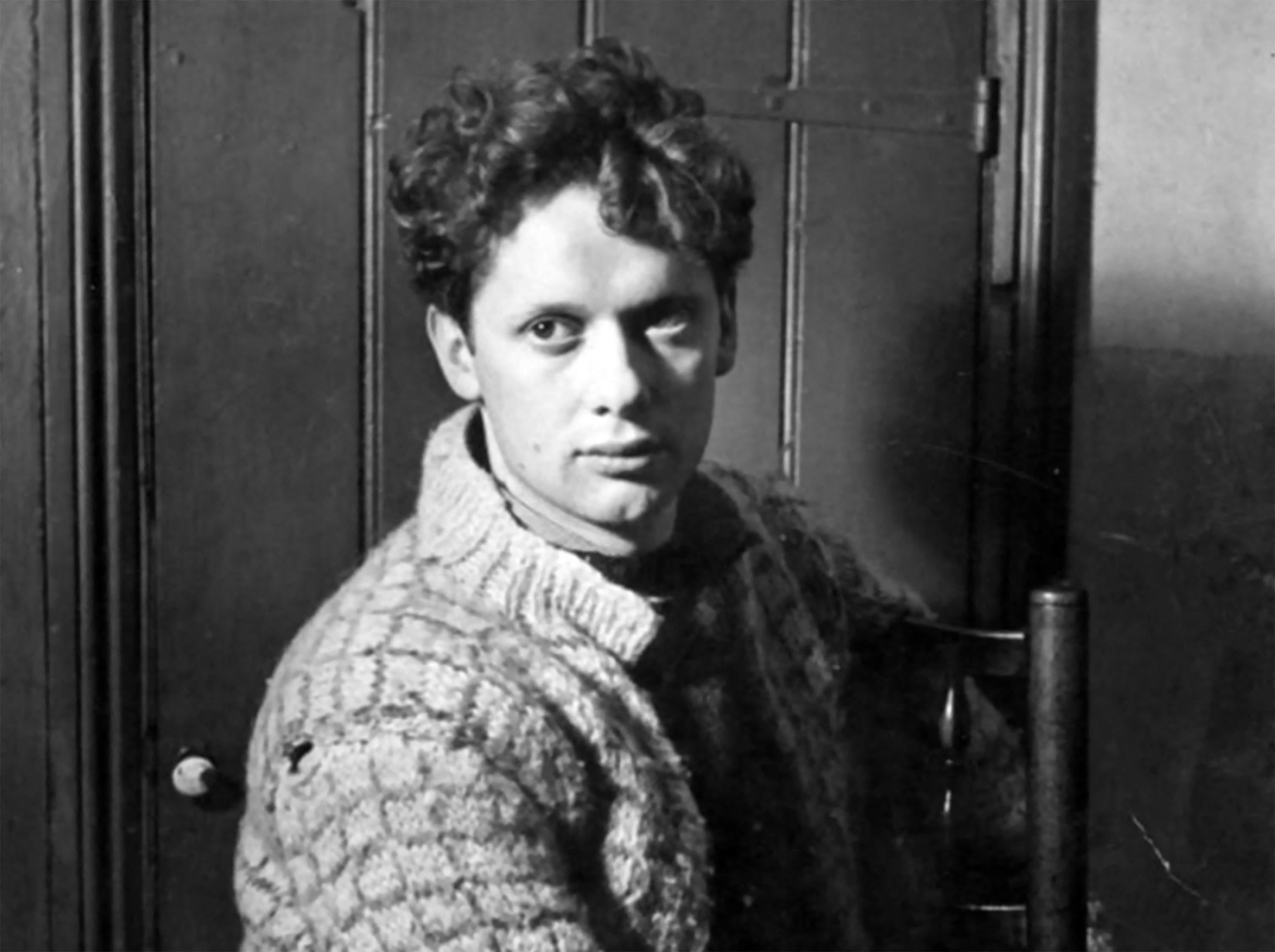
It was the longest pub crawl of my life – visiting numerous boozers across 250 miles over ten days – in homage to one of Britain’s most infamous drinkers, Dylan Thomas. I’m not, I must qualify, a Thomas obsessive, as this enterprise might suggest. If exposed to Thomas at length, I find myself recalling Private Eye’s 1980s characterisation of Neil Kinnock: ‘The Welsh windbag.’ Although, in fairness, even Thomas himself described his own verse as ‘a steaming pile of Welsh whimsy’.

We start in Swansea, Thomas’s birthplace, which he described as an ‘ugly lovely town’ – something locals have since adapted to the earthier ‘pretty shitty city’. The first stop had to be the Uplands Tavern. This pub is around the corner from Cwmdonkin Drive, the suburban terrace where Thomas was born in the front room of number 5 in October 1914. He was still living there when he left school at 17 and became a trainee reporter on the South Wales Post – and a regular at the Uplands Tavern.
Much of Swansea was destroyed by Luftwaffe bombs. Thomas himself once watched a pub burn to the ground during the Blitz. And Thomas pops up all over the patchily rebuilt city, including a particularly bad statue. It’s on the facade ofThe Eli Jenkins pub, named after a character in Under Milk Wood, for example. But further investigation suggests it was built after his death so is more tribute than marker plaque – and it’s unclear if the punters we see drinking pints at 10.40 a.m. are Thomas readers.
Heading west from Swansea, we stop at the town of Laugharne, a key point on the Dylan Thomas heritage trail. He lived here from 1949-53 – the final years of his life – spending much of that time sozzled in Brown’s Hotel. And, when we get to Brown’s Hotel, it doesn’t disappoint. I love this pub – or bar, or hotel or restaurant. Whatever it is, it’s special. A fine and atmospheric watering hole as it calls itself. And, amazingly, they haven’t found a way to ruin it yet. The Three Mariners around the corner is also rather good. Thomas, of course, would have drunk in every pub in town, if not been barred.
For the London portion of our pub crawl, we stuck to those best known for their Thomas links. We begin with a quartet of pubs in close proximity to each other in Fitzrovia, that portion of London north of Oxford Street, which are all pleasingly busy on a weekday early evening. Among them is the bijou Newman Arms on Rathbone Street, which has a striking red exterior while inside it has recently been refurbished. But there’s no sign of Thomas here.
If exposed to Thomas at length, I find myself recalling Private Eye’s 1980s characterisation of Neil Kinnock: ‘The Welsh windbag’
An alleyway leads from the Newman Arms directly to the front door of the best-known Thomas London pub of them all: the Fitzroy Tavern on Charlotte Street. It was here that Thomas was first introduced, by Augustus John, to his future bride, then Caitlin Macnamara, whom John himself had been sleeping with. Thomas later liked to claim that he and Caitlin were in bed together ten minutes after their introduction.
More than ten minutes later, we have a quick half in both the George, a fine corner pub, and the Stag’s Head, both close to the BBC in Portland Place, where Thomas would take refreshment after the wartime broadcasts that made him famous. And it’s at the Stag’s Head, a small but perfectly formed West End gem, that our crawl comes to an end – for now.
I also didn’t make it to where the trail ends, New York. But Thomas certainly put in his customary bar room effort there, mostly in Greenwich Village. Among those he frequented were Julius’ on West 10th Street, the Minetta Tavern on MacDougal Street and – most famously – the White Horse Tavern on Hudson Street. I went there once in the 1990s. I don’t remember much – as is customary after a visit, I gather. In the 2014 BBC film A Poet In New York, Thomas, played by Tom Hollander, pays tribute to the White Horse Tavern and its crowd: ‘This is a real pub, like a proper Swansea pub, and these are real people.’
It was in New York that he died, collapsing in Room 205 of the Hotel Chelsea in November 1953, apocryphally saying: ‘I’ve had 18 straight whiskeys, I think that’s the record.’ Thomas’s body was shipped back to be buried in a churchyard in Laugharne, the grave that we visited while waiting for Brown’s Hotel to open.
In the end, I found myself increasingly fond of Thomas. Perhaps, rather than a windbag, a kinder description would be that coined by David Profumo in his 2021 fishing memoir, The Lightning Thread: a title he took from a Thomas poem. Profumo calls him ‘The Swansea Showman’. I like that. And it sounds like a good name for a pub.





Comments