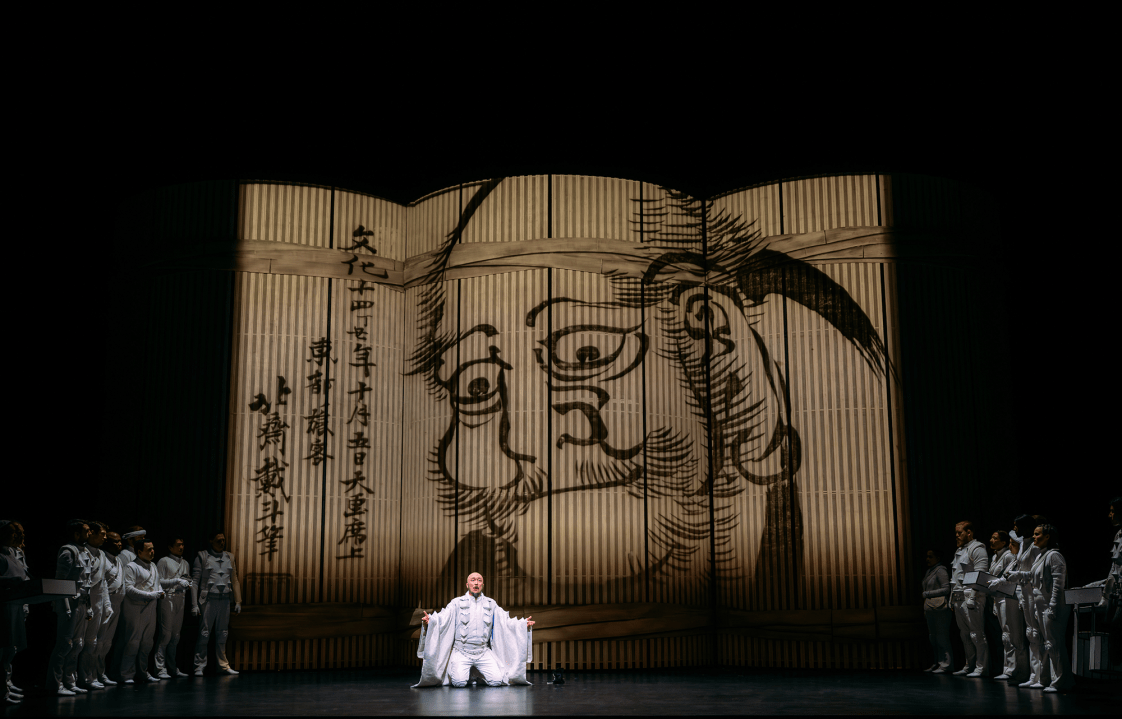
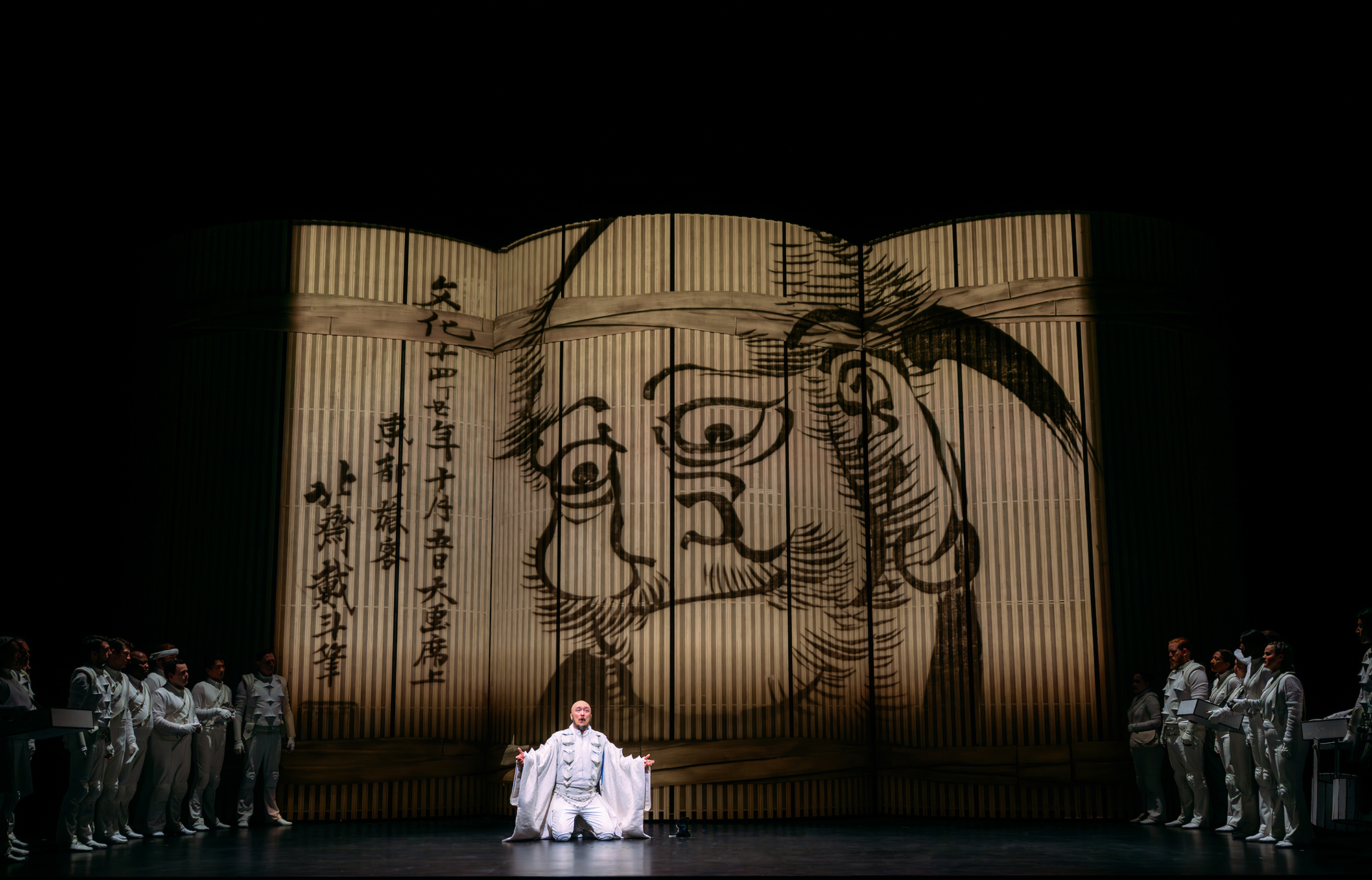
Some people like art to have a message. So here’s one, delivered by Katsushika Hokusai near the end of Dai Fujikura and Harry Ross’s new opera The Great Wave. ‘Remember art won’t change the world,’ sings the great painter (as incarnated by the baritone Daisuke Ohyama), and for that line alone I’d gladly have given the show five stars, if the Spectator did anything as barbaric as award stars. Words to live by, at least if you’re an artist; and the very private bliss of a life devoted to creativity is the heart, mind and dramatic engine of The Great Wave.
Is that enough to sustain a full-length opera? Opinions will vary, though the circumstances in which I saw The Great Wave were not typical – still battered and queasy from the previous night’s performance of Rise and Fall of the City of Mahagonny. Detach the gut response and Fujikura’s lithe, stylish music, coupled to Ross’s humane libretto, generated a momentum and atmosphere that were effective on their own terms. The plot is simply the life of Hokusai, recounted in flashback by his daughter (and fellow artist) Katsushika Oi (Julieth Lozano Rolong). They’re engaging, warmly drawn characters, performed with spirit.
You’ve never heard a more passionate love song to a pigment
So we see Hokusai’s emergence as an enfant terrible and his involvement – deemed scandalous, apparently – with western traders in 19th-century Japan. They supply him with the Prussian Blue paint that enables him to create his most celebrated work, ‘The Great Wave’, which he does just before the interval. On one level, it’s classic artist-as-hero cornball. But the elegance and restraint of the designs in Satoshi Miyagi’s production – parchment whites which suddenly flood with blue – matches the growing exaltation of Fujikura’s music, in which crisp minimalist rhythms are tinted with carefully-blended woodwind colours: cool, alert and radiant until the moments like this, when the energy swirls up and brims over. You’ve never heard a more passionate love song to a pigment.
From then on, the mood grows meditative as Hokusai paints into old age, pleading with the gods for more time to master his art. Other characters dance around him, but it’s really about father and daughter. By this point, Ohyama (puckish, then philosophical, and singing with a bluff oaky tone) and Rolong (bright and lively, with a voice that glowed in the twilight) can easily carry the closing scenes, where the serenity is ruffled only by the woody barking of an onstage shakuhachi (Shozan Hasegawa). The Great Wave is playful, big-hearted and intelligent, and Scottish Opera (whose music director Stuart Stratford conducted) even laid on a miniature Hokusai exhibition in the foyer. It would be nice to think that an opera as attractive as this will live on.

And yes, I wish I could have seen it at more distance from English National Opera’s Mahagonny, a work whose agitprop crudeness simply clobbered Fujikura’s subtler imagination, and whose melodies (that damned whisky bar!) stink up the tastebuds like a bad kebab. To be clear, this was a bold staging, directed by Jamie Manton on what was evidently a restricted budget and (by all accounts) an even more limited rehearsal period. In Milla Clarke’s designs the cavernous unadorned stage made a neat metaphor for a trash city thrown together in a wasteland; an appropriate setting for some ballsy revue-operetta singing and crowd choreography.
On that front, ENO didn’t stint, rolling out big guns across a sizeable cast: Kenneth Kellogg as Trinity Moses, Rosie Aldridge as a fearsomely ripe Leokadja Begbick and Simon O’Neill as Jimmy MacIntyre (rich and direct), with singers of the calibre of Mark Le Brocq (Fatty) and the seriously underrated Alex Otterburn (Billy) further down the ensemble. André de Ridder conducted with purpose, and yard upon yard of silky film-score menace. And then there was Danielle de Niese as Jenny, squeezing her voice and charisma like ketchup all over the whole grungy blow-out. As a company achievement, it deserves only praise.
As a piece, though: well, this is what happens when artists think they can change the world. Kurt Weill wrote better scores than Mahagonny, but he does at least deliver a couple of bangers. Bertolt Brecht, however, is in his Marxist bully pulpit from the get-go. With the first two acts rolled together at punishing length, it was like being trapped in a lift with an angry 14-year old or a Green party activist. Money bad! Politics bad! You’re bad! It’s never been more relevant, trill the Brecht apologists. No, only in the way that Punch and Judy is relevant – puppets tormenting puppets, with ideology where the soul should be. Rotten with cynicism and brutally simplistic, Mahagonny is one of those famous satirical sallies (as Tom Lehrer observed) that did little to halt the rise of fascism in Weimar Germany. Viewed from 2026, you wonder if it actually speeded up the process.

Comments