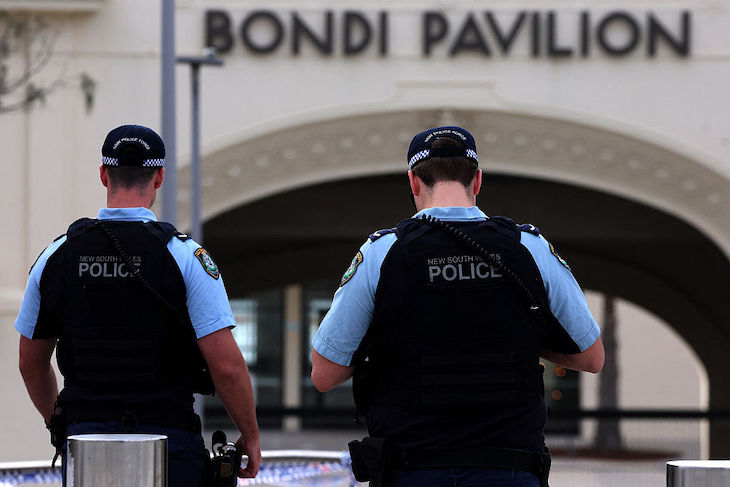
It’s hard to disagree with the verdict of former Australian cabinet minister Josh Frydenberg on the Bondi Beach attack. ‘Guns may have stolen the life of 15 innocent civilians,’ he said, ‘but it was radical Islamist ideology that pulled the trigger’. Despite that furious denunciation of Australian government inertia on antisemitism since 7 October – and ex-prime minister John Howard labelling gun control a ‘distraction’ – Anthony Albanese is determined to focus on cracking down on firearms. But is he ignoring the Islamist elephant in the room?
Cracking down on guns is sensible, but it won’t defeat the Islamist and antisemitic hate pulling the trigger
The Australian leader has announced a massive buyback of weapons from gun owners, likely to cost taxpayers over A$1 billion (£494 million). ‘The deadly terrorist attack at Bondi Beach is a national tragedy which can never be allowed to happen again,’ Albanese said on Friday. ‘This national buyback scheme will help get guns off our streets, and help keep all Australians safe.’
This gun buyback isn’t a bad idea. There are too many weapons in our country; there is no need for there to be one gun for every seven Australians. Addressing specifically the arsenal of the Bondi terrorists, licensed to the father of the pair, Sajid Akram, Albanese was right in saying ‘if a bloke in Bonnyrigg (a poorer suburb of Sydney) needs six high powered rifles and is able to get them under the existing licensing scheme, then there’s something wrong. I think Australians can see that.’
Why any private citizen in a city suburb needs any guns at all is beyond me. If you’re not in a shooting club, or in a profession that requires use of a weapon, why any private citizen, in suburbia, needs such a weapon is beyond rational comprehension.
This isn’t the first time a gun buyback scheme has been tried. After the 1996 Port Arthur massacre in Tasmania, where a mentally-ill gunman murdered 35 people with high-powered, semi-automatic weapons, Howard’s government initiated a massive gun buyback, funded through a temporary hike on Australia’s equivalent of National Insurance. Up to 650,000 guns were crushed, and gun murders and suicide rates plunged for nearly three decades. Until Sunday, there had been no mass shootings since.

Howard’s response to his successor’s scheme is both right and wrong. He is wrong to imply that gun law reform isn’t a priority. Bondi showed that it is. And the loopholes in Howard’s own reforms, which mean there are more guns in circulation now than in 1996, demonstrate the need to crack down on the sheer volume of deadly weapons in the Australian community, and further limit the number of gun licences.
But Howard is right in saying gun reform is a distraction from combating antisemitism. Guns are low-hanging policy and political fruit; nobody in the right mind disagrees that much needs doing on that front.
Yet it is a handy smokescreen for a prime minister and government still struggling to deal with a moral cancer their own pro-Palestine and anti-Israel support base refused to recognise.
In the Canberra press conference announcing the buyback, Albanese dodged hard questions on his Bondi response. He gave the impression he is still on the defensive about his record, and playing catch-up with fast-moving developments while failing to assuage grief and anger in Australia’s Jewish community. The PM is readily citing what his government has done. But beyond the qualified support of a National Action Plan on Antisemitism (which still falls well short in substance from what Albanese’s antisemitism envoy, Jillian Segal, actually recommended) his government isn’t doing enough.
Nearly a week on from the Bondi attack, Albanese is looking flummoxed and reactive rather than a national leader in full charge of a crisis. It’s telling he is refusing to entertain a royal commission in what led up to Sunday’s shootings and whether state and federal governments and law enforcement failed to avert this terror outrage. Perhaps he knows that commissions of inquiry are best called only when they give the answers wanted, and many related matters, such as risk assessments by security authorities of Sajid and Naveed Akram, occurred when his conservative opponents were in power. Yet he dodges the increasing clamour, giving the distinct impression his own government has dirty linen it doesn’t want washed in public.
After a brief moment of clarity on antisemitism, Albanese seems to be reverting to rabbit-in-the-headlights mode. He’s dealing with the relatively easy problem of gun law reform – where the states actually have direct regulatory responsibility – and still appears unwilling to defy his support base and reassure Australia’s Jews they can be safe in their own country. Cracking down on guns is sensible, but it won’t defeat the Islamist and antisemitic hate pulling the trigger.
The prime minister has announced that Sunday will be a Day of Reflection on the Bondi Beach massacre of the innocents. Albanese needs to use that opportunity to reflect on his own performance as a national leader, and ask himself whether it has been up to the mark Australians need in a profound national crisis like this.



Comments