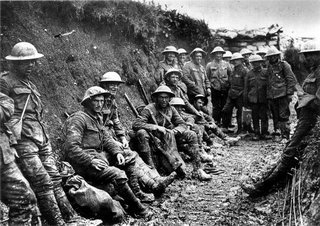
 Today marks the 90th anniversary of Armistice Day and the formal end of World War One. I quote from the climax of Norman Stone’s stunning work, WWI – A Short History:
“Meanwhile, as German morale was collapsing, the final crisis was precipitated by another act of desperation. In a weird descant upon the navy-army rivalry that had done so much to weaken the [German] war effort, the naval authorities resolved on a last, mad move. Captain von Levetzow, chief of staff of the navy, could see the likelihood that Germany’s great ships would be interned, none of them left for the eventual reconstitution of the Reichsmarine. Better, he thought, ‘immortal fame at the bottom of the ocean’, and orders went out on 27 October for the High Seas Fleet to put to sea in the general direction of the Thames Estuary. The 80,000 soldiers and stokers were not enthusiastic about the bottom of the ocean. They mutinied at Kiel, then at Lubeck and Wlihelmshaven, and insurrection spread to Cologne, then Munich, where an actor took over. There was now an air of Russia, with workers’ and soldiers’ councils being formed. The Social Democrats, already in government under Prince Max, knew that, if they were to avoid a Bolshevik revolution, certain things would have to be done. The war would have to be stopped forthwith and the Kaiser would have to go. The generals told him as much, and on 9 November he abdicated (escaping to Holland) just as the republic was being declared in Berlin. In any case, with the country in chaos, the time had come for an immediate armistice. A deputation made its way to Foch’s headquarters in the forest of Compiegne, and the guns were stopped at 11am on 11 November. The terms were harsh: Germany would not be able to fight again. The Allies took the Rhine. There was no occupation of Germany – as things turned out, a fatal decision. But it was over.”




Comments