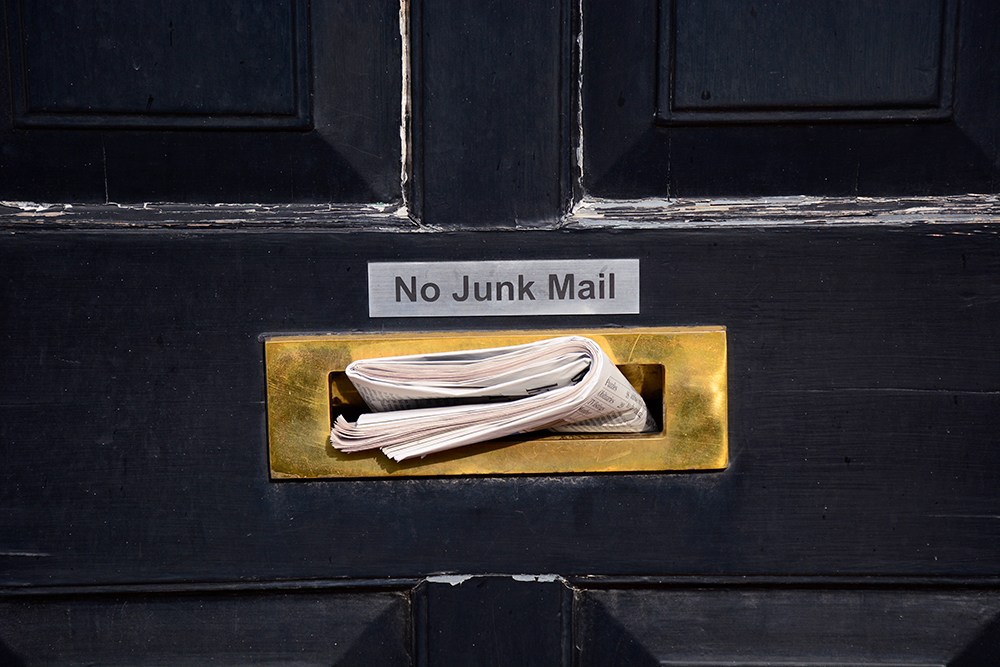
A detail of daily life – scarcely noticed because it is taken for granted – was added to our houses thanks to a campaign pursued by The Spectator. I mean the letter box in the front door.
In 1849, nine years after the Penny Post came in, the Postmaster General mildly suggested that time could be saved if householders were ‘to provide a letter-box, except where the outer door is kept open’. The box would function like a mailbox in America today, though a hole or slit in the door would do. In its issue of 21 July that year, The Spectator thought the recommendation ‘ought to be enforced, and might be with little difficulty. Tax every recipient of a letter living in a house which has no letter-box, by charging him an additional penny on delivery of each letter.’

Up to then the postman had to knock at every door and wait for it to be answered. The cover to the sheet music of a hit song of 1856, ‘The Postman’s Knock’, still showed a letter-carrier in tailcoat and tall hat rat-tatting on a door-knocker. The song celebrated his visits:
Number One he presents with news of a birth,
With tidings of death, Number Four,
At Thirteen a bill of terrible length
He drops through the hole in the door.
It was dedicated to Rowland Hill, the mythic hero of the Royal Mail. But this week, with second-class post pegged by Ofcom at 91p – as if that solves much – postmen are still throwing in their mailbags or going sick. We grow used to the post coming irregularly in little delayed bundles.
If Royal Mail goes under, it would mean more than simply blocking up our letter boxes and saving a draught in the hall. The postal service has a place in the nation’s hearts resembling the NHS (and, like it, undermined by delays). Its image is the fonder for its association with the monarch. Envelopes have arrived bearing little images of the sovereign since January 1840.
Yet the things most people think they know about the Royal Mail are false. In London, for example, a penny post did not begin in 1840. The enterprising William Dockwra had set up one in 1680 for items weighing less than a pound, with delivery six times a day within the city. In the suburbs, it was 2d within a ten-mile radius. The Post Office resented his challenge to its monopoly and eventually took over his system. Post within London continued to cost a penny until 1801, when the rate was doubled.
Post from out of town had been accelerated thanks to John Palmer, a theatre owner in Bath who from 1785 introduced fast nightly mail coaches protected by an armed guard taking only 16 hours to London on new turnpike roads. The Treasury overrode objections by the Post Office and ensured the scheme’s extension throughout the country.
The big bet of the Penny Post of 1840 was that volume would pay for a cheap, universal service. The system was identified with Rowland Hill, as penicillin is identified with Alexander Fleming. History is more complicated. But from 10 January 1840 a half-ounce letter might be sent anywhere in the country for 1d. London had up to 12 deliveries a day.
But Hill’s forecasts of the economics proved wrong. The number of letters rose from 76 million in 1839 to 169 million in 1840. That was not enough. In the first year of the new service, Post Office net revenue fell by 69 per cent. Even though by 1860 there were 19 letters posted annually per head, against three in 1839, labour costs outran income.
The patriotic Post Office myth was upheld by the 1936 documentary Night Mail
Constantly wrangling with new railway companies over their charges, Hill even wanted to nationalise railways to get his way. Not until 1873 could the Post Office match the £1.6 million earned in 1839.
Every stamp-collecting schoolboy once knew that Anthony Trollope introduced the pillar box in the 1850s. But Trollope was not part of one big happy Post Office family. He hated Hill. ‘It was a pleasure for me to differ from him on all occasions,’ he wrote in his autobiography, ‘and looking back now, I think that in all such differences, I was right.’
A year after Hill’s retirement in 1864, Trollope’s Can You Forgive Her? mocked his apotheosis. There, Plantagenet Palliser’s cousins, Iphy and Phemy, spend each morning writing letters to people they have never met. ‘Free communication with all the world is their motto, and Rowland Hill is the god they worship,’ wrote Trollope.
It wasn’t just Victorian women writing with steel nibs that made the Royal Mail so much part of life. Newspapers, including The Spectator, on which the stamp duty in 1828 was 4d (and was not removed until 1855) could be posted free. By 1875 the number delivered reached 121 million.
In 1860, for the Royal Academy exhibition, George Hicks captured one of the wonders of the metropolis in his painting ‘The General Post Office, One Minute to Six’. It showed the astonishing scrummage of getting stamped post accepted at the GPO headquarters in St Martin’s le Grand before it closed on a Friday evening.
The neoclassical building, which opened in 1829, was designed by Sir Robert Smirke, the architect of the British Museum, and bore a similar air of elevated public service. In operation it was noisier. Hicks’s painting showed newspapers being flung through the air into a big open hatch. It was based on an illustration by the Punch cartoonist William McConnell for Twice Round the Clock, a series of pieces about London life by that monster of foreign correspondence, George Augustus Sala. Sala called the six o’clock scramble a ‘fair’ and rejoiced in describing how newspaper boys and men would ‘boldly fling bags full, sacks full, of journals into the yawning casement. There is a legend that they once threw a boy into the window, newspapers and all.’
The patriotic Post Office myth was upheld by the 1936 documentary Night Mail with music by Benjamin Britten and words by W.H. Auden. Steam engines and post – what could be more wholesomely British? Postmen got through, come snow or floods. From 1810 (well before the Penny Post) a River Postman delivered letters to craft in the Thames, a job passed down in one family until it was abolished in 1952.
The pillar box, like the red telephone kiosk, still attracts tourists, and goes with snow for Christmas. To lose it would be like killing all the robins.





Comments