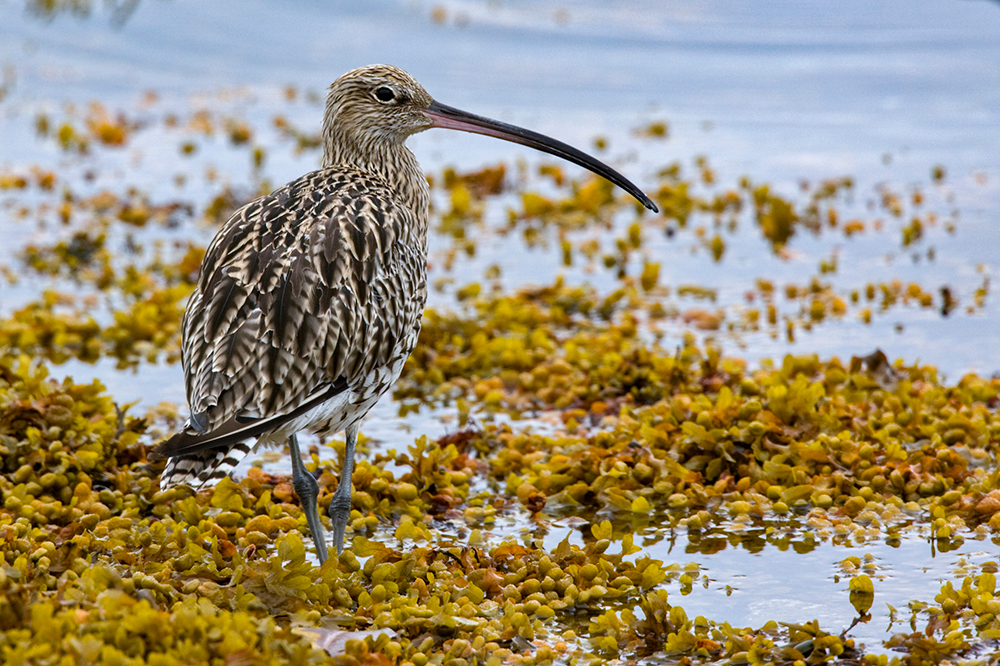
Unlike last year, when drought caused many curlews in the Durham dales to delay breeding, this has been a great spring for them. Last week, wherever I walked, anxious curlew parents were whinnying above me like aerial ponies. At one point I stepped carefully aside as a day-old chick, clumsy on its oversized blue legs, tried to hide in the cotton grass.
The Pennines, North York moors and eastern Scotland are the world stronghold of the curlew, or ‘whaup’, a bird whose bubbling aria fills the sky over these moors in spring so fully that you cannot find a one-minute gap of silence between their songs in a typical April dawn (I’ve tried). A Scotsman who was once taken to hear a nightingale was unimpressed: ‘It’s a’ very gude but I wadna gie the wheeple o’ a whaup for a’ the nightingales that ever sang!’
Its song has gone from most of the English lowlands, the Welsh hills and south-western Scotland
Of the world’s eight species of curlew, two have already gone extinct – a greater loss than any other genus of continental bird. The eskimo curlew of northern Canada has not been seen since 1987; the slender-billed curlew of central Asia since 2006. Being large birds that only breed from the age of three, curlews are easily wiped out.
Britain has at least a quarter of the world’s breeding population of (Eurasian) curlews. Yet the song of the curlew has gone from most of the English lowlands: too many badgers. You no longer hear it in much of the Lake District: too many foxes. The Welsh hills are increasingly no longer resounding to their calls: too many stoats. The alien sitka spruce forests of south-western Scotland and western Northumberland have silenced them. In Ireland the birds are almost extinct as a breeding species.
On the moor where I spend each spring, there are around 100 pairs of curlews on 2,500 hectares, about as many as in the whole of southern England. Most of their nests hatch and most of the young fledge, so this moor alone is churning out several hundred young curlews each year. Satellite tagging has told us that in July they go to Ireland, returning in February.
You would think the government might take an interest in what is being done right in the Durham dales so that a globally declining bird is not just hanging on but thriving. Yet in a recent 62-page assessment of this moor by Natural England, the curlew does not get a single mention; in the North Pennines National Landscape draft management plan, it gets just one. The BBC presenter Chris Packham has sneered that moors like this are ‘curlew farming’ – as if that were a bad thing.

Luckily, others are less indifferent. Mary Colwell, author of Curlew Moon, has set up Curlew Action to champion the species with the support of the singer David Gray. Lord Bolton has started Curlew Day (21 April). A group of conservation organisations came together in parliament to launch a curlew action plan last year.
But here is the problem. The reason curlews are thriving in the Pennines, and the reason some conservationists do not like to admit it, is because of grouse-shooting. This was proved beyond all doubt by a well-designed experiment by the Game and Wildlife Conservation Trust in the early 2000s at Otterburn in Northumberland, where over several years gamekeeping was swapped between different areas and the effect on birds carefully monitored.
With gamekeepers, the success rate of curlews at fledging young was 50 per cent; without them it was 15 per cent. With gamekeepers the curlew population increased; without them it decreased. The single biggest factor causing the decline of the birds is nest predation: sitting on four large, tasty eggs on the ground for a month, and then guarding clumsy, flightless chicks for another month, without attracting the attention of a passing crow, buzzard, fox, badger or dog, is all but impossible in much of England.
All those predators have dramatically increased in number because of human subsidy in the form of roadkill and waste. Gamekeepers kill foxes and crows – and that is pretty well all it takes to turn the curlew round. Sure, the habitat needs protecting too, from silage-making and other damaging practices. But getting the habitat right without controlling predators is probably worse than doing nothing at all: it lures the birds into breeding in places where they die of old age with no grandchicks. Long-lived birds, they can linger on as ‘ghost’ populations failing to produce chicks year after year.
Admitting this is no problem for people in other countries. In Finland and Germany, the government embraces and encourages predator control for the benefit of curlews. At Dummer in northern Germany, numbers have tripled since the 1990s to 100 pairs thanks to habitat management and the control (not eradication) by local hunters of badgers and buzzards as well as foxes, crows and raccoon dogs. When I asked Heinrich Belting, who runs this and other reserves for the state government, how they got public buy-in, he replied: ‘Education.’
On the ground in Britain the people who run nature reserves are also realising the need for predator control. Natural England kills foxes to protect curlews on the Marches Mosses in Shropshire, where the population has declined by 77 per cent since the 1990s. The Royal Society for the Protection of Birds contracts with pest controllers to kill foxes at Lake Vyrnwy in Wales, though it may be too late as curlews have declined there from 32 breeding pairs in 1980 to just one ‘possible nest’ in 2023.
It is not only curlew that grouse-keepers are saving: merlin, short-eared owl, hen harrier, dunlin, golden plover, redshank, lapwing, snipe, woodcock, oystercatcher and black grouse all nest in abundance on or near grouse moors. So (of course) does the only endemic species of bird in the British Isles, the red grouse. Yet the RSPB campaigns to blacken the reputation of grouse moors. Perhaps out of jealousy.



Comments